BPM vs Beat vs Tempo: What’s the Difference?
Learn the difference between BPM, beat, and tempo, how they relate, and why BPM matters when creating, playing, mixing, and understanding music.
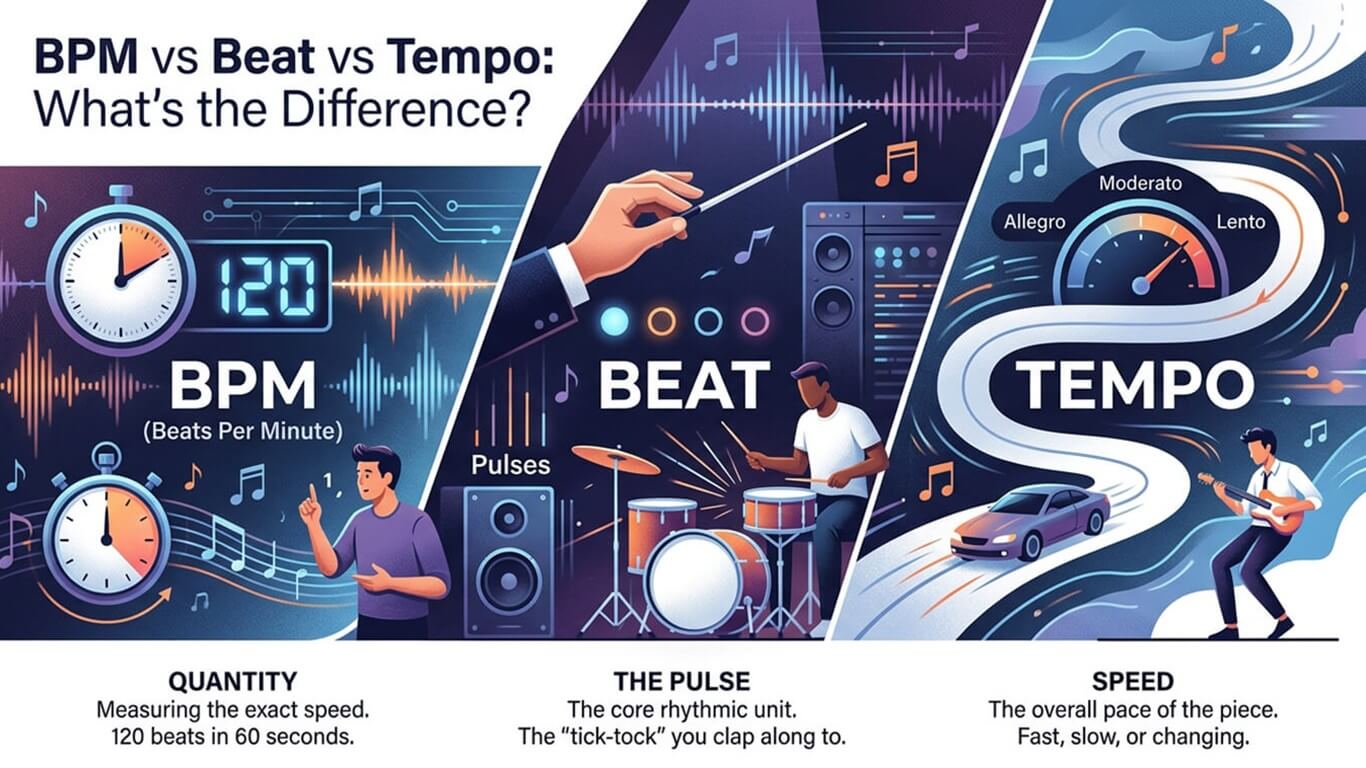
BPM, beat, and tempo are often used as if they mean the same thing, but each one describes something slightly different. Understanding the distinction makes it much easier to talk about how fast music feels, how rhythms are organized, and how songs are produced or mixed.
What Is a Beat, and How Does It Relate to Tempo?
The Beat as Music's Regular Pulse
Think about a song you know well. Even before you start paying attention to the melody, you can usually find yourself tapping your foot, nodding your head, or moving along with a steady underlying pulse. That repeating pulse is the beat.
The beat gives music a sense of movement and helps organize everything happening around it. Drums, bass lines, chords, melodies, and vocals can all be placed in relation to this underlying pulse. In simple terms, the beat is the musical reference point that helps you know when things happen.
It is also useful to separate the beat from rhythm. Rhythm is the pattern created by sounds and silences, while the beat provides the regular framework those patterns can move around. A drummer might play several notes between two beats, for example, but the underlying pulse can remain steady.
You can think of it like walking. Your footsteps create a regular pulse, while the different movements you make between steps are more like rhythm. Music works in a similar way: the beat keeps time moving forward, while rhythm gives that movement its character.
How Tempo Describes the Speed of the Beat
If the beat is the pulse, tempo is the speed of that pulse. A slow beat creates a relaxed or spacious feeling, while a faster beat can make music feel energetic, urgent, or driving.
This is where BPM, or beats per minute, comes in. BPM gives us a numerical way to describe tempo. At 60 BPM, there is one beat every second. At 120 BPM, there are two beats every second. The higher the BPM, the more quickly the beats occur.
That relationship is why people often use "BPM" and "tempo" almost interchangeably, even though they are not exactly the same thing. Tempo describes the pace of the music, while BPM provides a precise measurement of that pace.
For example, imagine playing the same simple drum pattern at 70 BPM and then at 140 BPM. The notes and pattern could remain exactly the same, but the second version would move twice as quickly. The change in tempo dramatically changes the energy and feel without necessarily changing the musical material itself.
Tempo also doesn't tell you everything about how fast a song feels. A track at 80 BPM can feel surprisingly energetic if its rhythms are busy, while a track at 120 BPM can feel relaxed if the arrangement leaves plenty of space. This is one reason beat, rhythm, and tempo are best understood as connected but distinct ideas.
BPM Explained: How Beats Per Minute Measure Musical Speed
What a BPM Number Actually Tells You
BPM stands for beats per minute, and it is the simplest numerical way to describe how quickly the beat moves in a piece of music. The number tells you how many beats occur during one minute. So, a song at 60 BPM has 60 beats per minute, while a song at 120 BPM has twice as many beats in the same amount of time.
This makes BPM especially useful because it gives musicians, producers, DJs, and listeners a shared reference for tempo. Instead of simply saying that one song is "faster" than another, you can identify its approximate BPM and know exactly how quickly its underlying pulse is moving.
For example, if a producer sets a project to 100 BPM, the software uses that tempo to determine how beats, bars, loops, and time-based effects are organized. Drum patterns and samples can then be created or adjusted to fit that consistent pulse.
It is important to remember that BPM measures the beat rate, not every individual sound in a song. A track at 100 BPM does not mean there are only 100 musical notes per minute. There can be many more notes because rhythms can be divided into smaller parts of each beat.
Slow, Moderate, and Fast BPM in Different Musical Styles
There is no single BPM number that automatically makes music slow or fast. The way a tempo feels depends heavily on the genre, rhythm, instrumentation, and how the beat is emphasized.
As a general guide, tempos around 60–80 BPM often create a slower or more relaxed feel. Many ballads, atmospheric tracks, and laid-back songs work within this kind of range. As the tempo moves toward 90–120 BPM, music often begins to feel more moderate and steady, a range commonly encountered across pop, rock, hip-hop, and other styles.
Tempos above 120–140 BPM can create a noticeably faster and more energetic sensation, although different genres use these numbers in very different ways. Electronic dance music, punk, metal, drum and bass, and other rhythm-focused styles can comfortably move into much faster BPM ranges.
Genre conventions can also make the same BPM feel completely different. A 120 BPM dance track may feel energetic because the kick drum strongly reinforces every beat, while another song at the same BPM might feel calmer because of its arrangement and rhythmic phrasing.
This is why BPM is best viewed as a measurement of tempo rather than a complete measurement of musical energy. It tells you how quickly the beats occur, but the rhythm, groove, instrumentation, and arrangement determine how that speed actually feels to the listener.
BPM vs Beat vs Tempo: Understanding the Differences
At first glance, BPM, beat, and tempo can sound like three ways of saying the same thing. They are closely connected, but they describe different parts of how music moves through time.
The beat is the regular pulse you can follow in a piece of music. Tempo describes how quickly that pulse moves. BPM gives us a numerical measurement of that speed. Put them together, and you have a simple way to understand both the timing and pace of a song.
Why BPM and Tempo Are Related but Not Identical
Tempo is fundamentally about the pace of a musical performance. A composer might describe a piece as slow, moderate, or fast, or use traditional terms such as Largo, Andante, or Allegro. These descriptions communicate the intended character and speed without necessarily giving an exact number.
BPM makes that idea more precise. If a song is set to 100 BPM, its underlying pulse occurs at a rate of 100 beats per minute. In this sense, BPM is a measurement used to express tempo.
The beat itself is different. It is the recurring pulse that the BPM is measuring. So you can think of the relationship this way:
- Beat: the regular musical pulse.
- Tempo: how quickly that pulse moves.
- BPM: the numerical measurement of that speed.
This distinction becomes especially useful in music production. If a producer changes a project from 90 BPM to 120 BPM, the tempo becomes faster because the beats occur more frequently. The beat remains the reference point, while BPM tells the software exactly how quickly that reference point should repeat.
How the Same BPM Can Feel Different in Different Songs
A BPM number doesn't tell the whole story. Two songs can have exactly the same BPM and still feel dramatically different.
Consider two tracks at 120 BPM. One might have a simple four-on-the-floor kick drum, a bright bass line, and short rhythmic patterns. It may feel energetic and strongly dance-oriented. Another song at 120 BPM could use longer notes, softer percussion, spacious vocals, and fewer rhythmic accents. The tempo is identical, but the overall experience can feel much slower or more relaxed.
Rhythm is one of the biggest reasons for this difference. Musicians can divide each beat into smaller rhythmic units, emphasize certain beats, leave space between sounds, or create syncopated patterns. All of these choices change the groove without necessarily changing the BPM.
There is also the idea of half-time and double-time feel. A song might be recorded at one BPM but performed in a way that makes listeners perceive the pulse as half or twice as fast. This is particularly common in genres where drum patterns and rhythmic subdivisions play a major role.
So, when comparing songs, BPM is a useful starting point, but it shouldn't be treated as a complete description of how fast or energetic music feels. BPM measures the rate of the beat; rhythm and arrangement shape how that rate is experienced.
Related Questions and Answers
- • What does BPM mean in music?BPM stands for beats per minute and measures how many beats occur in one minute of music. It is commonly used to describe how fast or slow a song's pulse feels.
- • What is the difference between BPM and tempo?Tempo describes the speed or pace of music, while BPM gives that tempo a numerical measurement in beats per minute. For example, a tempo of 120 BPM means there are 120 beats in one minute.
- • What is a beat in music?A beat is a regular pulse that helps organize music in time. It is the underlying rhythmic reference listeners can often tap their foot or nod their head to.
- • Is BPM the same as beat?No. A beat is a musical pulse, while BPM is a measurement of how frequently those beats occur. BPM tells you the rate of the beat.
- • What does 120 BPM mean?120 BPM means that the music has 120 beats occurring within one minute. It is often perceived as a moderate, steady tempo.
- • What is a fast BPM in music?There is no single cutoff for a fast BPM because genre and musical context matter, but tempos above roughly 140 BPM are commonly perceived as fast in many styles.
- • What is a slow BPM in music?Lower tempos, such as around 60–80 BPM, are often perceived as slow or relaxed, although the actual feel can change depending on rhythm, instrumentation, and genre.
- • How does BPM affect a song?BPM affects the perceived speed and energy of a song. Changing the BPM can make the same rhythmic material feel more relaxed, driving, tense, energetic, or danceable.
- • How do you find the BPM of a song?You can determine BPM by using a metronome, tapping along with the beat, counting beats over a measured period, or using music-production software and BPM-detection tools.
- • Why is BPM important for DJs and music producers?BPM helps DJs synchronize songs and helps producers align drums, loops, samples, and other musical elements to a consistent tempo.
- • Can two songs have the same BPM but sound different?Yes. Songs with identical BPM values can feel very different because rhythm, beat subdivision, instrumentation, groove, time signature, and arrangement all influence how the tempo is experienced.
- • Can a song have more than one BPM?Yes. Some songs change tempo during the arrangement, while others use different rhythmic interpretations that can make the same underlying BPM feel faster or slower.