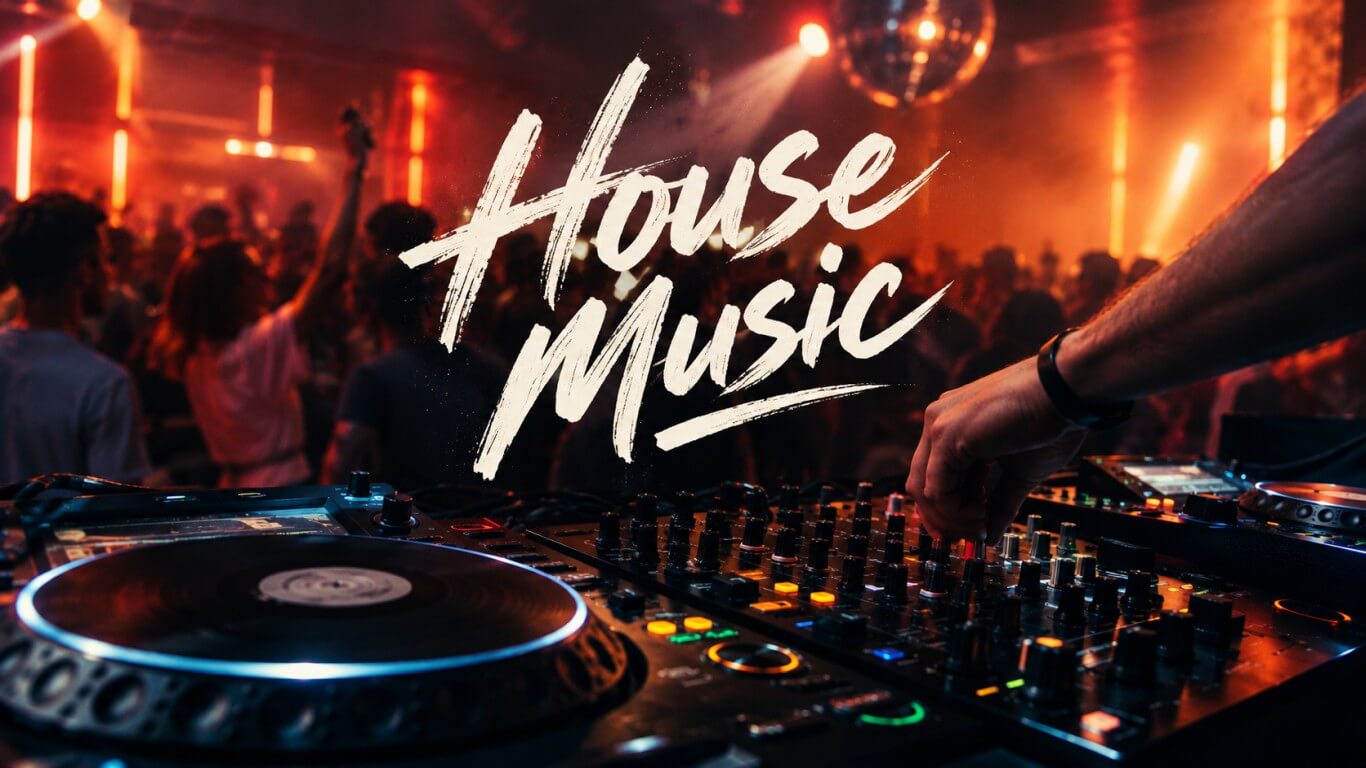
House Music: What It Is, History, Sound, and Culture
House Music can sound deceptively simple. Put a kick drum on every beat, add a bassline, some percussion, a few chords or samples, and somehow the whole thing starts moving.
But that simplicity is part of the magic.
House developed from Chicago's underground club culture, bringing together disco, funk, soul, gospel, electronic music, DJ techniques, and new studio technology. What began as a local dance-floor tradition eventually became one of the foundations of electronic dance music around the world.
So what actually makes something sound like House Music?
What Is House Music?
House Music is built around groove. The steady four-on-the-floor kick provides the pulse, while bass, percussion, chords, samples, vocals, and electronic sounds create movement around it.
The important thing isn't simply having a kick on every beat. It's what happens between those beats: the syncopation, repetition, swing, bass movement, small changes in percussion, and gradual arrangement that make the groove feel alive.
House commonly sits around 120–130 BPM, but tempo alone doesn't define the genre. A slower or faster track can still belong to the House tradition if its rhythmic feel, production approach, and relationship between its elements fit the style.
The Sound and Rhythm of House
The most recognizable rhythmic feature of House is the four-on-the-floor beat. In a typical 4/4 bar, the kick drum lands on all four quarter-note beats, creating a steady pulse that gives the music its forward motion.
The bassline works closely with that pulse. Rather than simply occupying the lowest frequencies, it often fills the spaces around the kick and creates another layer of rhythmic movement. Percussion adds further detail through claps, snares, hi-hats, shakers, tambourines, and other sounds.
Syncopation is particularly important. Elements do not have to land directly on the main beats to contribute to the groove. Off-beat hi-hats, percussion accents, bass notes, and vocal phrases can create tension against the regular kick pattern.
This is where a relatively simple drum pattern becomes a groove.
House also makes extensive use of repetition. A short bassline, chord progression, drum loop, vocal phrase, or sample may repeat for many bars. Repetition gives the listener something stable to lock onto, while small changes keep the track moving.
A producer might gradually introduce another percussion layer, remove the kick, open a filter, change a hi-hat pattern, bring in a vocal phrase, or alter the bassline. These changes can be subtle. House does not always need a dramatic drop or constant arrangement changes to maintain interest.
Chords, samples, vocals, and synthesizers provide additional musical identity. Some House tracks are built around soulful vocals or rich harmonic progressions, while others are much more minimal and rely heavily on rhythm and texture.
The result can be deceptively economical: a limited number of repeating elements, carefully arranged and shaped over time.
That balance between simplicity and movement is one of the defining qualities of House Music.
The History of House Music
House Music emerged from Chicago's underground club scene during the late 1970s and early 1980s.
The story begins with DJs working with disco and other dance records, extending grooves and reshaping them for their audiences. Rather than treating a record as something that simply played from beginning to end, DJs could select particular sections, blend records together, repeat rhythms, and create longer continuous experiences for dancers.
Chicago provided an environment where this approach could develop into a distinct musical culture.
As DJs and producers began combining these ideas with drum machines, synthesizers, samplers, and studio techniques, a new musical language started to emerge. The technology made it possible to build rhythms specifically for the dance floor and to extend the repetitive structures that DJs were already using in their sets.
From Chicago to the World
One of the most important figures in the early history of House was Frankie Knuckles. His work as a DJ at The Warehouse in Chicago became closely associated with the emerging sound and culture. The club itself became an important part of the story of how the term "House Music" came to be associated with this new style.
The music was heavily influenced by disco, but its foundations were broader than disco alone. Funk contributed rhythmic ideas and bass movement. Soul brought vocal and melodic qualities, while gospel contributed powerful vocal arrangements, harmony, and emotional intensity. Electronic instruments and studio technology gave producers new ways to reshape these influences.
The early Chicago scene also produced a generation of DJs and producers who helped establish House as a recorded genre. Jesse Saunders, Marshall Jefferson, Larry Heard, Farley "Jackmaster" Funk, and many other artists contributed different approaches to the developing sound.
Early House records circulated through clubs, record stores, radio, and DJ networks. As the music reached other cities, producers and DJs began interpreting the Chicago sound through their own local scenes.
House soon found an especially strong audience in Europe. British and European DJs, clubs, labels, and record buyers helped spread the music further, while local producers began developing their own interpretations.
This international expansion did not erase House's Chicago roots. Instead, it demonstrated how adaptable the basic House formula could be.
The combination of a steady rhythmic foundation, repetitive grooves, electronic production, and DJ-friendly structures could be adapted to different musical environments while remaining recognizably connected to House.
The Subgenres of House Music
As House Music traveled globally, it splintered into a vast ecosystem of subgenres. Each style takes the fundamental 4/4 groove and infuses it with different sonic textures, tempos, cultural influences, and production techniques.
The Core Roots & Early Variations
- Chicago House Music: The raw, foundational sound defined by early Roland drum machines (TR-808/909) and soul-infused sampling.
- Acid House Music: Instantly recognizable by the squelching, resonating basslines produced by the Roland TB-303 synthesizer.
- Deep House Music: Focuses on lush atmosphere, jazz-influenced chords, smooth basslines, and a relaxed, soulful vibe.
- Soulful House Music & Jazz House Music: Subgenres that lean heavily into gospel vocal arrangements, acoustic instruments, and complex jazz harmonies.
- Italo House Music: Known for driving piano riffs, uplifting vocal hooks, and bright, energetic melodies.
- Ghetto House Music & Lo-Fi House Music: Raw, minimalist styles focusing on stripped-back, aggressive drum patterns or warm, tape-saturating analog grit.
Regional & Global Styles
- French House Music: Defined by heavy sidechain compression, phaser-laden samples, and strong ties to Disco House Music and Filter House Music.
- Global House Music: Blends house rhythms with international styles, including percussion-heavy Latin House Music, laid-back Tropical House Music, and rhythmically rich Afro House Music.
Tech, Electro, & Peak-Time Styles
- Tech House Music: Merges the driving, minimal structures of techno with the swung, rhythmic warmth of house music. Includes variations like Minimal Tech House Music and Tribal Tech House Music.
- Electro House Music: Features prominent, distorted synth basslines, abrasive leads, and high-energy arrangements. Branching styles include Bass House Music, Dutch House Music, Fidget House Music, and intricate Complextro Music.
- Progressive House Music: Known for continuous, evolving arrangements, long build-ups, and emotional melodies, encompassing styles like Classic Progressive House Music and Melodic Progressive House Music.
- Minimal House Music: Strips back unnecessary elements to focus on subtle groove variations, micro-samples, and precise rhythms, often crossing into Microhouse Music.
High-Energy & Hard Dance Offshoots
- UK Hard House Music: Faster, tougher, and driven by aggressive basslines and off-beat synth stabs. This family includes regional offshoots such as Scouse House Music and Donk Music.
How House Music Is Made and Why It Matters
House production is usually less about filling every available space and more about making a small number of elements work together.
A producer might begin with the kick and percussion, build a bassline around the groove, add chords or a sample, and then introduce vocals, effects, and arrangement changes. The result needs to work not only as a recording but also as something a DJ can mix and a dancer can physically respond to.
The production process can therefore be surprisingly focused. A strong kick, bassline, and percussion pattern may provide most of the rhythmic foundation, while additional elements are introduced only when they serve the groove.
Production, DJs, and the Dance Floor
Drum programming is one of the foundations of House production. The kick establishes the four-on-the-floor pulse, while claps, snares, hi-hats, shakers, and other percussion create additional rhythmic patterns around it.
The bassline then interacts with the drums. Producers can use bass notes to reinforce the rhythm, answer the kick, create syncopation, or provide a repeating musical hook.
Samples are another important part of House production. A producer might use a vocal phrase, drum sound, chord, melodic fragment, or other recorded material and reshape it through chopping, looping, filtering, pitch changes, effects, or rearrangement.
Synthesizers provide another set of possibilities. They can produce basses, chords, pads, leads, percussion, textures, and transitional sounds. Effects such as filters, delay, reverb, distortion, and modulation can then change how these elements behave throughout the track.
Arrangement is where these individual parts become a complete House record.
Instead of constantly introducing completely new material, a producer can create movement by adding and removing layers. A breakdown might temporarily remove the kick and bass before the main groove returns. A filter can gradually change the character of a loop. A percussion element can enter after several repetitions. A vocal sample can appear at a strategically chosen point.
Looping is central to this approach. A loop gives the track a stable rhythmic or musical identity, while arrangement and automation determine how that loop evolves.
This also connects directly to DJ culture.
House tracks are often designed with extended sections that give DJs room to mix. Long intros and outros, repeated grooves, breakdowns, transitions, and predictable rhythmic structures make it easier to combine one track with another.
The relationship works both ways. DJ culture influenced the structure of House records, while House production gave DJs increasingly flexible material to work with.
Clubs and dance floors therefore remain important to understanding the genre. House was built around the idea that music could be experienced collectively and physically, with the groove itself becoming the main event rather than merely supporting a song.
House Music has changed enormously since its beginnings in Chicago, but its central idea has remained surprisingly consistent. Give the rhythm room to breathe, build a groove people can live inside, and let small musical changes create movement.
That combination of rhythm, repetition, technology, and human energy is what allowed House Music to travel from a Chicago club scene into one of the most enduring traditions in electronic dance music.