




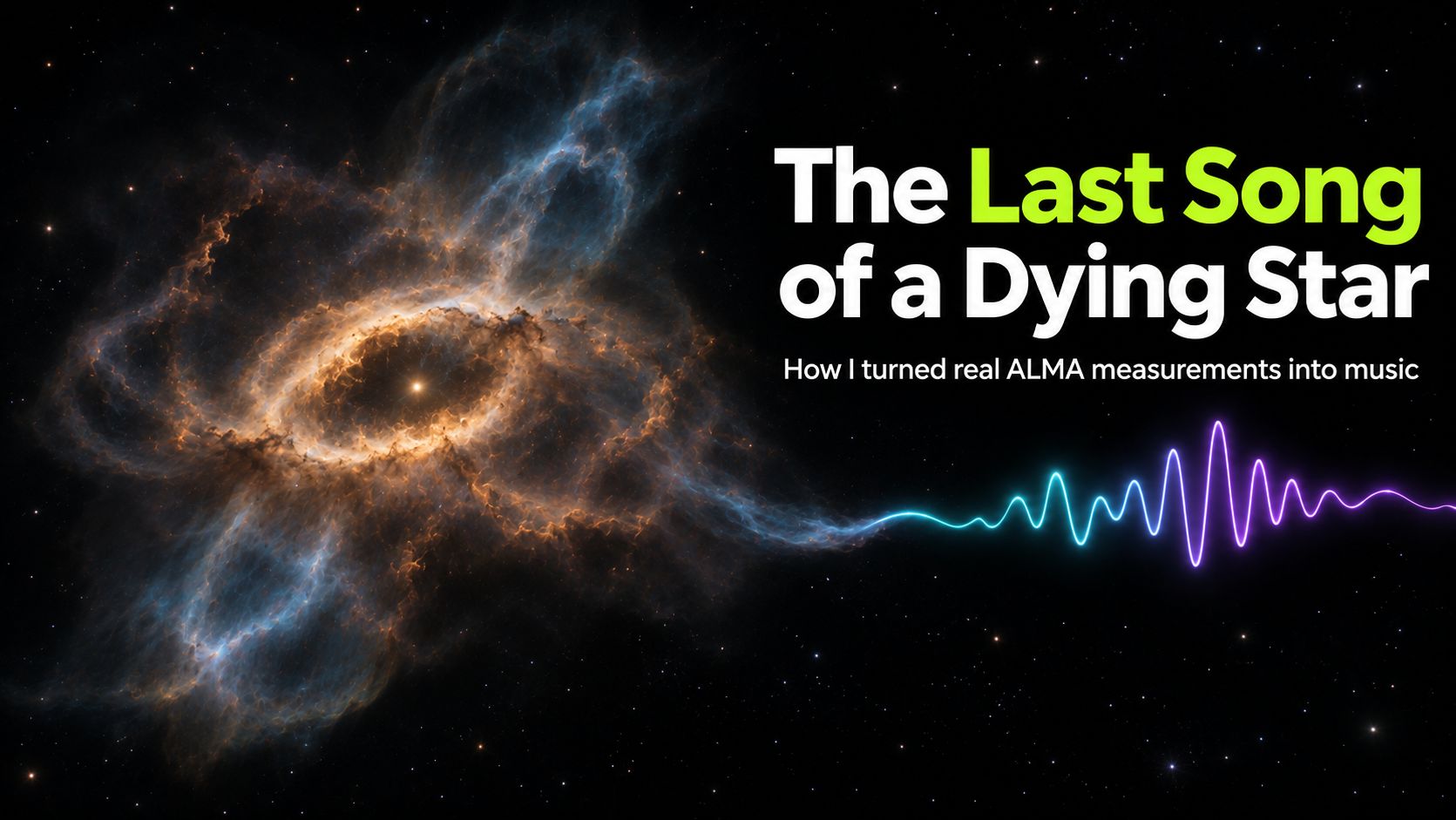
A dying star expelled a large amount of gas, leaving an expanding ring with an estimated age of roughly 6,500 years. That material preserves evidence of the star's past.
Astronomers studied the gas to understand how the star was changing. I had a different question: could that same evidence help write a song?
I downloaded the telescope data and built a Python program. Here is what happened.
Listen to its last song
Two versions of the same composition: start with the original, then compare the SoundFont arrangement. Both use the same notes and last approximately 70 seconds. Neither is a literal recording of sound from space.
1. Original version — sounds made from the measurements
Every instrument sound in this version is synthesized from the measured ALMA emission profiles.
2. SoundFont version — the same music, different instruments
This version plays the same composition with SoundFont strings, atmospheric pads, bass and bells. The notes and arrangement stay the same; the instrument sounds change.
A star that left its history behind
In November 2026, astronomers reported new findings about IRAS 06530–0213, a carbon-rich star roughly 12,000 light-years away. Its expanding gas ring provides evidence of its last thermal pulse, a brief episode of intensified nuclear burning inside the star. Closer to the star, younger structures reveal subsequent stages of mass loss.
The telescope was ALMA, a radio observatory in Chile. Its measurements reveal the frequencies and intensities of radiation emitted by molecules in the surrounding gas.
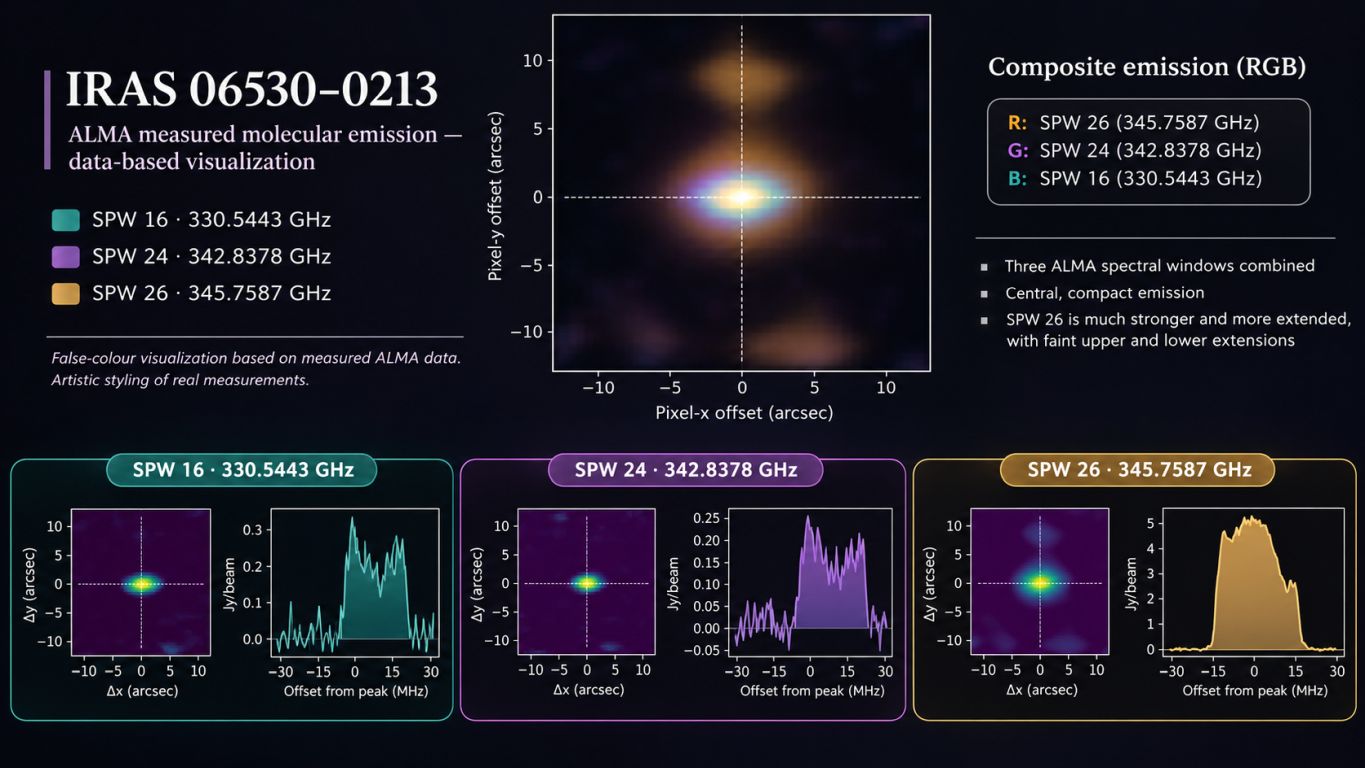
Three ALMA spectral windows shown separately and combined in false color. The colors are a visualization choice, not the visible appearance of the star.
That is useful information for a synthesizer, which also works with frequencies and amplitudes. There is just the small matter of turning those measurements into audible sounds.
My first attempt was not a song
I downloaded six processed spectral cubes containing 7,973 frequency channels. From these, my Python program extracted seven usable emission profiles.
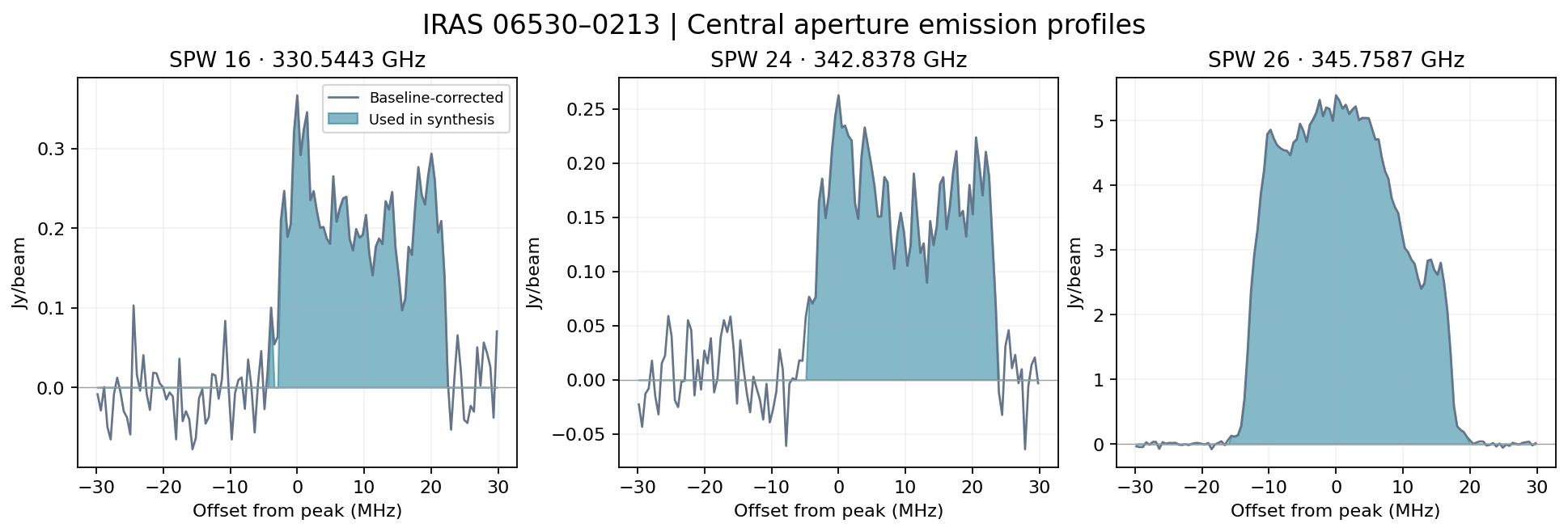
Actual ALMA measurements. Highlighted channels contribute to the synthesized sounds.
The first experiment produced a continuous tone. The next sounded like a scale exercise. A third resembled someone's first music lesson, with long pauses between notes.
Apparently, dying stars are not automatically good composers.
The version that worked used the measured spectral intensities to build instrument timbres and influence melodic contours. I remapped the spectral patterns into audible tones rather than simply shifting all the radio frequencies down. A musical framework gave those measurements room to develop into a piece of music.
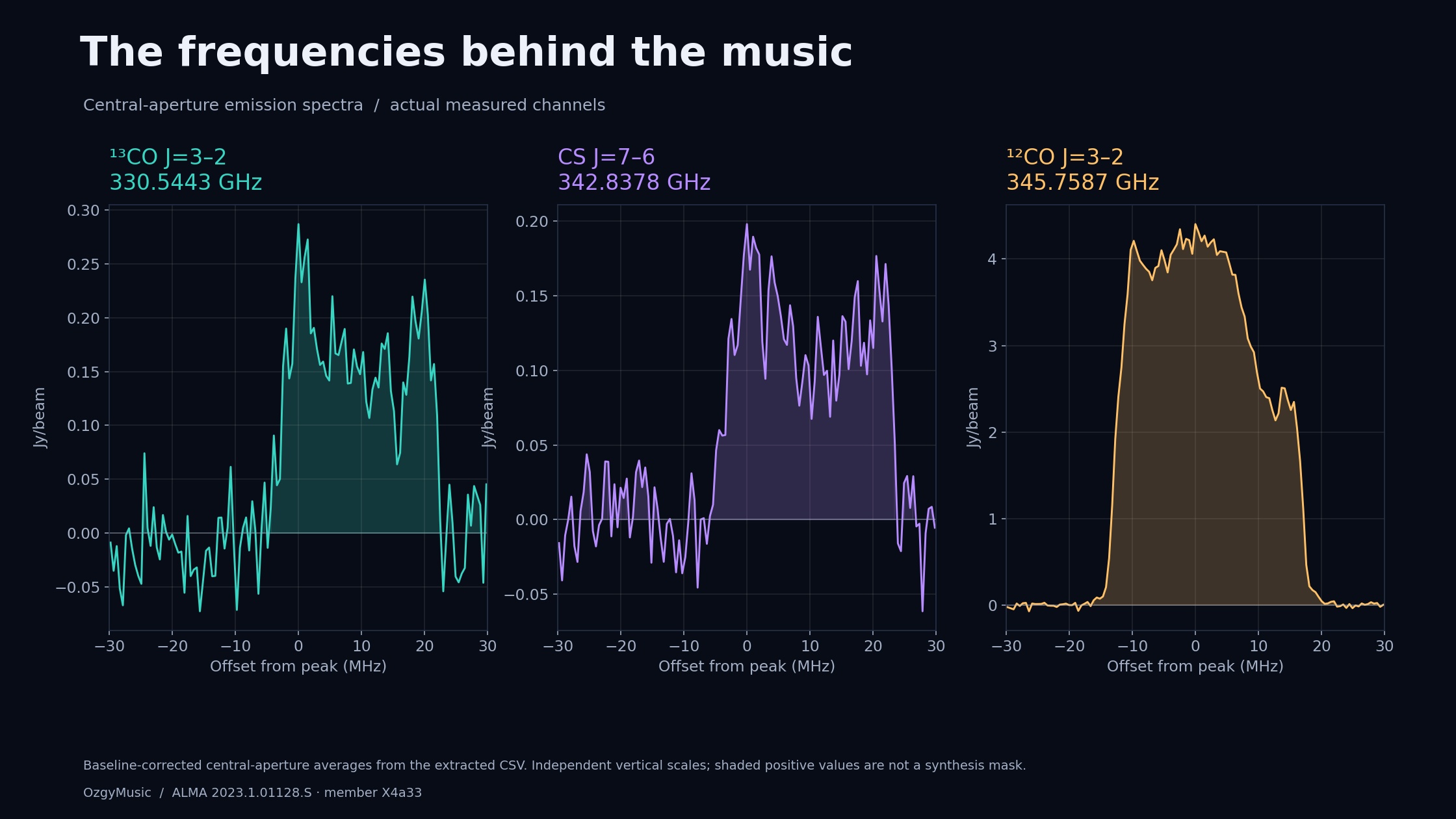
Three measured emission profiles behind the synthesized timbres. Each plot uses its own vertical scale; the shaded positive values are not a synthesis-selection mask.
Four chapters in 70 seconds
I arranged the composition around four structures described in the scientific study, following their inferred chronological order.
| Chapter | Musical interpretation |
|---|---|
| Outer gas ring | A quiet opening |
| Filamentary arcs | A developing melody and pulse |
| Torus | A denser, layered climax |
| Central bipolar nebula | A gradual resolution |
The software generates 283 notes across five musical layers in D minor at 84 BPM. It also creates variations, exports MIDI and WAV files, and lets me blend the original sounds with SoundFonts using an adjustable mix.
How much of the song belongs to the star?
| From the star's measured traces | From my musical decisions |
|---|---|
| Spectral intensities and instrument timbres | Key, chord progressions and tempo |
| Data-influenced melodic contours | Rhythm, arrangement and ending |
| Evidence of earlier and later mass loss | Four musical chapters of equal length |
The original version uses only instrument sounds synthesized from the measured emission profiles. The SoundFont version uses sampled instruments, with some of the original synthesized recording mixed underneath. That blend changes the sound; it does not measure how much of the music came from the star. Both versions use the same composition, shaped by the measurements and my musical rules.
We have observations of the material the star left behind, not a recording of thousands of years of its life. The chapters interpret that history; the spatial apertures used for synthesis are not individually identified with those structures.
Still, those ancient emissions ended up influencing a melody on my computer. Of all the things a dying star could leave behind, a piece of electronic music was probably not on its list.
Data and credits
Research: The Last Gasps of a Dying Star, Sahai et al.. Measurements: public pipeline-processed ALMA Band 7 data, project 2023.1.01128.S, member uid://A001/X3621/X4a33, not the paper's combined Band 7 and Band 9 images.
The SoundFont edition uses:
- A-String by Soundsource Studios — Roland Alpha Juno-2: A-String, offered under CC BY 2.0.
- Nord PCM Pad, using the PCM Pad preset, by RODI — the author permits personal and commercial use, including derivative works and their distribution, provided appropriate credit is given.
- Cindy-Bells, using the Lover's Bells preset, by Soundsource Studios — Synth Icons Vol.2, offered under CC BY 2.0.
- GeneralUser GS by S. Christian Collins — Synth Bass 1 and Pizzicato Strings; source and licence.
Rendered with FluidSynth. The original SF2 files are not distributed here. The banner is an artistic illustration, not an ALMA observation.
This paper makes use of the following ALMA data: ADS/JAO.ALMA#2023.1.01128.S. ALMA is a partnership of ESO (representing its member states), NSF (USA) and NINS (Japan), together with NRC (Canada), NSTC and ASIAA (Taiwan), and KASI (Republic of Korea), in cooperation with the Republic of Chile. The Joint ALMA Observatory is operated by ESO, AUI/NRAO and NAOJ.