




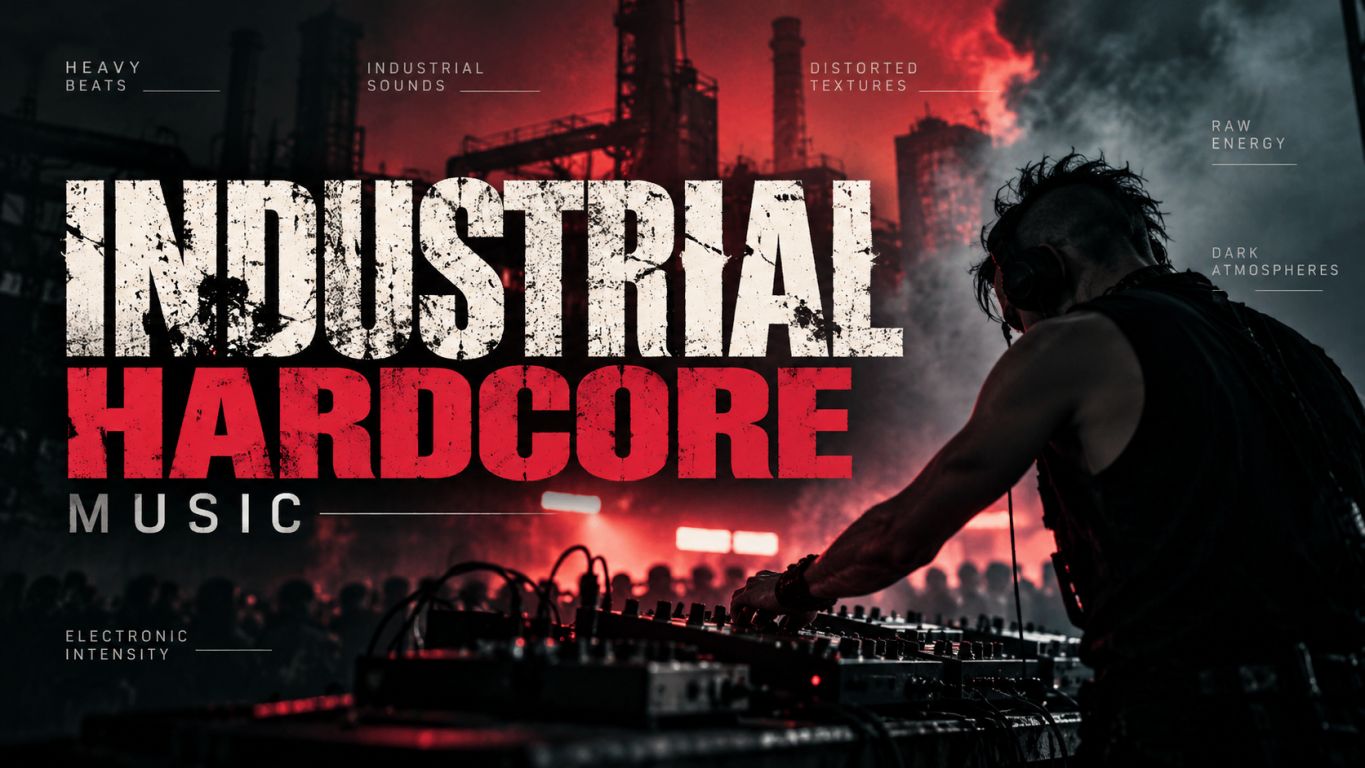
Industrial hardcore is a subgenre of Hardcore Techno Music that combines aggressive electronic rhythms with the harsh textures and mechanical qualities of industrial music. Its sound revolves around heavily distorted kick drums, metallic percussion, dark atmospheres, and experimental sound design.
Compared with more conventional Gabber Music, industrial hardcore often favors abrasive textures and unpredictable arrangements over straightforward rave melodies. The distinction is not absolute, but its experimental approach gives the genre a recognizable identity.
Origins and Development
Industrial hardcore developed during the 1990s as hardcore techno producers explored darker and more abrasive forms of Electronic Music.
The genre drew inspiration from industrial music, noise, and experimental electronics. Earlier industrial acts such as Throbbing Gristle and Einstürzende Neubauten had established an approach to sound based on distortion, mechanical rhythms, and unconventional instrumentation, although they were not themselves industrial hardcore artists.
Meanwhile, European hardcore scenes were pushing electronic dance music toward increasingly aggressive sounds. Labels such as Industrial Strength Records, founded by Lenny Dee in 1991, helped establish a space for harder and more experimental productions.
During the 2000s, artists including The Outside Agency further developed the style, combining intricate percussion, atmospheric sound design, and influences from other underground electronic genres.
What Does Industrial Hardcore Sound Like?
Industrial hardcore is defined more by its sonic character than by a fixed set of production rules.
Tempo and Rhythm
Industrial hardcore commonly operates around 150-200 BPM, although tempos vary considerably.
Many tracks use a four-on-the-floor rhythm, with a kick drum on every quarter-note beat in 4/4 time. Others introduce syncopated percussion, broken rhythms, and irregular accents to create tension.
Distorted Kick Drums
The kick drum is usually the dominant element. Heavy distortion, saturation, and clipping transform ordinary electronic kicks into dense, abrasive sounds.
These kicks often have grinding or metallic qualities, with distorted tails that contribute much of the track's bass energy.
Mechanical Textures and Atmosphere
Industrial hardcore frequently incorporates metallic impacts, machine-like percussion, electronic noise, distorted samples, and ominous synthesizer drones.
Melodies may appear, but they are often minimal, dissonant, or atmospheric. Rhythm and texture generally take priority over conventional melodic hooks.
These qualities connect industrial hardcore with Industrial Techno Music, although the two styles have different rhythmic foundations.
Production Techniques
Industrial hardcore relies heavily on electronic sound manipulation rather than any particular instrument or hardware setup.
Producers commonly use synthesizers, samplers, drum machines, and digital audio workstations. Several techniques are especially characteristic:
- Distortion and saturation: Create aggressive kicks and harmonically rich textures.
- Resampling: Transform sounds through repeated rendering and processing.
- Layering: Combine percussion, metallic impacts, and electronic noise.
- Filtering and automation: Introduce movement and tension into evolving sounds.
- Rhythmic variation: Add unexpected accents, interruptions, and syncopation.
Because heavily distorted sounds occupy a broad frequency range, careful equalization and dynamic control help prevent the mix from becoming indistinct.
Influential Artists and Labels
The Outside Agency, consisting of Dutch producers DJ Hidden and Eye-D, is among the most recognizable names associated with industrial hardcore. The duo's productions combine aggressive rhythms with detailed sound design and influences from drum and bass.
Their label Genosha Recordings, established in 2003, became an important outlet for darker and more experimental hardcore.
Other notable contributors include Lenny Dee, founder of Industrial Strength Records, and producers such as The DJ Producer and Delta 9, whose work helped develop the broader experimental hardcore scene.
Industrial Hardcore vs. Related Genres
Industrial hardcore shares characteristics with several Electronic Music styles, and the boundaries are not always clearly defined.
| Genre | Main distinction |
|---|---|
| Gabber Music | Often emphasizes direct, driving rhythms and rave-oriented energy. |
| Mainstream Hardcore Music | Generally places greater emphasis on prominent melodies, breakdowns, and anthem-like arrangements. |
| Industrial Techno Music | Typically focuses on repetitive, mechanical techno grooves. |
| Crossbreed Music | Explicitly combines hardcore techno with drum and bass rhythms and production techniques. |
| Speedcore Music | Primarily emphasizes exceptionally fast tempos and extreme rhythmic intensity. |
Individual tracks may combine elements of several styles, particularly industrial hardcore, industrial techno, and crossbreed.
A Distinctive Branch of Hardcore
Industrial hardcore takes the intensity of hardcore techno in a darker, more experimental direction. Its distorted kicks, mechanical percussion, and abrasive atmospheres make sound design just as important as rhythmic impact.
Rather than following one rigid formula, the genre continues to provide space for producers to explore unconventional rhythms and extreme electronic textures.