




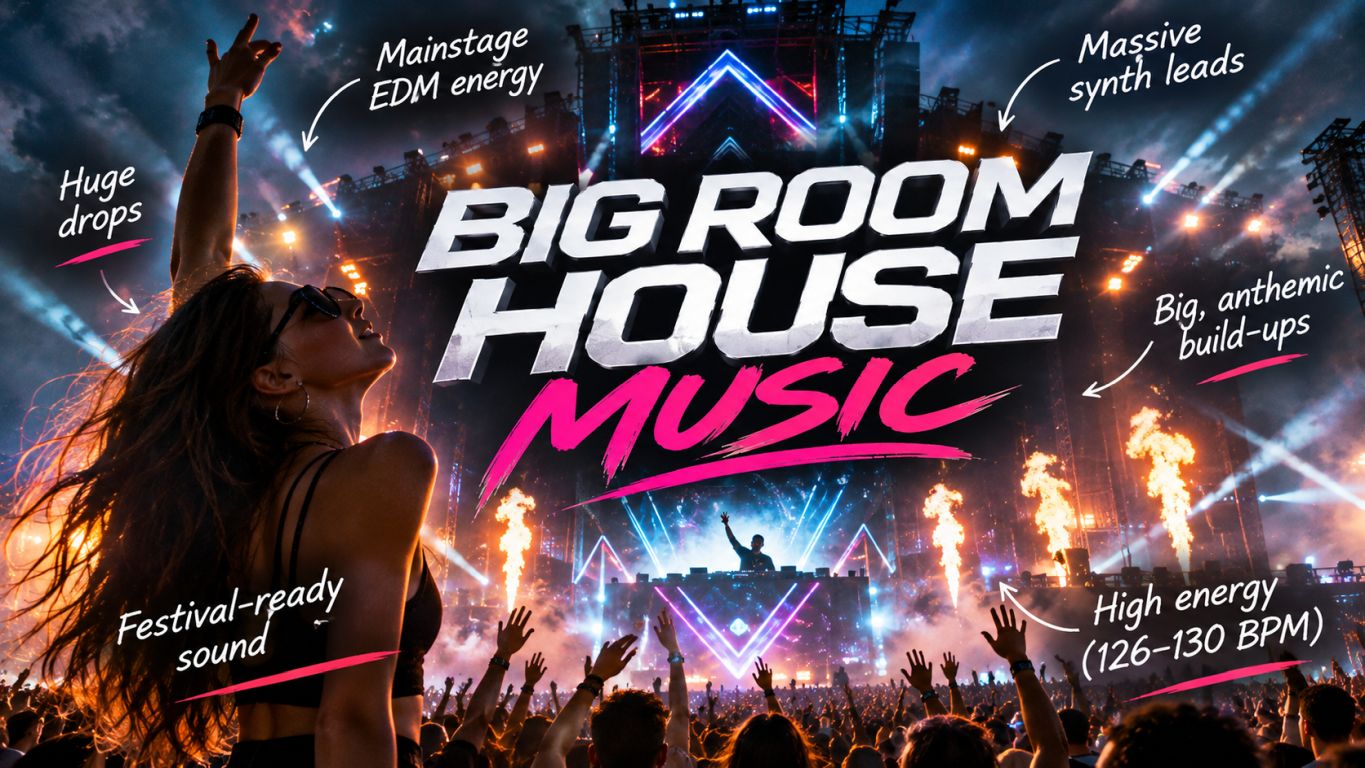
Some electronic dance music tries to tell an elaborate story. Big room house would rather get 30,000 people to recognize three notes at exactly the same moment. Neither goal is easy, but one involves considerably more confetti.
Big Room House Music is a festival-focused branch of Electro House Music, best known for its imposing kick drums, suspenseful buildups, and surprisingly uncluttered drops. It reached its commercial peak in the early 2010s, when enormous mainstage crowds and instantly identifiable hooks became a powerful combination.
The important point is that big does not mean busy. The genre gets much of its impact from deciding which sounds not to play.
What does big room house sound like?
Big room usually moves at 126-132 BPM, with 128 BPM a familiar reference. It uses a four-on-the-floor rhythm: the kick plays on every quarter-note beat of a 4/4 bar. What separates it from many other house styles is how deliberately the arrangement moves between tension and release.
| Element | What you typically hear |
|---|---|
| Tempo | Around 126-132 BPM, often near 128 |
| Drums | A large, punchy kick, firm claps, and driving hi-hats |
| Build | Rising effects, snare rolls, repeated phrases, and short silences |
| Drop | A short synth, bass, or percussion motif with plenty of space |
| Breakdown | Sweeping chords or melodies that prepare the next peak |
| Overall feel | Direct, theatrical, and designed for collective impact |
A big room track may introduce a soaring melodic breakdown, but its main drop can be little more than a hard kick and a rhythmically precise lead. That reduction is intentional. The audience has already been told to expect something enormous; a distinctive phrase, delivered at the right moment, can complete the illusion.
How big room took over festival mainstages
The sound grew from the meeting point of electro house, anthemic progressive house, Dutch club production, and the wider EDM festival boom. It did not appear overnight, and no single producer deserves an invention certificate.
A useful early landmark is Sandro Silva and Quintino's "Epic" (2011). Its forceful kick and stripped-down lead helped establish an approach that would become familiar in festival sets. Hardwell's "Spaceman" (2012) brought a different, soaring synth identity to a similarly large-scale arrangement.
Then came Martin Garrix's "Animals" (2013). Its stark, easily remembered drop became one of the era's most recognizable dance-music moments and brought the style to a much wider audience. W&W, Blasterjaxx, and Dimitri Vegas & Like Mike were also prominent in the big-room circuit, though none of those artists was limited to a single genre.
By the middle of the decade, the formula was familiar enough to attract criticism: too many buildups, too many similar drops. That criticism was not entirely imaginary. The strongest records, however, show how much personality a producer can put into a deliberately small musical idea.
Why the drop works even when it is sparse
A big room arrangement often has three connected stages.
First, the breakdown creates a promise. Chords, a vocal phrase, or a bright lead establish a musical destination. The kick may recede, allowing the track to feel wider and more emotional.
Next, the build narrows the listener's attention. Risers, accelerating snare patterns, repeated notes, and a temporary reduction in bass make the next downbeat seem increasingly important. A brief gap can be more effective than yet another white-noise sweep.
Finally, the drop pays off the expectation. The kick returns with a simple hook. Because the middle and low frequencies have been carefully cleared, that hook stands out. It feels bigger partly because the previous section was intentionally smaller.
The distinction matters in production: a loud drop is not automatically a powerful drop. If every section is equally dense and equally compressed, there is little contrast left to enjoy.
Big room house versus electro, progressive, and Dutch house
The labels overlap in actual DJ sets, but they describe different emphases.
- Electro House Music is the broader parent genre. It can feature gritty bass design, dense riffs, or intricate synth programming without relying on the classic big-room build-and-drop formula.
- Progressive House Music often emphasizes evolving harmony and extended melodic development. Its festival-oriented side influenced big room, but the two are not interchangeable.
- Dutch House Music is associated with sharper, sometimes squealing leads and lively syncopation. Big room may borrow those sounds while organizing them around a more monumental drop.
You may also hear a heavy bass patch that resembles Bass House Music. One sound does not determine the genre; listen to the drums, arrangement, and purpose of the track as a whole.
Five songs and artists worth listening to
For a short tour, focus on how the sections connect, not just how loudly the drop arrives.
- Sandro Silva & Quintino - "Epic" (2011): Hear the economy of the lead and the sheer emphasis placed on the downbeat.
- Hardwell - "Spaceman" (2012): Notice how the melodic material makes the energetic sections feel more expansive.
- Martin Garrix - "Animals" (2013): Follow the minimal drop motif and the space left around it.
- DVBBS & Borgeous - "Tsunami" (2013): Compare its percussive hook and festival-ready tension.
- W&W - "Bigfoot" (2014): Listen to the memorable lead motif and the arrangement's direct physical momentum.
These are listening landmarks, not a list of songs that all use the same formula. Differences between them are more instructive than their shared festival reputation.
Build a convincing big room drop in your DAW
Start at 128 BPM with a clean four-on-the-floor kick, a clap on beats two and four, and a short synth riff. Try three or four notes with a distinct rhythm. If the hook only works after adding six more synth layers, the hook may need another meeting.
Make an eight-bar drop with the kick, riff, and a restrained bass supporting the roots. Keep sustained low notes from masking the kick, and leave the lead enough midrange space to be recognizable on modest speakers.
Now write an eight- or sixteen-bar build before it. Begin with a filtered or harmonized version of the riff, then gradually increase percussion and brightness. Thin out the bass near the end and leave a short pause before the drop. Compare the transition with and without that pause: the difference is often more useful than adding another riser.
Finally, check the arrangement at a moderate volume. Does the hook still read clearly? Does the drop feel like a change rather than simply a louder version of the build? Fix those questions before reaching for another limiter.
Is big room house still relevant?
Big room no longer defines the entire festival conversation as it did during its early-2010s peak, but its arrangement language remains familiar. A carefully staged pause, an unmistakable hook, and a powerful first downbeat are useful well beyond this style.
That is big room house's lasting lesson: scale is often a matter of contrast, not the number of channels in your project.