House Music Family
Explore the Chicago origins of house music and the eleven major styles within the House Music Family.
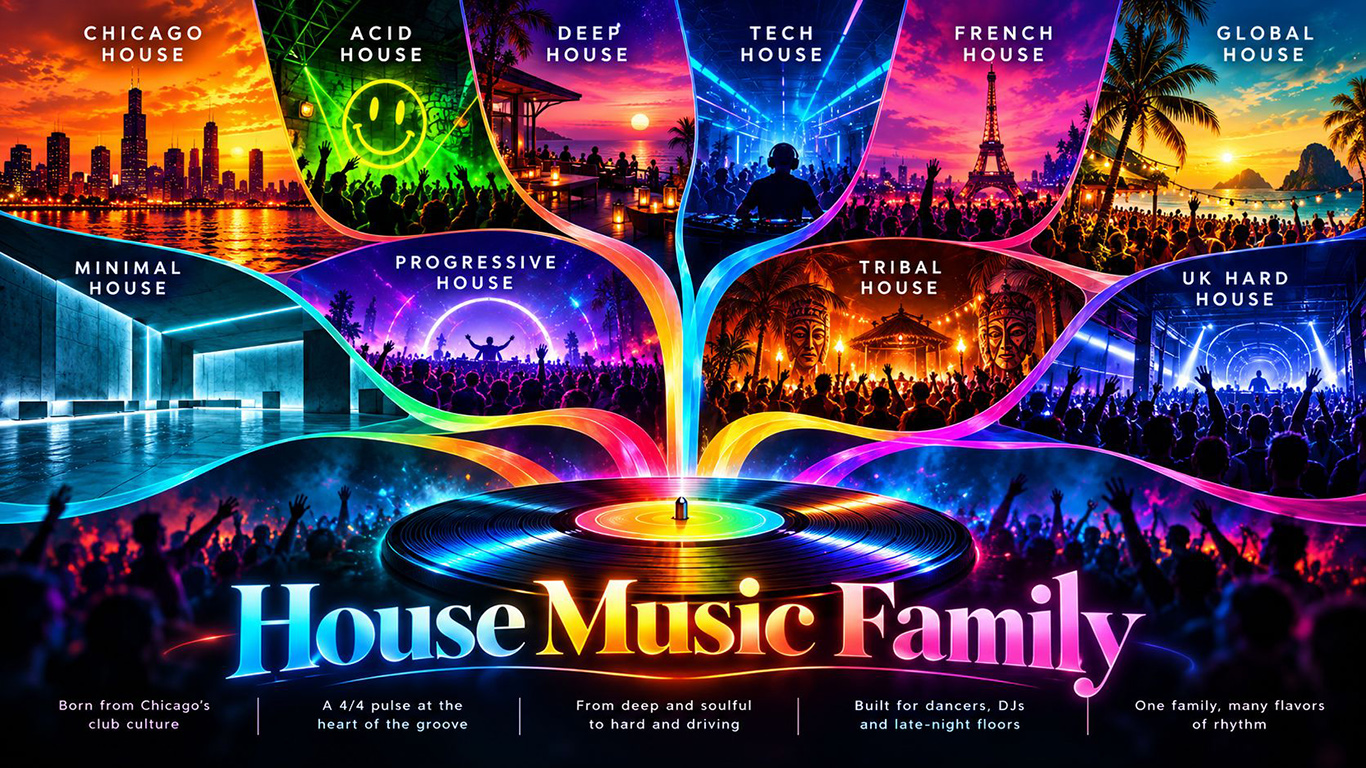
What Is the House Music Family?
House Music is a genre within the wider House Music Family. The family includes eleven major genres, each representing a different approach to house-related rhythm, production, or club culture.
These styles share musical connections, but they did not all descend directly from Chicago house. Scenes influence one another, and individual tracks often cross several genre boundaries.
Chicago Origins and the House Foundation
House Music took shape in Chicago in the early 1980s, building on disco, funk, soul, gospel-influenced vocals, and DJ practices that favored continuous dancing. Frankie Knuckles and the Warehouse are central to the story, alongside other DJs, producers, clubs, and communities. Drum machines, synthesizers, and sampling tools helped define the emerging sound.
A common foundation is the four-on-the-floor kick, syncopated percussion, bass-led grooves, and arrangements designed for mixing. These traits are useful reference points, not requirements shared identically by every branch.
The Eleven Branches of the House Music Family
House music has developed in different directions through regional scenes, production techniques, and changing dance-floor preferences. These eleven branches illustrate that range.
1. House Music
The core Chicago-derived tradition, spanning deep, soulful, jackin, disco-oriented, and newer hybrid styles. Its sound often features four-on-the-floor kick drums, repeating grooves, basslines, and DJ-friendly structures.
Its flexibility is central to the family: producers can shift between warm, vocal-led tracks and stripped-back club tools without abandoning the underlying groove.
2. Electro House Music
A more forceful, synth-led branch associated with distorted bass, prominent leads, and drops. Common features include dense sound design, energetic build-ups, and heavy bass.
In club settings, tension often comes from rising synth layers, abrupt transitions, and carefully timed breakdowns rather than subtle groove changes alone.
3. French House Music
A French scene and production aesthetic widely associated with filtered disco and funk samples. Its production often features looped samples, filtering, compression, and rhythmic repetition.
Closely associated with the French touch movement of the 1990s, this approach turns short sampled passages into evolving dance tracks through filter sweeps and repetition.
4. Afro House Music
House-oriented club music drawing on a wide range of African rhythmic and musical traditions. Common elements include layered percussion, groove-led arrangements, and varied melodic and vocal influences.
Rather than describing a single national sound, the label covers varied approaches that connect house production with different African club scenes and percussion traditions.
5. Latin House Music
House music incorporating rhythms, percussion, and musical influences associated with Latin American scenes. It often features percussion-forward grooves and Latin-influenced rhythmic patterns.
Congas, bongos, handclaps, and syncopated accents can add rhythmic conversation around the steady kick, while vocals and melodic elements reflect diverse influences.
6. Tropical House Music
A melodic, generally relaxed house style commonly associated with bright timbres and spacious arrangements. Typical features include light percussion, melodic hooks, and an airy production palette.
It became especially visible in the mid-2010s, when its softer, summery sound brought house-influenced production to a wider pop audience.
7. Amapiano Music
A South African dance-music movement with distinctive rhythmic and bass characteristics. Characteristic sounds include log-drum bass, spacious grooves, keys, and syncopated percussion.
Emerging in South Africa during the 2010s, the style developed a recognizable identity through rolling low-end patterns, spacious tempos, and keyboard-led arrangements.
8. Minimal House Music
A pared-back house approach prioritizing repetition, small variations, and space. Common characteristics include sparse arrangements, subtle rhythmic changes, and restrained timbres.
Small shifts in timing, texture, and percussion do much of the work, making the space between sounds as important as the individual elements.
9. Progressive House Music
A long-form house approach that develops arrangements gradually over time. Its arrangements often use evolving motifs, layered textures, and extended builds.
Its sense of movement usually comes from gradual layering and long transitions, allowing DJs to build energy without frequent hard cuts.
10. Tech House Music
House grooves combined with techno-related rhythmic precision and production textures. Typical elements include driving low end, tight percussion, and stripped-down hooks.
The style often uses tightly edited loops and subtle changes in drum and bass patterns to maintain momentum without relying on prominent melodies.
11. Tribal House Music
A rhythm-led house approach centered on repeated, layered percussion. It emphasizes prominent drums, polyrhythmic interplay, and sustained dance-floor momentum.
Its layered drum patterns draw attention to swing, repetition, and call-and-response between percussion parts, particularly in extended club mixes.
How the Branches Differ
These are broad listening and production tendencies; they are not strict genre tests.
| Approach | Representative branches | Common traits |
|---|---|---|
| Groove- and percussion-led | House Music, Afro House Music, Latin House Music, Amapiano Music, Tribal House Music | Distinctive rhythmic accents, layered percussion, bass-driven movement |
| Sound-design- and impact-led | Electro House Music, Tech House Music | Focused synth or bass design, tight drums, club-oriented energy |
| Sample- and loop-led | French House Music | Repeated disco/funk-derived material, filtering, loop variation |
| Space- and progression-led | Minimal House Music, Progressive House Music, Tropical House Music | Sparse details, gradual evolution, or melodic openness, depending on the branch |
Where Genre Boundaries Overlap
A track may combine a Deep House Music chord palette with minimal percussion or blend techno textures into a House Music groove. Likewise, regional influences do not imply that all Afro House Music, Latin House Music, or Amapiano Music tracks sound alike. Genre names help listeners discover related sounds, but they do not restrict how artists describe their work.
House Music Genres at a Glance
Use this comparison to recognize the differences between the eleven branches by ear. The descriptions identify common tendencies rather than rules that apply to every track.
| Genre | Signature sound | Groove and energy | What to listen for |
|---|---|---|---|
| House Music | Drum-machine kicks, basslines, chords, and sometimes soulful vocals | Steady, danceable, often swinging | Repeating four-on-the-floor beats with an emphasis on groove |
| Electro House Music | Aggressive synth leads, distorted bass, and prominent effects | Punchy, high-impact, build-and-drop driven | Dramatic transitions into heavy synthesized bass sections |
| French House Music | Disco or funk samples, filters, and compressed loops | Bouncy, repetitive, sample-driven | Short loops transformed by sweeping filters and rhythmic edits |
| Afro House Music | Layered percussion, melodic motifs, and varied vocal textures | Deep, rolling, rhythm-focused | Interlocking percussion patterns carrying the track forward |
| Latin House Music | Latin-influenced percussion, rhythmic accents, and vocals | Lively, syncopated, percussion-forward | Hand percussion and rhythmic phrasing woven into house beats |
| Tropical House Music | Bright plucked or mallet-like tones, soft synths, and airy melodies | Relaxed, light, melodic | Breezy hooks and restrained percussion rather than hard drops |
| Amapiano Music | Log-drum bass, keyboards, and spacious arrangements | Laid-back but rhythmically intricate | Rolling low-end phrases answering syncopated percussion |
| Minimal House Music | Sparse drums, restrained bass, and small textural details | Hypnotic, understated, repetitive | Tiny changes in timing and sound that reshape an otherwise steady loop |
| Progressive House Music | Evolving melodies, pads, and layered arrangements | Flowing, gradually intensifying | Musical ideas unfolding over extended builds and transitions |
| Tech House Music | Tight drums, punchy bass, and clipped vocal or synth hooks | Driving, groove-led, club-focused | A persistent bass-and-drum groove with economical melodic material |
| Tribal House Music | Dense hand percussion, drum layers, and rhythmic calls | Percussive, insistent, energetic | Multiple drum parts interacting while melody stays secondary |
Related Questions And Answers
- • What is the House Music Family?The House Music Family brings together eleven related electronic music genres with distinct rhythms, production styles, and club traditions.
- • What is the difference between House Music and the House Music Family?House Music is one genre; the House Music Family is the larger classification that also includes other related branches.
- • Where did House Music originate?House Music emerged from Chicago club and DJ culture in the early 1980s, drawing on disco, soul, funk, and electronic instruments.
- • What are the main branches of the House Music Family?The eleven branches are House Music, Electro House Music, French House Music, Afro House Music, Latin House Music, Tropical House Music, Amapiano Music, Minimal House Music, Progressive House Music, Tech House Music, and Tribal House Music.
- • What are some House Music subgenres?House Music includes Chicago House Music, Acid House Music, Deep House Music, Dub House Music, Ghetto House Music, Italo House Music, Jazz House Music, Lo-Fi House Music, Soulful House Music, Disco House Music, Chicago Juke Music, Garage House Music, Funky House Music, Jackin House Music, Future House Music, Melodic House Music, Organic House Music, Ambient House Music, Hip House Music, Slap House Music, Brazilian Bass Music.
- • How is Afro House Music different from Latin House Music?Afro House Music draws on diverse African rhythmic traditions, while Latin House Music incorporates rhythmic and musical influences associated with Latin American scenes.
- • What defines French House Music?French House Music is known for disco and funk samples, filtering, loop-based grooves, and rhythmic repetition.
- • What makes Amapiano Music distinctive?Amapiano Music is associated with log-drum bass, spacious grooves, keyboard melodies, and syncopated percussion.