


Amapiano Music
Explore Amapiano Music, from its South African township roots and piano-led grooves to distinctive log drum basslines, regional styles, and global dance culture.
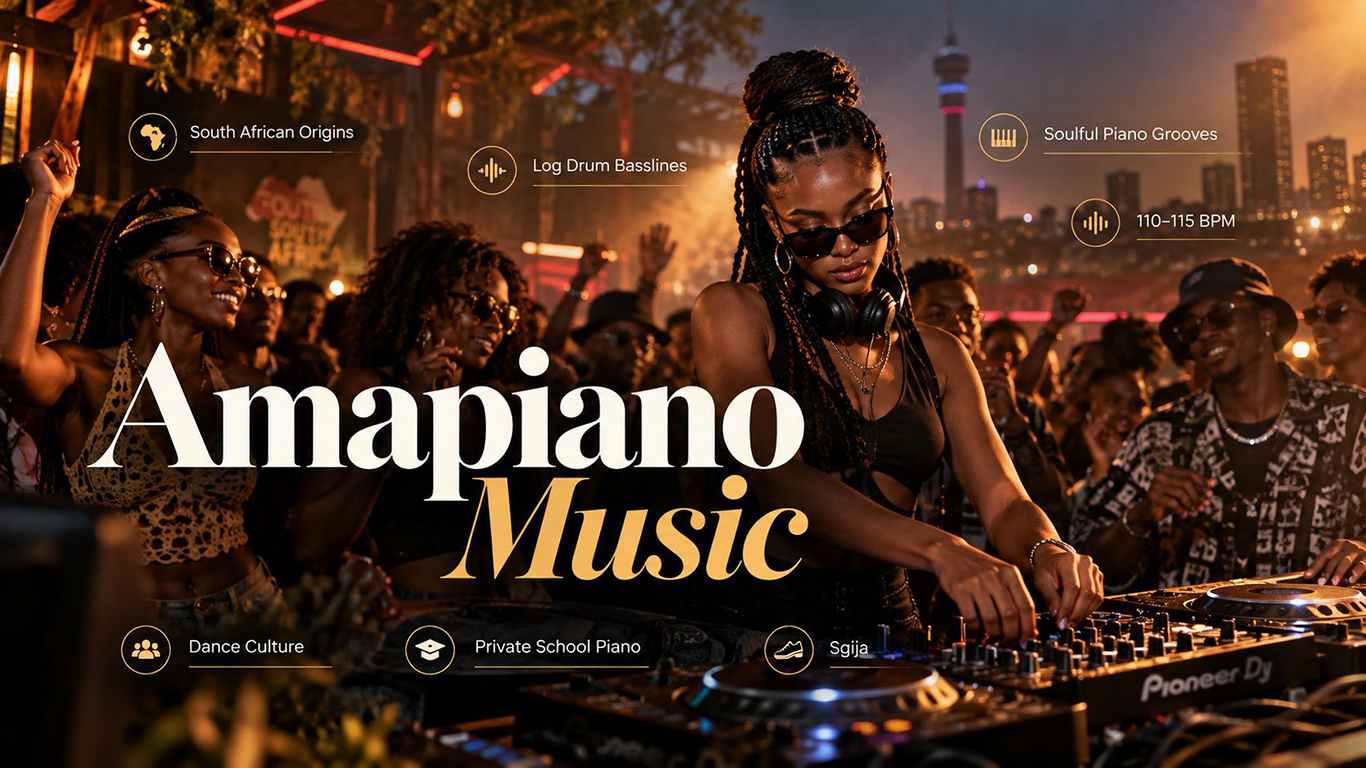
What Is Amapiano Music?
Amapiano Music is a South African electronic dance music genre built around fluid rhythms, spacious arrangements, piano-centered harmonies, and deep, pitched bass phrases often called log drums. Its name is commonly translated as “the pianos,” reflecting the keyboard textures associated with its early identity. Yet the genre is as much about percussion, bass movement, and the spaces between notes as it is about piano chords.
Emerging during the 2010s, Amapiano grew through local DJs, producers, dancers, and community-driven circulation before reaching wider national and international audiences. It shares musical ground with House Music, especially South African approaches to house, while drawing on kwaito, jazz, lounge, gospel, and other regional sounds. Those relationships help explain its character without reducing Amapiano to a slower version of another genre.
Origins: From Gauteng to International Dance Floors
Amapiano developed through overlapping local scenes rather than a single founding track or producer. Pretoria and Johannesburg, along with surrounding townships and communities in Gauteng, were important centers for its early development. DJs circulated recordings through informal networks, while parties, local venues, and dancers helped shape which sounds caught on.
As more producers explored the style, its recognizable combination of airy chords, layered shakers, and moving low-end patterns became increasingly prominent. The music expanded through South Africa and across borders, supported by collaborations, streaming, DJ sets, dance videos, and a growing international audience.
Amapiano remains closely connected to South African musical and social contexts. Its global success is part of the story, but it does not replace the local scenes that continue to develop the sound.
The Defining Sound of Amapiano
The genre's identity emerges from the interaction of several musical elements:
- Log drum basslines: Rounded, pitched low-frequency sounds that combine the functions of bass and percussion. They can answer a vocal phrase, introduce rhythmic accents, or carry a memorable hook.
- Piano and keyboard harmony: Jazz-influenced chords, electric-piano textures, organ tones, and other melodic layers give many tracks their warm or reflective character.
- Syncopated percussion: Shakers, hand percussion, claps, and other small rhythmic events move around the main pulse, producing a rolling groove.
- Space and repetition: Repeated ideas unfold gradually. A short percussion figure or a small change in bass phrasing can transform an otherwise restrained arrangement.
- Vocals and communal energy: Sung hooks, chants, spoken phrases, and collaborations contribute to the style's connection with dance and social gathering.
Tempo, Groove, and Related House Styles
Many Amapiano tracks run around 110–115 BPM, but there is no absolute tempo boundary. The feel is frequently relaxed even when the percussion is intricate. A four-on-the-floor kick may establish the underlying pulse, while bass and upper percussion create rhythmic movement around it.
Compared with many forms of Deep House Music, Amapiano often gives the log drum a more prominent rhythmic and melodic role. Both styles can use smooth chords and understated arrangements, so a shared tempo or keyboard sound alone is not enough to identify a track.
| Element | Amapiano Music | Common deep house approach |
|---|---|---|
| Tempo | Often around 110–115 BPM | Varies widely; commonly around 115–130 BPM |
| Bass | Pitched, rhythmically active log drum patterns | Rounded bass grooves or sustained synthesized bass |
| Percussion | Interlocking shakers, syncopation, varied fills | Steady house pulse with layered percussion |
| Harmony | Piano-led, jazz- and soul-influenced passages | Warm chords, pads, and soulful harmonic textures |
These are tendencies rather than rigid rules; individual tracks can cross the boundaries.
How the Amapiano Log Drum Works
The log drum is not necessarily a recording of a wooden instrument. In Amapiano production, the term usually describes a synthesized, resonant sound with a pronounced low-frequency body and a percussive attack. Its pitch can move dramatically between notes, allowing a single patch to function as both a bassline and a rhythmic voice.
Producers often create the sound with frequency-modulation synthesis or related sound-design techniques. A widely influential version came from the Log Drum preset in FL Studio’s Fruity DX10 synthesizer, popularized within Amapiano by producers including MDU aka TRP. Producers also create related sounds with other synthesizers, samples, and sound-design methods.
A typical production approach starts with a short, punchy envelope, a controlled sub-bass component, and careful note placement. Pitch changes, rests, and quick fills establish movement. The bass part then interacts with the kick and shakers instead of merely following the root notes of the harmony.
Extended arrangements leave space for these patterns to evolve. A producer might introduce a sparse piano figure, bring in additional percussion, then alter the log drum phrase to create a new section without relying on an oversized festival-style drop.
Amapiano Subgenres
Amapiano is not a single uniform sound. Producers may favor richer harmony, minimal club percussion, prominent vocals, or more forceful bass patterns. Two recognized branches in this guide are:
Private School Piano Music
Private School Piano Music is associated with a sophisticated, often jazz-influenced approach to Amapiano. Detailed chords, subtle instrumentation, and patient arrangements tend to take priority over immediate rhythmic impact. The result can feel spacious, intricate, and reflective while retaining the genre's characteristic groove.
Sgija Music
Sgija Music generally emphasizes driving, percussion-led Amapiano grooves, often with assertive log drum patterns and a more direct club-focused energy. Its arrangements can be sparse in melody while remaining rhythmically intense. The approach highlights how much variety can come from changes in rhythm and bass programming alone.
These branches overlap with the broader Amapiano scene. They describe useful musical tendencies, not rules that every track must follow.
Influential Artists and the Wider Scene
Kabza De Small is one of Amapiano's most prominent producers and is widely nicknamed the “King of Amapiano.” His work helped establish the sound for larger audiences while demonstrating the expressive possibilities of keyboard harmony and rhythm.
DJ Maphorisa has been central to major collaborations and the genre's broader visibility. His partnership with Kabza De Small as the Scorpion Kings brought together production, songwriting, and a recognizable shared identity.
Uncle Waffles has helped introduce Amapiano DJ performance and dance culture to audiences beyond South Africa. Her sets illustrate the role of selectors and dancers alongside record producers in the genre's international growth.
An influential recording associated with the genre's global reach is TitoM & Yuppe's “Tshwala Bam,” featuring S.N.E and EeQue. Its rhythmic hook and accompanying dance culture reached listeners far beyond its original scene.
No shortlist can represent the entire scene. Amapiano continues to evolve through networks of vocalists, beatmakers, DJs, dancers, and local audiences whose contributions are not always equally visible internationally.
Dance Culture and Global Influence
Dance is central to Amapiano's identity. Its measured tempo and detailed rhythmic accents encourage expressive footwork, body movement, and synchronized group routines. Performances and social videos have helped specific tracks reach wider audiences, but the relationship between music and dance began long before a song became an online trend.
The sound has also entered conversations with Afrobeats, house, pop, and hip-hop. Producers working across different scenes borrow log drum timbres or collaborate with Amapiano artists, creating hybrid tracks that do not always fit neatly into one label. These connections expand the genre's influence while raising useful questions about musical origin, credit, and collaboration.
Where Amapiano Fits in Electronic Music
In this guide, Amapiano Music belongs to the House Music Family alongside other related but distinct house traditions. Its primary classification reflects musical relationships rather than a claim that it descends from just one style. Amapiano's South African roots, rhythmic vocabulary, and development through local dance culture are essential to understanding it on its own terms.
The genre shows how electronic dance music can emerge from an identifiable community, develop a distinctive production language, and find global listeners without losing its local creative centers. Listen for the interplay of piano, percussion, and the log drum: the details of that conversation are where much of Amapiano's character lives.
Related Questions And Answers
- • What is Amapiano Music?Amapiano is a South African electronic dance music genre known for piano-led harmonies, spacious grooves, syncopated percussion, and deep, melodic log drum basslines. It developed through exchanges among local house, kwaito, jazz, and other South African musical traditions.
- • Where did Amapiano Music originate?Amapiano emerged in South Africa during the 2010s, particularly through scenes in Gauteng, including Pretoria and Johannesburg. Its early development involved numerous producers, DJs, dancers, and local communities.
- • What is the Amapiano log drum?The log drum is a resonant, pitched bass-percussion sound that often plays rhythmic and melodic phrases. Producers commonly create it with synthesis, including FM-style patches, and shape its attack, pitch, and sub-bass response.
- • What BPM is Amapiano Music?Many Amapiano tracks sit around 110 to 115 BPM, although tempo varies. Rhythm, percussion, bass movement, and arrangement identify the genre more reliably than BPM alone.
- • What are the subgenres of Amapiano Music?In this guide, Amapiano Music includes Private School Piano Music, which emphasizes refined jazz-influenced harmonies and restrained arrangements, and Sgija Music, which often foregrounds sparse, driving percussion and log drum patterns.
- • Who are important Amapiano artists?Kabza De Small and DJ Maphorisa helped establish the genre's wider popularity, while performers such as Uncle Waffles have brought its DJ and dance culture to international audiences. The scene extends far beyond any single artist.