


Acid House Music
Discover Acid House Music, from Chicago's pioneering TB-303 experiments to the UK's late-1980s rave culture and its enduring electronic influence.
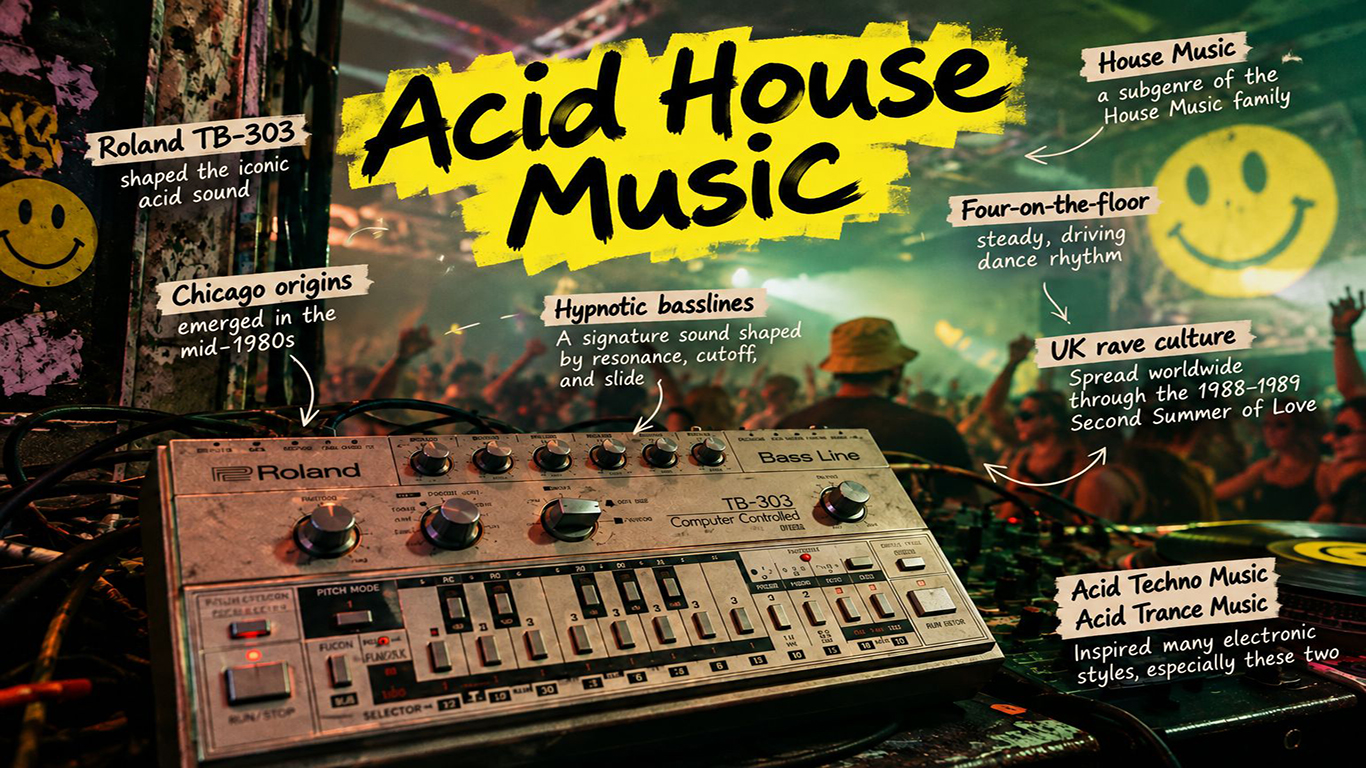
Acid House Music: What It Is, History, Sound, and Culture
Acid House Music is a branch of House Music best known for the rippling, squelching bass patterns of the Roland TB-303. Repeated sequences, sharp filter sweeps, and four-on-the-floor rhythms made it distinctive in Chicago clubs before it helped soundtrack the UK's late-1980s rave movement.
The term acid describes a recognizable approach to electronic sound, not a precise tempo or a rule that every track must use one particular machine.
What Is Acid House Music?
The classic Acid House arrangement places a sequenced, constantly changing bass figure over a steady dance groove. Rather than relying on elaborate chord progressions, producers build movement by manipulating a short pattern: its notes repeat while filter cutoff, resonance, accents, and slides make each pass feel different.
The Sound and Rhythm of Acid House
A four-on-the-floor kick often anchors the groove, with claps, snares, hi-hats, and other drum-machine percussion forming a repeating 4/4 pattern. Many classic tracks sit roughly around 120–130 BPM, though slower and faster examples exist. Tempo alone cannot establish whether a track is Acid House.
The best-known sonic feature is a resonant, sliding TB-303-style bassline. Turning the filter cutoff and resonance creates a changing, sometimes vowel-like tone; programmed accents and slides give the sequence its bouncing, elastic character. Some tracks add short vocal samples or atmospheric effects, while others stay almost entirely instrumental.
The History of Acid House Music
Chicago, Phuture, and the Roland TB-303
Roland introduced the TB-303 Bass Line in 1981 as an electronic accompaniment tool intended to simulate bass parts for musicians practicing or performing without a bassist. It did not become a major success in that original role. Its second life began when dance producers explored the unusual sounds available from its sequencer and resonant filter.
In Chicago, Phuture; Nathan "DJ Pierre" Jones, Earl "Spanky" Smith Jr., and Herbert "Herb J" Jackson; experimented with the TB-303 in the mid-1980s. Their track, initially known as "In Your Mind," reached DJ Ron Hardy, who played the tape at the Music Box club around 1985. After circulating within the local scene, a version produced with Marshall Jefferson was issued by Trax Records in 1987 as "Acid Tracks." It became a defining release in the history of Acid House.
Phuture was central to the genre's identity, but it is more accurate to describe the beginnings of the style as an evolving Chicago scene rather than the work of one producer alone. Its emergence took place within the wider tradition of Chicago House Music.
From Chicago to Britain: The Second Summer of Love
Imported American House records found receptive listeners in Britain during the late 1980s. DJs including Danny Rampling, Paul Oakenfold, and Nicky Holloway drew inspiration from the eclectic Balearic club atmosphere they experienced in Ibiza in 1987. At the same time, DJs and venues in Manchester and elsewhere; including Mike Pickering and the Haçienda; helped develop Britain's distinct House scene.
The Second Summer of Love, especially 1988–1989, brought Acid House and related dance music into much wider British visibility. Clubs, warehouse parties, and outdoor raves attracted large crowds. The yellow smiley face became a recognizable symbol; loose-fitting clothes and dance-floor-focused fashion became associated with parts of the scene.
Some unlicensed events used recorded telephone information lines, meeting points, and convoys to communicate their locations, but not all Acid House parties were illegal. Tabloid concern, policing, and later legislation shaped the movement's public image. In particular, major legislation targeting certain rave gatherings came after the initial 1988 explosion; the UK's Criminal Justice and Public Order Act was passed in 1994.
British producers developed their own variations rather than simply replicating Chicago records. A Guy Called Gerald's "Voodoo Ray" (1988) is an influential example of the UK's early Acid House-era sound.
How Acid House Music Is Made
The classic style centers on a limited set of sounds, carefully sequenced and changed over time. Early recordings used standalone hardware, analog mixing, and recording equipment; modern DAWs and software emulations are contemporary production options, not the core toolkit of Phuture's original mid-1980s sessions.
Essential Acid House Instruments and Techniques
| Equipment or technique | Role in Acid House |
|---|---|
| Roland TB-303 | Monophonic bass sequences with distinctive filter sweeps, resonance, programmed accent, and slide |
| Roland TR-707 / TR-727 | Digital-sample-based drum and percussion machines associated with early Chicago Acid House, including Phuture's recordings |
| Roland TR-808 / TR-909 | Influential drum machines widely used across House and related club music; not required for every Acid House track |
| Sequencers, mixers, and tape recording | Pattern repetition, live level or filter changes, and assembling early hardware-based tracks |
| Modern synths and DAWs | Current ways to create, automate, record, and arrange 303-style sounds |
A practical Acid House production pattern is straightforward:
- Program a short bass sequence: Repeat a pattern, adding rests, slides, and accents for rhythmic variation.
- Shape the tone: Adjust low-pass filter cutoff and resonance as the sequence plays. The movement of the filter is as important as the notes themselves.
- Build the drum groove: Layer a steady kick with claps or snares and syncopated hats or percussion.
- Evolve the arrangement: Introduce or remove layers and vary the filter gradually to create tension over extended passages.
A hardware TB-303 is historically important, but it is not a requirement for producing Acid House today.
Acid House and Related Electronic Music Styles
Acid House belongs to the House Music Family in the site's taxonomy, alongside styles such as Deep House Music and Chicago House Music. The word acid also appears in related but separately classified styles:
- Acid Techno Music: Uses 303-like filter modulation within a more Techno-focused rhythmic and production approach. It belongs to the Techno Music Family, alongside Techno Music.
- Acid Trance Music: Brings acid-style sequences into Trance-oriented patterns and arrangements. It belongs to the Trance Music Family, alongside Trance Music.
- Psychedelic Trance Music: Often includes resonant electronic sequences but is its own Trance branch, not a subgenre of Acid House.
- Big Beat Music: Part of the Breakbeat Music branch in the site's Electro and Breakbeat Music Family; some Big Beat productions incorporate acid-like synth sounds, though these do not define the entire style.
Acid timbres can also appear in other genres without making every track an Acid House track. It is safer to describe specific sounds and production techniques than to attribute entire later artists' discographies to a single instrument.
Why Acid House Music Still Matters
Acid House helped popularize the idea that repeating electronic sequences can evolve dramatically through live timbral control. Its sound connected the Chicago underground to a major British dance-culture movement, and its bass synthesis techniques remain available through modern instruments and software.
Conclusion
Acid House Music is both a specific House style and a chapter in electronic dance culture. Its identity rests in the interplay between rhythm, repetition, and the expressive TB-303 sound; not in a single BPM range, a myth about one invention, or a claim that all subsequent electronic music descended from it.
Related Questions And Answers
- • What is Acid House Music?Acid House Music is a form of House Music known for hypnotic, resonant bass sequences associated with the Roland TB-303 and repetitive club-oriented rhythms.
- • Where did Acid House Music originate?Acid House emerged from Chicago's House Music scene in the mid-1980s, with Phuture among its defining early groups.
- • Who pioneered Acid House Music?Phuture, founded by DJ Pierre, Spanky, and Herb J, helped define the sound; DJ Ron Hardy championed their early track, and Marshall Jefferson produced its 1987 release.
- • What is the Roland TB-303?The Roland TB-303 Bass Line is a programmable monophonic bass synthesizer introduced in 1981 that became central to Acid House through its resonant filter, sequencer, accent, and slide functions.
- • What makes the Acid House sound distinctive?Sweeping resonant filters, sliding and accented TB-303 notes, repeating bass patterns, drum-machine beats, and gradual changes in texture are hallmarks of Acid House.
- • What BPM is Acid House Music?Many classic Acid House tracks run roughly between 120 and 130 BPM, but the style is not defined by a fixed tempo range.
- • What is four-on-the-floor in Acid House?Four-on-the-floor places a kick drum on each quarter-note beat in a 4/4 measure, providing a steady dance pulse.
- • When was Phuture's Acid Tracks released?Phuture's Acid Tracks circulated on tape in the Chicago club scene around 1985 and was officially released on Trax Records in 1987.
- • Who was Ron Hardy?Ron Hardy was an influential Chicago DJ whose plays of Phuture's early Acid Tracks tape at the Music Box helped establish its audience.
- • What instruments were used in early Acid House?Early Acid House relied on sequenced synthesizers such as the TB-303, drum machines including the TR-707, TR-727, TR-808, and TR-909, and recording or mixing equipment.
- • How do you make an Acid House bassline?Program a repeating TB-303-style sequence, combine accented and sliding notes, and automate filter cutoff and resonance while arranging it around a dance beat.
- • Does Acid House require a TB-303?No. The TB-303 defined the classic sound, but modern hardware, synthesizers, and software emulations can produce similar acid-style basslines.
- • How is Acid House different from Chicago House?Chicago House is the broader scene and foundational style; Acid House is a related form distinguished especially by resonant, evolving 303-style basslines.
- • How is Acid House different from Acid Techno?Acid House usually follows House-oriented rhythms and groove, while Acid Techno uses comparable acid synthesis within more driving Techno-oriented structures.
- • What was the Second Summer of Love?The Second Summer of Love refers to the British dance-culture explosion of 1988 and 1989, associated with Acid House, clubs, and large rave gatherings.
- • How did Acid House spread to the UK?Imported Chicago records, DJs, club nights, the Balearic club influence of Ibiza, and UK producers helped Acid House reach British audiences in the late 1980s.
- • What does the smiley face mean in Acid House?The yellow smiley face became a widely recognized visual symbol of the late-1980s British Acid House and rave scene.
- • Is Acid House still influential?Yes. Its resonant, modulated bass sound continues to appear in Acid Techno, Acid Trance, and other electronic styles.
- • Is Acid House a subgenre of House Music?Yes. Acid House is categorized under House Music and shares its club-oriented rhythmic roots.
- • What is the connection between Acid House and Psychedelic Trance?Both may feature rapidly modulated, resonant synthesizer sequences, but Psychedelic Trance is a distinct branch of Trance Music.