




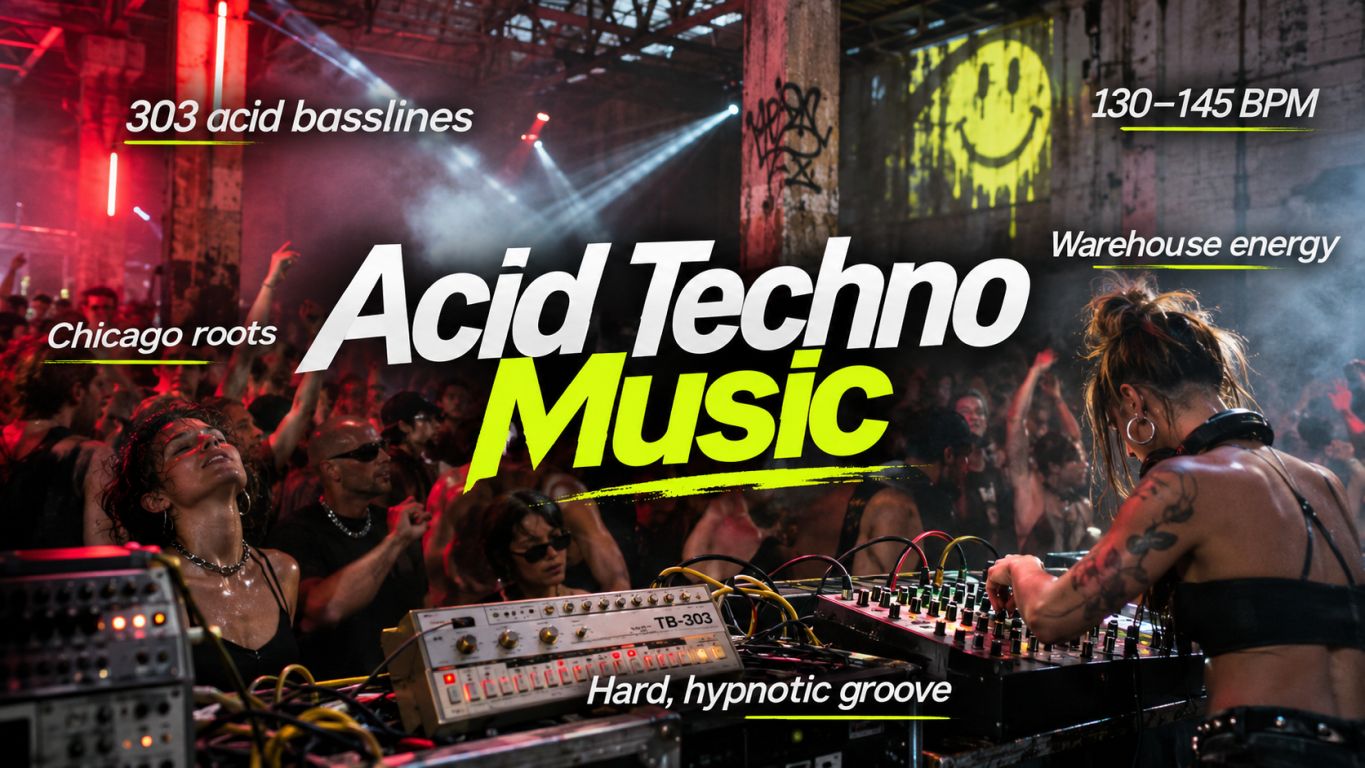
Acid Techno Music is a techno genre built around driving drums and repeating synthesizer patterns that change shape as they play. Its signature is the sharp, rubbery, sometimes snarling sound associated with the Roland TB-303: a few notes, lots of filter movement, and considerably more attitude than the note count suggests.
The style connects the acid sound of Chicago house with harder techno and rave traditions. One of its most influential scenes emerged in 1990s London, where free-party crews turned abrasive acid sequences into long, high-energy dance records.
What makes acid techno sound like acid techno?
Most acid techno has a strong kick-driven pulse, active hi-hats, and a bass or lead sequence that repeats while its tone keeps changing. Rather than constantly introducing new melodies, a producer might transform the same short phrase for several minutes.
The defining ingredients often include:
- Tempo: commonly around 130-145 BPM, with harder examples sometimes reaching 150 BPM or more.
- Drums: steady four-on-the-floor kicks, sharp hats, rides, and percussion designed for continuous momentum.
- Acid sequence: a short, repeating synth line with slides, accents, and tightly controlled note lengths.
- Movement: filter cutoff, resonance, and distortion changes that turn the sequence from restrained to aggressive.
- Arrangement: extended builds, breakdowns, and shifts in texture rather than a new hook every eight bars.
These are tendencies, not entrance requirements. A fast track with distortion is not automatically acid techno, and a single squelchy bass sound cannot do all the classification work.
From Chicago acid house to London's free parties
The familiar acid-synth language took off in 1980s Chicago, especially through Phuture's "Acid Tracks." The group used the TB-303's unusual sequencing and filter behavior to create a sound that became central to Acid House Music. Its sliding notes and shifting resonance became a vocabulary that producers carried into techno, trance, and other dance styles.
Acid sounds soon spread into techno, rave, and trance scenes across Europe. In London during the early and mid-1990s, squat parties and independent sound-system culture helped shape a tougher, faster interpretation. The Liberator DJs; Chris, Aaron, and Julian; founded Stay Up Forever in 1993 to release the music they wanted to play at those events. That independent label became a hub for producers and DJs developing the London acid-techno sound.
Artists including D.A.V.E. The Drummer, Geezer, and DDR helped develop the London sound alongside labels such as Routemaster and Smitten. This was as much a do-it-yourself network of parties, producers, and records as it was a production formula. A synthesizer does not organize a warehouse party by itself.
London was not the only place where acid and techno met. It was, however, a particularly influential home for the sound many listeners now associate with London acid techno.
What does the Roland TB-303 actually do?
Roland designed the TB-303 Bass Line as an electronic bass accompaniment device. Its commercial life as a substitute for a bass player was limited; its second life as an acid instrument was rather more successful.
Three features explain much of its appeal:
- Slide connects notes with a pitch glide instead of a clean jump.
- Accent makes selected steps hit harder and interact differently with the synth's sound-shaping controls.
- Filter cutoff and resonance change which frequencies stand out, producing the familiar squelch or scream as the pattern repeats.
Distortion and delay can add aggression or depth, but the crucial trick is variation within repetition. You can make convincing acid sequences with a software instrument or another synthesizer. Owning an original 303 is an option, not a musical qualification.
Acid techno vs acid house and hard techno
Acid House Music and acid techno share the 303-derived sound. Acid house generally places it in a house groove; acid techno often uses a firmer, faster techno foundation and longer stretches of intense rhythmic pressure. There is substantial overlap, especially in records that crossed between late-1980s and 1990s club scenes.
Hard Techno Music can be similarly forceful, but it does not require the distinctive resonant acid sequence. Acid techno and hard techno are separate primary genres within the Techno Music Family. Some recordings comfortably sit near both labels, and Acid Trance Music is another neighboring sound with its own rhythmic and melodic priorities.
The most useful test is to listen beyond the synth patch: how do the drums, sequence, arrangement, and overall energy work together? BPM alone will not settle the argument.
Where to start listening
For the story of the acid sound, begin with Phuture - "Acid Tracks." It is an acid-house landmark rather than a London acid-techno record, and hearing it first makes the later changes easier to recognize.
Then move into the London catalog:
- A+E Department - "The Rabbit's Name Was...": an early Stay Up Forever record that captures the scene's rough, playful approach.
- Dynamo City - "One Night in Hackney": a later example of the label's unapologetically direct warehouse energy.
- Stay Up Forever releases by the Liberator network and D.A.V.E. The Drummer: compare how different producers push a looping acid line through long club arrangements.
Listen for when the bassline's notes stay put but its tone changes. That is often where the real action is.
How to make a basic acid techno groove
Start at 140 BPM in 4/4 with a firm kick on every beat and simple offbeat hats. Program a short 16-step bass sequence using only a few notes. Add slides between selected notes and accents on a handful of steps; the pattern should already have character before any effects arrive.
Over the next 16 or 32 bars, gradually open the filter cutoff, increase resonance with care, and introduce a controlled amount of distortion. Bring in a ride cymbal or additional percussion as the intensity grows. Pull the acid line out briefly, then return it with a different filter setting.
Keep the kick and bass distinct, particularly below the low mids. More distortion can sound louder while making the groove less clear. The goal is tension and motion, not a competition to see which frequency reaches the limiter first.
Why the sound lasts
Acid techno turns repetition into development. A handful of notes can carry an entire arrangement when their articulation, tone, and relationship to the drums keep evolving. That simple idea has outlived several generations of studio equipment; and gives producers plenty of room to keep making it their own.