




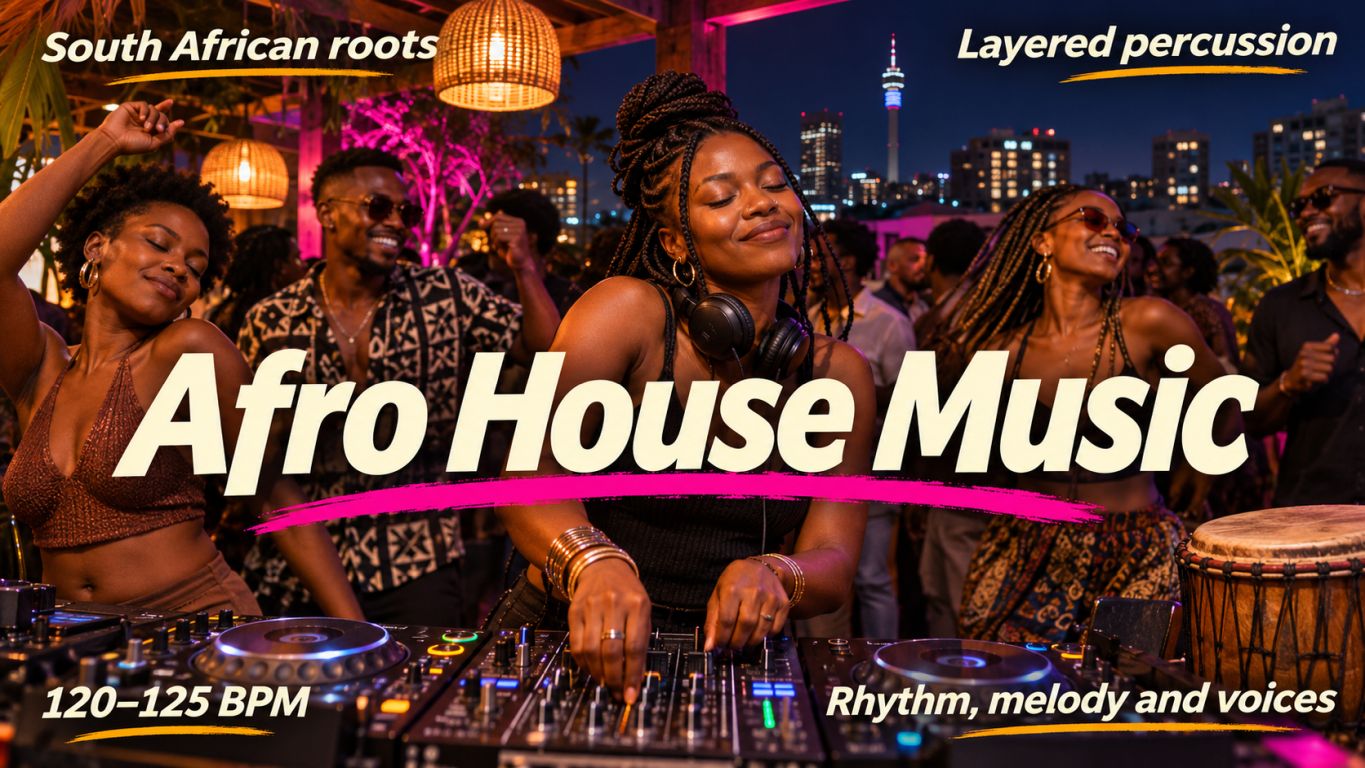
An Afro house track can keep the same kick drum going for minutes and still sound as if the rhythm is constantly changing. The trick is everything happening around that kick: shakers, hand percussion, bass, voices, and small accents that pull against the main pulse.
Afro House Music is a branch of House Music with particularly important roots in South Africa. It combines dance-floor repetition with rhythmic detail and often a strong sense of melody or vocal storytelling. It is not simply house music with a conga sample. A sample pack can supply the drum; it cannot supply the musical history.
Where did Afro house come from?
South Africa's relationship with House Music reaches back to the late 1980s and 1990s, when DJs and audiences developed local scenes around records arriving from the US and elsewhere. Those sounds met South African musical preferences, including the bass-heavy, slower dance language of kwaito, as well as soulful and deep-house traditions.
By the 2000s, producers were developing increasingly distinctive local approaches. Black Coffee, Culoe De Song, and others brought intricate arrangements and South African voices to a wider audience. Earlier DJs and producers, including Oskido, DJ Christos, and Vinny Da Vinci, had already helped establish the country's house culture. The story starts before the names most international festival audiences know.
Afro house was shaped by a network of DJs, producers, dancers, clubs, and radio audiences rather than by one inventor. The music later travelled widely, but its international popularity did not erase those South African foundations.
What does Afro house sound like?
The most recognizable feature is the relationship between a steady pulse and percussion that moves around it. In a common 4/4 groove, the kick lands on every quarter-note beat; often called four-on-the-floor. Shakers, claps, toms, and other sounds create movement between those beats.
| Element | What to listen for |
|---|---|
| Tempo | Often around 120-125 BPM; not a fixed rule |
| Kick and bass | A dependable low-end pulse, with bass notes that answer rather than simply copy the kick |
| Percussion | Interlocking, syncopated patterns that add momentum without necessarily speeding up |
| Melody | Repeating chords, atmospheric textures, and motifs that may develop slowly |
| Vocals | Anything from fully instrumental music to prominent singing, chants, and spoken phrases |
| Arrangement | Gradual layering, long transitions, and changes that reward close listening |
Those tempo figures are a practical guide rather than a border checkpoint. A track does not change genre because a producer moves the tempo by two beats per minute.
Why rhythm matters more than a drum preset
Listen to two percussion parts separately. One might fill the spaces between kicks; the other might repeat a longer phrase that only resolves after several beats. Together they create tension and release while the underlying pulse remains stable.
But percussion is not the whole identity. Bass placement, harmonic movement, vocals, language, and musical context can be just as important. Afro house includes warm, soulful recordings, darker club music, and highly melodic arrangements. No single hand drum or synthesizer is compulsory.
Afro house vs Afro tech, amapiano, and Afrobeats
These names are frequently mixed up, partly because artists collaborate and borrow ideas across scenes. The distinctions are still useful.
| Style | Main distinction |
|---|---|
| Afro house | The broader house-derived style, ranging from soulful and vocal to percussion-driven and atmospheric |
| Afro Tech Music | Often more synthetic, driving, and tension-focused; overlaps with Afro house |
| Afro Melodic House Music | Emphasizes recognizable melodies, evolving chords, and an expressive harmonic arc |
| Amapiano Music | A separate South African dance style strongly associated with log-drum bass, spacious keys, and distinctive rhythmic approaches |
| Afrobeats | A broad contemporary West African popular-music field, not another name for Afro house |
Afrobeats is also not the same term as Afrobeat, the older style associated with artists including Fela Kuti. Similar names do not make these genres interchangeable. For another South African rhythmic offshoot within the Afro house branch, explore 3Step Music, which often plays with a three-kick pattern inside a four-beat bar.
Three recordings worth hearing
1. Black Coffee featuring Bucie - "Superman" (2009). From Home Brewed, this is an approachable entry into the songwriting and vocal side of South African house. Notice how the vocal sits naturally inside a repetitive, club-friendly arrangement.
2. Culoe De Song featuring Busi Mhlongo - "Webaba" (2009 album version). Listen for the relationship between the performance, percussion, and gradual development across the arrangement.
3. Da Capo featuring Berita - "Found You" (2017). A useful contrast that brings the melody and vocal narrative further forward. It also offers a bridge into the more melody-led corner of Afro house.
These are listening routes, not a claim that three songs can summarize an entire continent's dance-music culture.
How to build a simple Afro house groove
Start a project around 122 BPM with a four-on-the-floor kick. Add one shaker pattern that keeps time and another percussion phrase that accents the gaps. Try altering velocity and timing slightly so the layers do not sound as if they have all been photocopied onto the same grid.
Next, write a short bassline that responds to the kick rather than landing on every hit. Introduce a chord or vocal phrase, then develop the arrangement over 16 or 32 bars by adding and removing parts. The groove should still be interesting when the main melody disappears.
Finally, compare your sketch with actual recordings. Pay attention to the choices those musicians make, not just which instruments they use. When working with recorded performers or sampled material, credit collaborators and clear the necessary rights.
The bigger picture
Afro house is recognizably House Music, but its rhythmic language and musical history go well beyond a standard club beat. The most useful way to understand it is to hear how South African artists; and the wider scenes in conversation with them; make rhythm, melody, and voices work together. Once you hear those interactions, the genre label becomes a starting point rather than the whole explanation.