




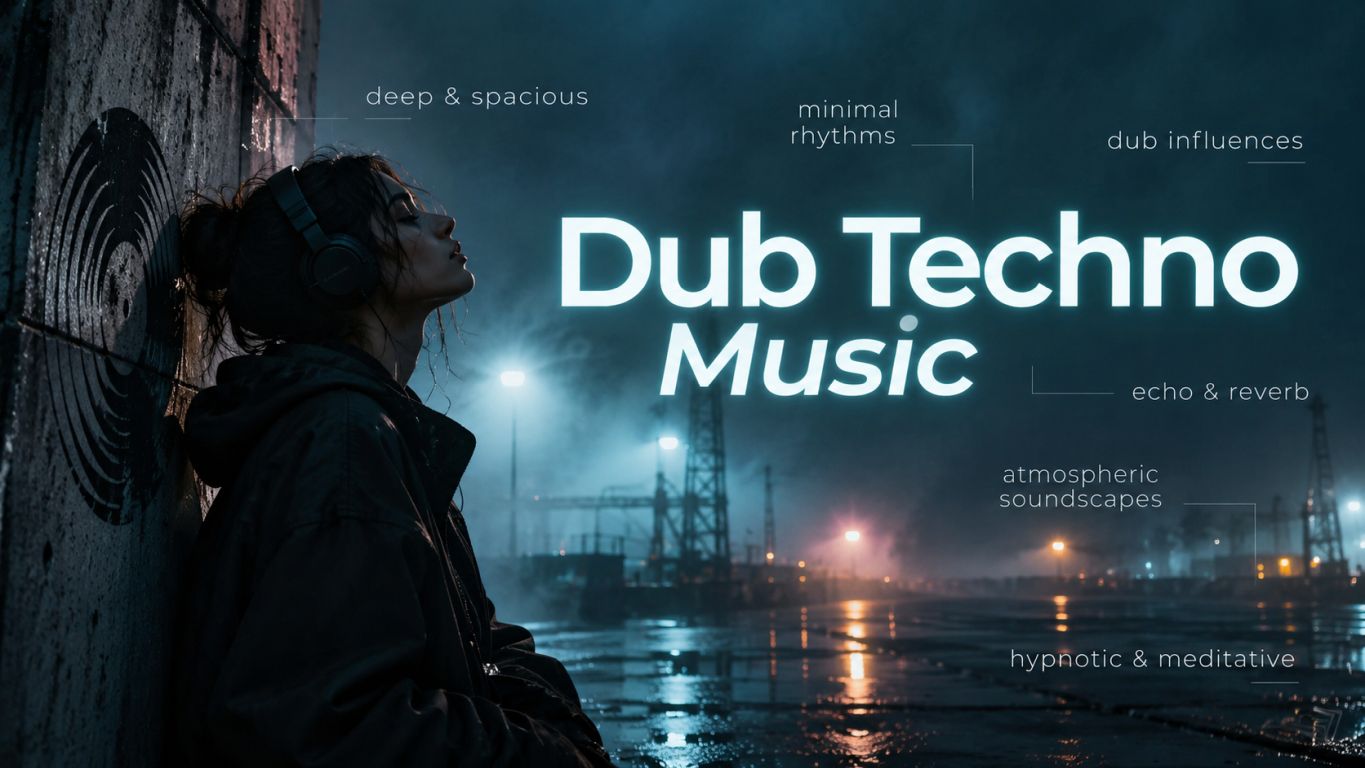
A steady kick drum, deep bass, and distant chords that dissolve into endless echoes. Dub Techno Music turns a handful of sounds into an immersive, hypnotic experience.
Combining the rhythmic foundation of Techno Music with the echo-heavy production techniques of Jamaican Dub Music, the genre favors atmosphere and repetition over dramatic drops or complex melodies.
Where Did Dub Techno Originate?
Dub Techno emerged in Berlin during the early 1990s, influenced by Detroit techno and Jamaican dub.
Its defining pioneers were Moritz von Oswald and Mark Ernestus, who founded Basic Channel in 1993. Their recordings used stripped-down beats, heavily processed chords, and long, evolving echoes to create a distinctive sound.
The duo's associated Chain Reaction label helped expand this approach, introducing artists who explored deeper, darker, and more experimental variations.
Basic Channel's influence remains central to Dub Techno, particularly its philosophy of creating complexity through sound processing rather than adding more musical elements.
What Does Dub Techno Sound Like?
Dub Techno is recognizable through a few characteristic elements:
- Deep bass: Warm, repetitive basslines that provide weight beneath the rhythm.
- Hypnotic beats: Steady four-on-the-floor kicks with restrained percussion.
- Dub chords: Short, filtered synthesizer chords surrounded by delay and reverb.
- Spacious textures: Echoes, subtle noise, and reverberation that create depth.
- Gradual evolution: Small changes in filtering and effects instead of dramatic transitions.
Its signature sound often comes from a simple chord repeating through a delay. As the echoes overlap and filters slowly change, the texture evolves even though the underlying notes remain the same.
What BPM Is Dub Techno?
Dub Techno typically ranges from approximately 118 to 128 BPM, with many productions around 120-125 BPM.
The genre usually follows a four-on-the-floor rhythm, meaning the kick drum plays on every quarter-note beat in 4/4 time.
Compared with faster, more aggressive forms of techno, Dub Techno often feels slower and more spacious. Its restrained rhythm leaves room for long echoes and atmospheric textures.
For producers, 123 BPM is a practical starting point, although tempo alone does not determine whether a song belongs to Dub Techno.
Essential Dub Techno Artists
Several influential projects helped define and expand the genre:
- Basic Channel: The Berlin pioneers whose minimal rhythms and atmospheric processing established the style.
- Porter Ricks: Known for darker, abstract textures and the influential album Biokinetics.
- Fluxion: Creates deep, fluid productions with warm bass and immersive atmospheres.
- DeepChord: Rod Modell's project, recognized for spacious reverberation and slowly evolving textures.
- Echospace: A collaboration between Rod Modell and Stephen Hitchell, exploring the atmospheric boundaries between dub and ambient Electronic Music.
These artists illustrate Dub Techno's range, from hypnotic club rhythms to deeply atmospheric compositions.
Dub Techno vs. Minimal and Ambient Techno
Dub Techno shares repetition and stripped-down arrangements with Minimal Techno Music, but places greater emphasis on echo, deep bass, and atmospheric effects.
Ambient Techno Music also uses immersive textures, although its rhythms may be softer or less prominent. Dub Techno generally retains a stronger connection to dub-style processing and steady techno grooves.
The boundaries overlap, but Dub Techno's combination of rhythm, bass, and evolving spatial effects gives it a recognizable identity.
How Is Dub Techno Produced?
Dub Techno production often begins with a simple drum pattern, deep bassline, and short synthesizer chord.
The chord is filtered to soften its tone, then processed with delay and reverb to create repeating echoes. Gradual automation changes the filter cutoff, feedback, or reverberation, making the sound evolve over time.
Analog equipment helped shape the genre's early recordings, but modern software can achieve similar results.
The guiding principle is simple: use fewer sounds, but give each one room to develop.
The Lasting Appeal of Dub Techno
Dub Techno proves that repetition does not have to mean stagnation. A familiar rhythm can feel entirely different as chords fade, echoes overlap, and textures gradually transform.
Its combination of hypnotic grooves and immersive sound design continues to connect the dancefloor with atmospheric Electronic Music.