




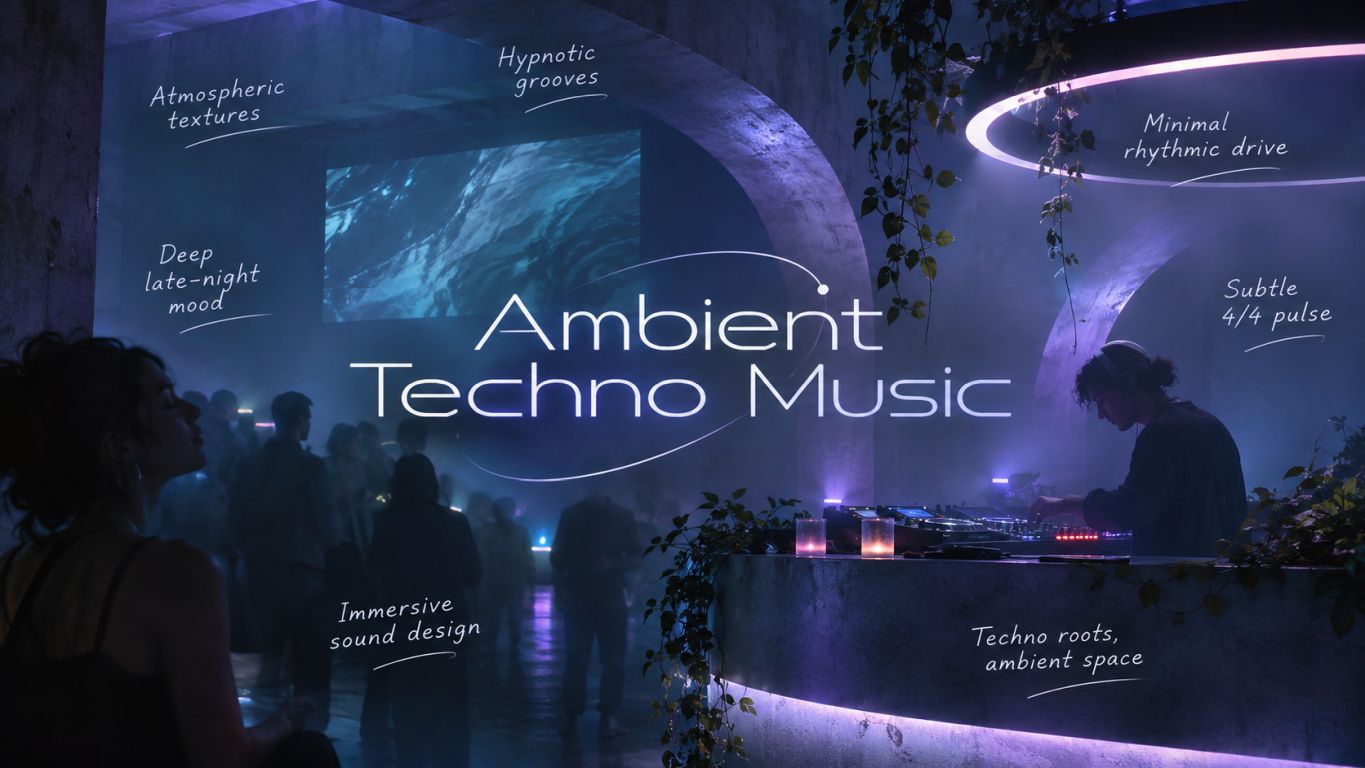
Some techno tracks announce every change with a crash, a riser, and an urgent request for your attention. Ambient Techno Music takes a different approach. A melody can drift for minutes while a small drum pattern quietly keeps everything moving. The details matter more than the announcement.
Ambient techno brings the rhythm and sequencing of Techno Music into the spacious world of atmospheric Electronic Music. It may be calm, eerie, warm, or strangely mechanical. What holds it together is the interaction between repetition and evolving texture; not a specific synthesizer, mood, or BPM.
What does ambient techno sound like?
Imagine a soft machine pulse beneath a slow-moving chord. Short synthetic notes repeat, but their filter tone, timing, or position in the mix changes almost imperceptibly. A bass note appears, recedes, and leaves space for a distant melody. You can follow the groove or forget about it for a while; the music works either way.
| Element | What to listen for |
|---|---|
| Rhythm | Drum-machine patterns, broken beats, or gently repeating sequencer pulses |
| Bass | Rounded electronic low notes that support rather than crowd the arrangement |
| Harmony | Long pads, minor-key melodies, drifting chords, and sustained tones |
| Texture | Filtered noise, sampled fragments, subtle modulation, and small details |
| Effects | Reverb and delay used to suggest depth and distance |
| Arrangement | Slow changes in color, density, and phrasing rather than constant drops |
These are tendencies, not admission requirements. A track with a firm kick can be ambient techno; so can a sparse piece in which rhythmic sequences do most of the work.
What BPM is ambient techno?
There is no standard ambient-techno tempo. Some quieter productions fall around 100-125 BPM, but influential recordings also use quicker beats, syncopation, or pulses that are difficult to count. BPM can tell you how rapidly events repeat. It cannot tell you whether a track feels spacious.
A 120 BPM kick can seem unhurried when the hats are quiet and the chords take several bars to change. Conversely, a nearly beatless sequence may feel tense because of its sound design. In this genre, perceived pace often matters more than the number in the project settings.
Where did ambient techno come from?
Ambient techno took shape around the early 1990s, when electronic musicians were exploring ways to use dance-music equipment outside a strictly dancefloor setting. Detroit techno and electro provided rhythmic and melodic foundations; experimental Ambient Music offered a different sense of space and duration.
In the UK, producers associated with B12, The Black Dog, and early Aphex Twin made recordings that combined programmed beats with intricate synthetic melodies. The electronic-listening approach gained visibility through labels such as Warp and the 1992 Artificial Intelligence compilation. That project was part of a broader conversation about Electronic Music that rewarded concentrated listening as much as physical movement.
This was not a single invention or a neat replacement for club techno. Artists moved between dance tracks, abstract experiments, and deeply melodic pieces. Later labels such as intelligent techno and IDM overlapped with parts of the scene, but neither is a perfect synonym for ambient techno.
Three ambient techno records worth hearing
There is no definitive playlist that settles a genre with blurred edges. These albums make a useful starting route because they emphasize different sides of the sound.
- Aphex Twin - Selected Ambient Works 85-92 (1992). Start with "Xtal" for softened rhythmic motion and suspended melody, then hear how other tracks shift between atmospheric listening and more direct techno energy. Not every piece on the album occupies the same stylistic space.
- B12 - Electro-Soma (1993). Listen for Detroit-influenced chords, detailed sequencing, and the way a clear drum pattern can support unusually spacious electronic arrangements. "Basic Emotion" is a useful entry point.
- The Black Dog - Temple of Transparent Balls (1993). This is a more intricate, sometimes less immediately inviting side of early-1990s electronic listening music. Its rhythms and textures reward attention rather than providing instant background comfort.
Listen once for the drums, once for the sustained sounds, and once for what changes without drawing attention to itself. The third pass is often where the interesting work happens.
Ambient techno vs ambient music, ambient house, and dub techno
The names overlap, but each points to a different center of gravity.
Ambient Music is broader. It can be beatless and may rely entirely on texture, sustained tones, or environmental sound. Ambient techno generally retains some relationship to techno's rhythmic patterns, sequencing, or sound palette; even when the drums are almost absent.
Ambient House Music grew in part from UK house and chill-out culture. It may feature house rhythms, sampling, dub effects, and long-form sound collage. Ambient techno tends to emphasize machine sequences and techno-derived melodic structures, although an individual track may fit both descriptions.
Dub Techno Music often builds its identity around repeating chord stabs, delays, and a deliberately spacious groove. Ambient techno can use those tools too, but its arrangement need not revolve around dub-style echoes. A long reverb tail is not a genre certificate.
The distinction from club-focused techno is mostly one of musical priority. In a driving techno track, atmosphere may serve the rhythm. In ambient techno, rhythm often serves the atmosphere.
How to make ambient techno without making everything blurry
You do not need vintage hardware or a wall of expensive synthesizers. Try this compact production exercise:
- Establish a pulse. Set a project to 116 BPM. Program a soft kick, a restrained hat, or a repeating eight-step sequence. Choose one clear rhythmic idea rather than a full drum kit competing for space.
- Write a short melodic figure. Use three to five notes, with pauses. Repeat it for eight bars, then change one note or its timing. Small variations become noticeable when the arrangement is deliberately sparse.
- Build an evolving pad. Hold one or two chords with a slow attack. Automate a filter or gentle modulation over 16 bars so the texture gradually changes without demanding a new chord every few seconds.
- Separate depth from mud. Keep the kick and main bass relatively clear. Use longer reverb on selected upper-register sounds and remove unnecessary low frequencies from reverb returns.
- Arrange by subtraction. Remove the drums for a passage but keep the sequence moving. Bring the pulse back quietly; the return need not resemble an emergency announcement.
As a test, lower the volume and listen for three identifiable layers: pulse, melody, and atmosphere. If they merge into one indistinct cloud, reduce effects or simplify the arrangement. Spacious music still benefits from contrast.
Why the style keeps its appeal
Ambient techno gives listeners something to follow without insisting that they follow it constantly. The best pieces balance recognizable patterns with textures that change just enough to invite another listen. Start with the early recordings, notice the detail behind the rhythms, and let the music take its time. That is usually where it becomes interesting.