


Bass House Music
Explore Bass House Music, an Electro House Music subgenre rooted in the early-2010s UK scene, known for heavy distorted bass, wobbling basslines, and house grooves.
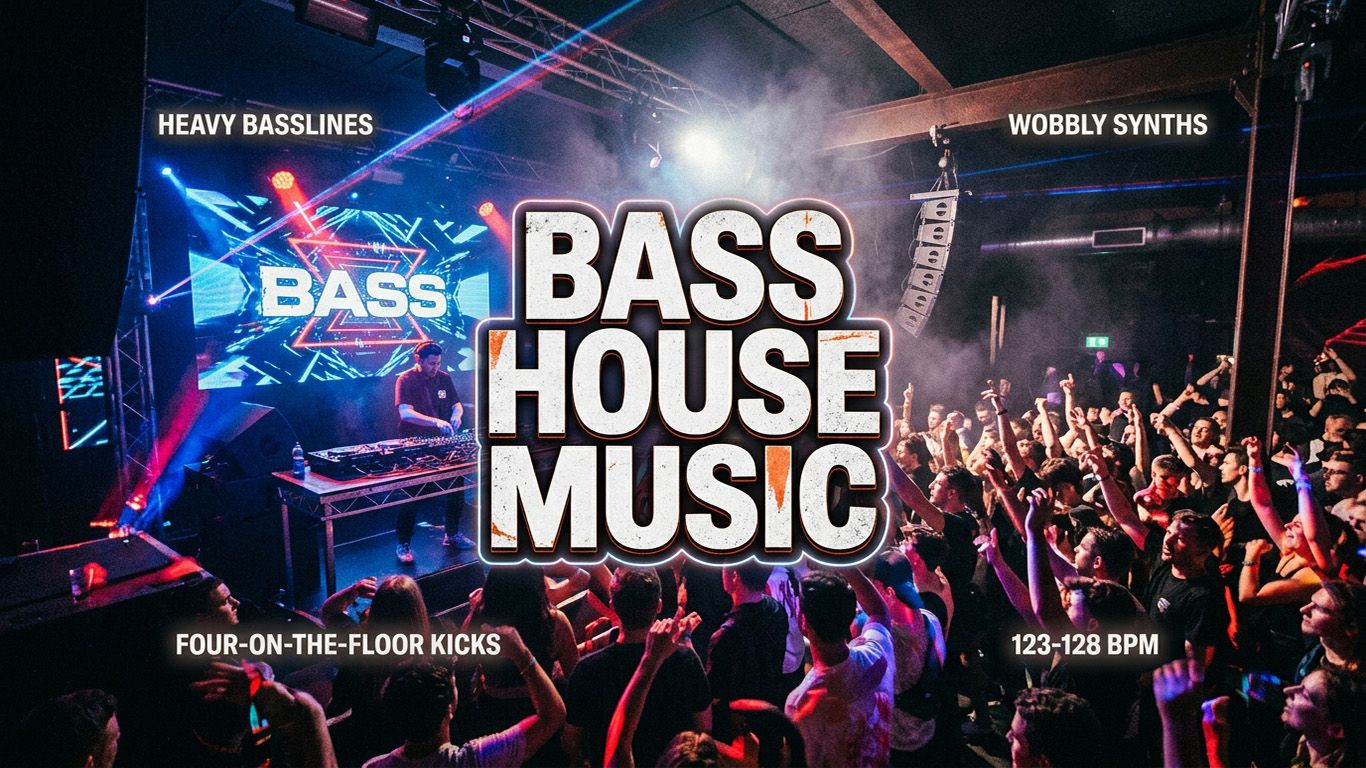
What Is Bass House Music?
Bass House Music is a bass-driven subgenre of Electro House Music in the house music family. Emerging from the United Kingdom in the early 2010s, it blends house grooves with the heavy, distorted basslines and wobbling low-end textures associated with UK Bass Music and Dubstep Music. The bass often becomes the track's main rhythmic hook.
The style shares house music's dancefloor pulse but takes a more aggressive approach to sound design. Growling bass stabs, short rhythmic pauses, clipped vocal phrases, and dramatic drop sections are common, though not every track uses all of them.
Origins and Development
Bass House Music originated in the United Kingdom in the early 2010s. It developed as a bass-heavy approach to house, combining driving dance grooves with distorted bass and wobble sounds associated with UK Bass Music and Dubstep Music. It also has stylistic connections to Fidget House Music, with its pitch-bent synths and stutter edits, and to Bassline Music, with its bouncy UK club bass patterns. These connections describe audible similarities rather than additional parent genres.
Artists associated with Bass House Music include Jauz, Malaa, JOYRYDE, Habstrakt, and AC Slater. The UK roots of the sound preceded its wider international circulation; later scenes and releases helped bring its bass-heavy club style to larger audiences.
Bass House Music did not originate with a single artist or release. It developed through overlapping club scenes and production approaches, eventually reaching both underground venues and large electronic music stages.
Defining Characteristics of Bass House Music
| Element | Typical Bass House Music Approach | What It Contributes |
|---|---|---|
| Tempo | Reference range of 124–128 BPM, not an absolute limit | A driving, dance-oriented pace |
| Kick and percussion | Usually a four-on-the-floor kick with a backbeat and offbeat or shuffled hats; some tracks use breaks | A clear pulse or a more broken club groove |
| Bassline | Heavy, distorted bass riffs, sub-bass weight, and modulated wobble sounds | The central hook and the style’s aggressive low-end character |
| Rhythm | Syncopated bass hits, rests, and call-and-response patterns | Accents between strong beats and rhythmic contrast |
| Vocals | Chopped phrases, short hooks, or sampled shouts | Recognizable accents without requiring a full vocal lead |
| Arrangement | Builds, breakdowns, bass-led drops, and DJ-friendly sections | Tension, release, and mixability |
These are tendencies, not fixed rules. A Bass House Music track can sound stripped-back and club-oriented or louder and more dramatic, depending on its production and arrangement.
How Bass House Music Gets Its Sound
Drums and Groove
A typical drum pattern starts with a kick on each quarter note, with a clap or snare reinforcing beats two and four. Hi-hats, shakers, and percussion add movement around this stable foundation. Swing changes the relative timing of subdivisions, particularly in hats and percussion; syncopation instead places emphasis on normally weaker beats or offbeats. Either can add movement, and neither requires a particular percentage.
The relationship between the kick and bass is especially important. Leaving small gaps in the bass pattern around kick hits can create impact before any processing is applied.
Bass Synthesis and Modulation
Bass House Music often uses wavetable synthesis, frequency modulation (FM), filtering, distortion, and saturation to produce gritty, sometimes vowel-like bass timbres. Wavetable synthesis scans or selects different stored waveforms, while FM changes the frequency of one oscillator using another signal; the two techniques can be combined. Modulating filter cutoff, wavetable position, or FM depth over time creates movement.
Synthesizers such as Serum, Vital, and Massive can create these sounds, but no specific instrument is required. Short envelopes and carefully placed MIDI notes often matter as much as the complexity of the synth patch.
Vocals, Effects, and Transitions
Chopped vocals, pitch-shifted samples, risers, impacts, and noise sweeps can mark transitions between sections. Producers often alternate dense bass passages with brief silences or simpler passages to make the next drop feel heavier.
Arrangement
A common arrangement moves from an intro into a build-up, a bass-led drop, a breakdown, another build-up, and a final drop or outro. In production, a drop is the arrival of a main high-energy section, often after a build-up or break. The section lengths depend on the track: fixed 8-, 16-, or 32-bar templates are useful starting points, not requirements.
Bass House Music and Related Genres
Bass House Music belongs to Electro House Music and shares musical techniques with other bass-focused dance styles. The distinctions below describe their characteristic sounds, not alternative classifications of Bass House Music.
| Genre | Main Emphasis | Difference from Bass House Music |
|---|---|---|
| Electro House Music | Parent genre in the House Music Family | Bass House Music is its bass-heavy subgenre, emphasizing distorted low-end riffs and wobbles. |
| Fidget House Music | Compressed house beats, pitch-bent electro synths, rapid vocal cuts, and stutter edits | A sibling of Bass House Music under Electro House Music, with a stronger emphasis on skittering edits. |
| Tech House Music | Percussion-led, repetitive club grooves | Usually relies less on overtly distorted bass-lead drops. |
| UK Garage Music | The parent genre of Bassline Music in this classification | Distinct from the Electro House Music branch that contains Bass House Music. |
| Bassline Music | Bouncy 4/4 UK club beats, walking basslines, and pop or R&B vocal hooks | A UK Garage Music subgenre, distinct from Bass House Music’s distorted bass wobbles and electro-house placement. |
| Dubstep Music | Bass-heavy electronic production | An influence on Bass House Music’s aggressive low-end sound rather than its parent genre. |
Genre boundaries are not absolute. A producer may borrow techniques from several of these styles within a single track.
How to Produce Bass House Music
For a Bass House Music production, start with the interplay of rhythm and bass rather than focusing only on the loudness of individual sounds.
- Build the drum groove. Start with a four-on-the-floor kick, a backbeat clap or snare, and hats that complement the groove. Choose a kick with enough low-end weight but a clear transient.
- Write a syncopated bass riff. Use short notes, rests, and rhythmic variation. Test the pattern against the kick before adding elaborate processing.
- Design the bass texture. Try wavetable synthesis or FM, envelope-controlled filters, and distortion. Compare the processed sound at matched loudness so added volume does not masquerade as improved tone.
- Manage the low end. A clean sub layer and a more processed mid-bass layer can make mixing easier, but a split at any particular frequency is not mandatory. Check for phase cancellation and unwanted low-frequency buildup.
- Create kick–bass separation. Use arrangement, EQ, and sidechain or volume ducking when needed. Excessive ducking can weaken the groove rather than strengthen it.
- Add contrast and movement. Automate filters, introduce vocal chops or effects selectively, and use breakdowns or short pauses to set up the main drop.
- Check the mix in mono. Keep critical sub-bass energy stable when summed to mono, and use stereo effects more cautiously on higher bass harmonics. Reference tracks at similar playback levels.
The key is balance: a powerful bass hook needs space, timing, and contrast to sound effective on both headphones and club systems.
Why Bass House Music Stands Out
Bass House Music keeps the direct, danceable rhythm of house music while placing complex bass sound design at the center of the arrangement. Its appeal comes from that contrast: a predictable pulse underneath unpredictable bass movement. Whether a track leans toward tight club grooves or dramatic drops, the strongest examples make drums, bass, and arrangement work together rather than competing for attention.
Related Questions And Answers
- • What is Bass House Music?Bass House Music is a subgenre of Electro House Music that blends house grooves with heavy distorted basslines and wobbling bass sounds influenced by UK Bass Music and Dubstep Music.
- • What BPM is Bass House Music?The reference range for Bass House Music is 124–128 BPM; individual tracks may fall outside it.
- • Where did Bass House Music come from?Bass House Music originated in the United Kingdom in the early 2010s, combining house grooves with bass-heavy influences from UK Bass Music and Dubstep Music.
- • Is Bass House Music a type of Electro House Music?Yes. Bass House Music is classified under Electro House Music within the House Music Family.
- • How is Bass House Music different from Tech House Music?Bass House Music generally foregrounds heavily processed bass hooks and forceful drops, while Tech House Music more often emphasizes sustained percussion-and-bass grooves.
- • What instruments are used in Bass House Music?Common elements include electronic kick drums, claps, hi-hats, synthesizer basses, sub-bass, chopped vocals, and transitional effects.
- • How do you make a Bass House Music bassline?Start with a syncopated MIDI rhythm, create a bass patch using wavetable or FM synthesis, and add filtering, saturation, and controlled distortion.
- • How do you mix the kick and bass in Bass House Music?Balance their frequency content and timing, then use sidechain compression or volume ducking when needed so the kick remains clear.
- • Which artists are associated with Bass House Music?Jauz, Malaa, JOYRYDE, Habstrakt, and AC Slater are the representative Bass House Music artists.
- • How is a Bass House Music track arranged?Many tracks use DJ-friendly intros and outros, build-ups, bass-led drops, and breakdowns, but there is no mandatory bar-count formula.