




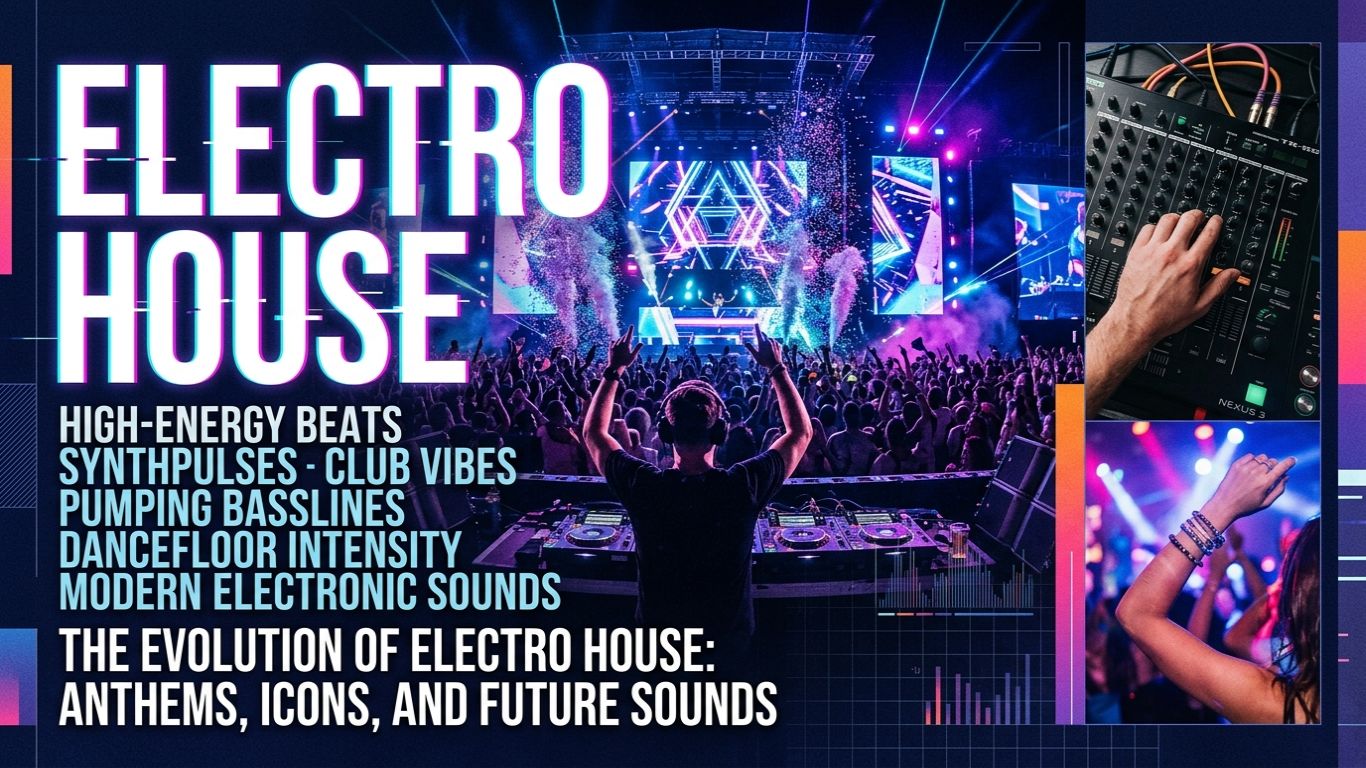
What Is Electro House Music?
Electro house is a genre within the House Music Family, alongside House Music. It combines steady dance rhythms with powerful electronic basslines, distorted synthesizers, and energetic arrangements. Emerging in the early 2000s, it developed into a recognizable style of club music and later influenced the international electronic dance music scene.
The genre places particular emphasis on electronic sound design. Rather than relying primarily on conventional melodies or chord progressions, many tracks build their musical identity around distinctive synthesizer riffs, rhythmic bass patterns, and changes in texture.
Compared with traditional House Music, which often draws on disco, funk, and soul, electro house generally favors more aggressive synthetic sounds and stronger contrasts in intensity. Its arrangements range from relatively minimal, groove-driven club tracks to elaborate productions with dramatic transitions.
Despite its name, electro house should not be confused with Electro Music. While the two styles share electronic influences, electro commonly uses syncopated or broken-beat rhythms, whereas electro house generally retains the continuous four-on-the-floor pulse of House Music.
The genre also connects with several other electronic styles. Its rhythmic foundation comes from house, while its approach to synthesis and arrangement has influenced bass-driven club music, festival-oriented productions, and increasingly complex forms of electronic sound design.
The Characteristic Sound of Electro House
The recognizable character of electro house comes from the interaction between its rhythmic foundation, prominent basslines, synthesizer textures, and changes in musical intensity.
Although individual recordings vary considerably, several musical characteristics appear frequently.
Tempo and Rhythm
Most electro house tracks operate around 125-130 beats per minute (BPM), with 128 BPM particularly associated with the style.
The rhythmic foundation usually follows a four-on-the-floor pattern in 4/4 time, meaning the kick drum plays on every quarter-note beat. Claps or snares commonly emphasize beats two and four, while hi-hats and additional percussion introduce movement.
This consistent pulse provides a stable framework for more elaborate bass and synthesizer patterns.
Tempo alone does not determine the genre. Other house styles and some forms of Techno Music may use similar speeds, so the overall sound and arrangement are more useful identifying characteristics.
Distorted Basslines
One of the most distinctive elements is the prominence of the bassline.
Instead of functioning only as harmonic support, the bass often carries the track's central rhythmic or melodic hook. Short, sharply articulated phrases may alternate with sustained, heavily processed synthesizer tones.
Harmonically rich waveforms, filtering, modulation, and distortion contribute to these sounds. The resulting textures can be buzzing, metallic, growling, or sharply percussive.
The relationship between bass and kick drum is especially important because both elements contribute energy in overlapping low-frequency regions.
Synthesizers and Melodies
Bright electronic leads, repeating arpeggios, and short melodic motifs frequently appear alongside the bassline.
Some recordings rely on simple, memorable riffs, while others incorporate more elaborate melodies and harmonic progressions.
Electronic timbre is often as important as the notes themselves. Changes in filtering, pitch, distortion, and modulation can transform a repeating phrase without altering its underlying melody.
This emphasis on timbre helps distinguish electro house from styles that place greater importance on traditional instrumentation or sustained harmonic development.
Breakdowns, Build-Ups, and Drops
Changes in intensity are an important part of many electro house arrangements.
A breakdown reduces or removes major rhythmic elements, allowing melodic, vocal, or atmospheric sounds to become more prominent.
During a build-up, rising effects, percussion rolls, automation, and additional layers can increase anticipation.
The drop introduces or restores the main rhythmic and bass elements, creating a contrast with the preceding section.
These techniques are common across electronic dance music. In electro house, they frequently highlight the return of a particularly distinctive synthesizer or bass sound.
Earlier club-oriented productions sometimes favor gradual transitions, while later festival-oriented recordings often use more dramatic contrasts.
Key Musical Characteristics
| Element | Common Characteristics | Musical Function |
|---|---|---|
| Tempo | Approximately 125-130 BPM | Establishes rhythmic momentum |
| Kick drum | Four-on-the-floor pattern | Maintains the dance groove |
| Bassline | Distorted, modulated synthesizers | Provides groove and musical identity |
| Lead synthesizer | Bright or aggressive electronic sounds | Creates hooks and melodic contrast |
| Percussion | Claps, snares, hi-hats | Reinforces rhythm and movement |
| Arrangement | Breakdowns, build-ups, drops | Controls tension and release |
| Effects | Distortion, filtering, modulation | Shapes electronic texture |
Electro House Production Techniques
Creating electro house involves more than selecting aggressive synthesizer sounds. Its characteristic impact depends on rhythmic programming, sound design, arrangement, and careful control of the relationship between musical elements.
Many different combinations of software and hardware can produce suitable results.
Creating an Electro House Bass
A common starting point is a harmonically rich waveform, such as a sawtooth or square wave.
Filters, envelopes, distortion, and modulation can then transform the basic oscillator into a distinctive electronic bass sound.
A typical workflow involves:
- Selecting a sawtooth or square-wave oscillator.
- Applying a filter to shape the frequency content.
- Using an envelope or low-frequency oscillator to introduce movement.
- Adding saturation or distortion for harmonic richness.
- Programming a rhythmic bass phrase.
- Adjusting the sound to work effectively with the kick drum.
Layering provides additional possibilities. A relatively clean low-frequency layer can supply weight, while a more distorted midrange layer contributes definition and character.
However, combining layers requires attention to phase relationships and frequency overlap. More layers do not automatically produce a stronger sound.
Sidechain Compression
Rhythmic separation between kick and bass is a common mixing priority.
One technique is sidechain compression, in which the kick drum triggers a compressor that temporarily reduces the volume of a bass or synthesizer signal.
This creates space for the kick and can produce a characteristic pumping effect.
The result depends on the compressor's attack, release, threshold, and ratio settings. A short, subtle reduction may improve clarity, while a more pronounced effect can become an audible part of the rhythm.
Similar results can be achieved through volume automation or dedicated volume-shaping tools.
Although widely used, sidechain compression is not essential to every electro house track.
Distortion and Modulation
Aggressive electronic textures often emerge from combining several sound-processing techniques.
Saturation adds harmonics, while stronger distortion can create buzzing, metallic, or abrasive timbres.
Filters control the frequency spectrum, and modulation changes sound parameters over time. Envelopes and low-frequency oscillators can animate filter cutoff, pitch, amplitude, or other synthesizer controls.
For example, modulating a filter cutoff can make a repeated bass phrase sound as though it is changing shape, even when the notes remain identical.
The objective is to create a distinctive sound while maintaining enough clarity for the musical arrangement to remain effective.
Arrangement and Mixing
Repetition is central to dance music, but electro house arrangements often introduce variation through changes in instrumentation and intensity.
Percussion may enter gradually, basslines may disappear during breakdowns, and automation can prepare transitions between sections.
During mixing, particular attention is given to the interaction between kick and bass.
Equalization, envelope adjustments, sound selection, and sidechain processing can help reduce unwanted overlap.
Distorted synthesizers may also occupy substantial midrange frequencies, making balance important when several electronic layers play simultaneously.
A powerful mix depends on controlled dynamics and clear relationships between sounds rather than maximum loudness or distortion alone.
Software and Instruments
Electro house can be produced in digital audio workstations such as Ableton Live, FL Studio, Logic Pro, and Cubase.
Virtual analog and wavetable synthesizers are particularly useful for creating modulated basslines and electronic leads.
Common production tools include synthesizers, equalizers, compressors, distortion processors, filters, delays, and reverbs.
No specific synthesizer, plugin, or production environment defines the genre. Understanding synthesis, rhythm, arrangement, and mixing is more important than using particular equipment.
Electro House Subgenres
Electro House Music is a genre within the House Music Family. Its six subgenres explore different approaches to rhythm, bass design, synthesizer programming, and arrangement: Bass House Music, Complextro Music, Dutch House Music, Fidget House Music, Big Room House Music, and Melbourne Bounce Music.
These styles have recognizable musical tendencies rather than absolute boundaries. Individual recordings may combine characteristics from several related styles.
Bass House Music
Heavy, syncopated basslines take center stage in this club-oriented variation of electro house.
Drawing on influences from UK Bass Music, Bass House Music emphasizes rhythmic movement, low-frequency impact, and the interaction between percussion and electronic bass.
Rather than relying primarily on sustained synthesizer leads, many tracks build their identity around short, modulated bass phrases.
The resulting sound is often groove-focused, with rhythmic variation playing a particularly important role.
Complextro Music
Rapidly changing synthesizer sounds are the defining feature of this intricate production style.
In Complextro Music, individual notes or short phrases may be assigned to different synthesizer patches, creating the impression of a continuously transforming electronic instrument.
Dense editing, detailed modulation, and carefully programmed transitions distinguish this approach from more straightforward electro house arrangements.
The style became recognizable around the early 2010s, with Wolfgang Gartner, Porter Robinson, and Zedd among the artists associated with its development and popularization.
Complextro illustrates how electro-house-related sound design evolved toward increasingly elaborate rhythmic programming.
Dutch House Music
Bright, sometimes abrasive synthesizer leads and syncopated rhythmic accents give this style its distinctive energy.
Emerging from the Netherlands' electronic dance scene, Dutch House Music became internationally recognized through producers such as Chuckie and Afrojack.
The term Dirty Dutch is closely associated with this sound.
Its arrangements often favor sharp electronic hooks, prominent rhythmic accents, and direct dancefloor impact.
Fidget House Music
Unexpected samples, exaggerated pitch movement, and elastic basslines create a playful, deliberately unpredictable sound.
These characteristics became associated with Fidget House Music, a style that developed during the 2000s through artists including Switch and Crookers.
Short vocal fragments, abrupt edits, and unusual rhythmic accents frequently interrupt or transform the groove.
Compared with more conventional electro house, the result can feel restless, unconventional, and rhythmically animated.
Big Room House Music
Strong contrasts in intensity define this festival-oriented style, which typically combines dramatic build-ups with powerful, relatively sparse drops.
Big Room House Music became particularly prominent during the international EDM expansion of the early 2010s.
Its arrangements often emphasize a dominant kick drum, simple musical motifs, and large-scale rhythmic impact.
While it shares several production techniques with electro house, big room house generally places less emphasis on intricate bass programming and more on immediate, high-energy impact.
Big Room House Music is a subgenre of Electro House Music. Genre labels may be used differently elsewhere, and individual recordings can draw on several styles.
Melbourne Bounce Music
A distinctive offbeat bass groove gives this Australian-developed style its buoyant rhythmic character.
Popularized internationally by artists such as Will Sparks, Melbourne Bounce Music combines energetic four-on-the-floor rhythms with short, bouncing bass patterns and bright electronic sounds.
Compared with heavier electro house productions, the emphasis is often on rhythmic playfulness and continuous dancefloor movement.
Its characteristic bass rhythm provides a recognizable musical identity even when the arrangement uses relatively simple melodic material.
Subgenre Comparison
| Subgenre | Defining Feature | Typical Character |
|---|---|---|
| Bass House Music | Heavy bass and syncopated groove | Bass-driven and club-oriented |
| Complextro Music | Rapid synthesizer changes | Intricate and highly programmed |
| Dutch House Music | Bright leads and rhythmic accents | Sharp and energetic |
| Fidget House Music | Elastic bass and playful samples | Bouncy and unpredictable |
| Big Room House Music | Dramatic build-ups and drops | Spacious and festival-oriented |
| Melbourne Bounce Music | Offbeat bass movement | Upbeat and rhythmically buoyant |
Together, these subgenres demonstrate how a shared emphasis on electronic bass design and rhythmic energy can produce substantially different musical results.
Origins and History of Electro House
Electro house developed around the early 2000s as producers began combining established house rhythms with increasingly aggressive electronic sound design.
Its emergence involved overlapping musical scenes, changing production technologies, and experimentation with synthesizer-driven dance music.
Early Influences
The rhythmic foundation came primarily from House Music, while electroclash, Synth-Pop Music, and other electronic styles contributed influences involving synthetic textures, mechanical rhythms, and distortion.
Developments in computer-based production also made detailed sound manipulation increasingly accessible.
These conditions encouraged producers to experiment with tracks in which distorted synthesizer riffs and electronic basslines became central musical features.
Rather than emerging from one recording or producer, electro house developed gradually through related club scenes and musical approaches.
Benny Benassi and "Satisfaction"
One of the most influential early recordings was "Satisfaction," originally released in 2002 under the name Benny Benassi presents The Biz.
Created through the collaboration of Benny and Alle Benassi, the track featured a repetitive, heavily processed synthesizer riff, mechanical rhythms, and synthetic vocals.
Its international success helped popularize a bass-driven electronic sound that became closely associated with electro house.
The recording is widely recognized as an early reference point for the genre, although its development involved multiple artists and scenes.
The AllMusic biography of Benny Benassi provides further background on his career and influence.
The European Club Scene
During the mid-2000s, electro house and related electronic styles became increasingly prominent in European club culture.
French duo Justice developed an aggressive sound combining distorted synthesizers with disco and rock influences. Their 2007 album †, commonly known as Cross, became an important reference point for heavily processed electronic dance music.
Justice emerged from a French electronic scene connected to French House Music and other dance styles.
Germany's Digitalism explored related sounds that combined synthesizer-driven club production with indie-rock influences.
Both acts contributed to the broader musical environment surrounding electro house, although their recordings span multiple genres.
Meanwhile, producers such as deadmau5 and Wolfgang Gartner explored increasingly detailed synthesis, electronic arrangements, and digital production techniques.
International Growth and Festival Culture
By the late 2000s, electro house had become an established part of international electronic dance music.
The expansion of large Electronic Music festivals during the early 2010s encouraged productions built around strong rhythmic impact, prominent synthesizer hooks, and dramatic transitions.
Electro house production techniques contributed to this development, particularly through distorted basslines and tension-building arrangements.
The period also encouraged overlap with Progressive House Music and festival-oriented styles such as Big Room House Music.
However, electro house and EDM are not interchangeable terms. EDM encompasses numerous electronic dance genres, while electro house describes a more specific musical approach.
Electro House Today: Artists, Tracks, and Legacy
Electro house remains recognizable through its bass hooks and synthesizer textures, while many of its techniques now circulate across club music, festival productions, and electronic pop. The recordings below offer a starting point for hearing those connections.
Influential Artists
Benny Benassi, Justice, and Digitalism represent different sides of the early sound and its surrounding scene: repetitive bass riffs, distorted disco and rock textures, and indie-oriented songwriting. deadmau5 and Wolfgang Gartner developed other approaches through detailed synthesis and arrangement.
These artists work across genres. Their relevance here comes from particular recordings and production approaches, rather than every release sharing one classification.
Essential Listening
Several recordings illustrate the development of electro house and the surrounding Electronic Music scene.
| Artist | Track | Year | Significance |
|---|---|---|---|
| Benny Benassi presents The Biz | Satisfaction | 2002 | An influential early bass-driven recording |
| Justice | Waters of Nazareth | 2005 | Heavy distortion and aggressive electronic textures |
| Justice | D.A.N.C.E. | 2007 | Melodic, disco-influenced French Electronic Music |
| Digitalism | Pogo | 2007 | A crossover between club production and indie-oriented sounds |
| Wolfgang Gartner | Illmerica | 2010 | Detailed synthesizer programming and energetic electro house arrangement |
| Porter Robinson | Spitfire | 2011 | An example of increasingly complex, bass-driven electronic production |
The selection includes both electro house recordings and influential neighboring styles. It illustrates the genre's development without suggesting that every track belongs exclusively to electro house.
Contemporary Electro House and Related Styles
Bass House Music and Complextro Music explore two contrasting directions within electro house: syncopated bass grooves and rapidly changing synthesizer textures. Both show how sound design can shape musical phrasing rather than merely decorate it.
Festival-oriented productions often favor larger contrasts between build-ups and drops. Those techniques extend beyond electro house, so arrangement alone is not enough to identify the genre.
Lasting Influence
Electro house offers producers a useful way to study the relationship between timbre, rhythm, and arrangement. A bass patch becomes more convincing when its notes, pauses, modulation, and interaction with the kick form a coherent musical phrase.
For listeners, comparing early club records with later, more elaborate productions reveals how that approach evolved. The House Music Family provides the broader context; electro house and its six subgenres offer distinct routes through it.