




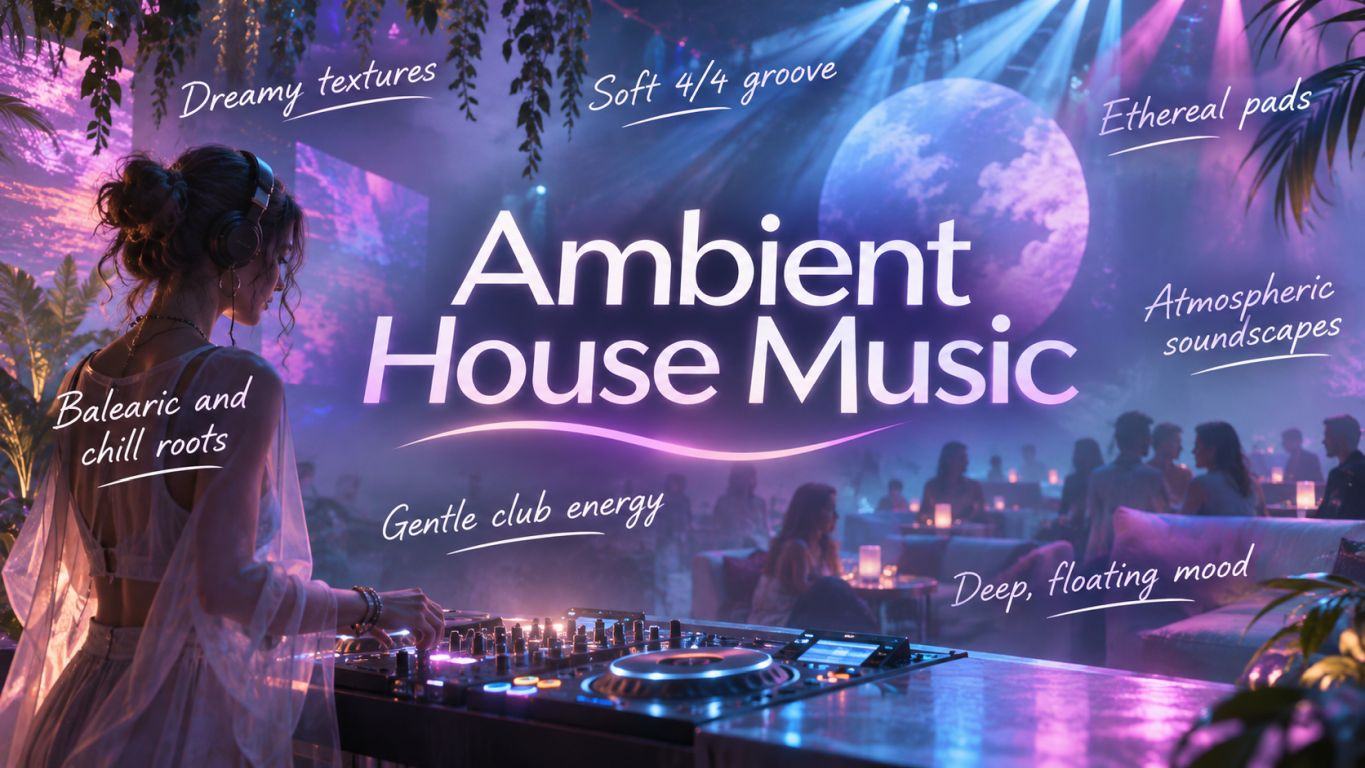
Some House Music makes you watch the clock until the next drop. Ambient House Music is content to let you forget the clock exists. It keeps the sense of movement found in House Music while giving equal attention to atmosphere, space, and sounds that take their time arriving.
The name can be confusing: ambient house is not always quiet, and it does not always have a house beat. That apparent contradiction has been part of the style since its beginnings.
What Does Ambient House Sound Like?
Imagine a soft dance pulse underneath slowly changing chords, distant voices, field recordings, and echoes that seem to stretch beyond the edge of the track. Some recordings are clearly dance music. Others drift toward a sound collage where the groove is only implied.
| Element | What you might hear |
|---|---|
| Drums | A restrained house kick, sparse percussion, broken beats, or no beat at all |
| Harmony | Long synth chords, floating pads, and slow harmonic movement |
| Bass | Rounded low notes or dub-influenced basslines with plenty of space |
| Sampling | Voices, radio fragments, environmental recordings, or musical excerpts |
| Effects | Delay, reverb, filtering, modulation, and creative stereo placement |
| Structure | Extended transitions, changing textures, and fewer obvious drops |
What BPM Is Ambient House?
There is no official ambient-house BPM range. A beat-led production might work comfortably at 115-125 BPM, but that is a suggested starting point, not a definition. Some foundational recordings have so little regular percussion that assigning them a dance tempo would tell you very little.
A 120 BPM loop can feel relaxed when the drums are soft and the atmosphere changes slowly. Conversely, a beatless collage can still feel closely connected to club music through its samples, bass movement, and the culture that produced it.
How Ambient House Began in the UK
The style took shape in the late 1980s and early 1990s, as British acid-house and rave culture developed places to listen rather than dance continuously. London's Land of Oz nights at Heaven are a key reference: Alex Paterson and Jimmy Cauty played atmospheric records and sound effects in a separate chill-out space while the main room kept moving. The separation between a dancing room and a listening room helped encourage experiments with slower, more spacious musical structures.
This was not simply a case of lowering the volume on an existing house record. DJs mixed Ambient Music, dub, psychedelic rock, found sound, and electronic dance material into an experience with different expectations about time and structure.
The Orb, associated early on with Paterson and Cauty, developed expansive, sample-led recordings. The KLF, the partnership of Bill Drummond and Cauty, took a related approach with the 1990 album Chill Out. The music crossed boundaries so readily that even contemporary descriptions struggled to fit it into a neat genre box. By 1990, atmospheric listening and dance rhythms were already in lively conversation.
Essential Ambient House Tracks and Albums
Start with these three recordings. They show the genre's range much better than a single preset marked Atmosphere ever could.
- The Orb - "Little Fluffy Clouds" (1990). Listen for the speech sample, the steady rhythmic motion, and the way borrowed sounds become part of a new musical setting.
- The Orb - "A Huge Ever Growing Pulsating Brain That Rules from the Centre of the Ultraworld" (1989). An extended, drifting piece that makes atmosphere and gradual change feel like events in themselves.
- The KLF - Chill Out (1990). This album is largely beatless, with voices, environmental sounds, and musical fragments forming an imagined journey. It is central to ambient-house history, not a standard four-on-the-floor demonstration.
For neighboring sounds, try 808 State's "Pacific State." It helps illustrate the broader late-1980s conversation between house grooves and spacious electronic production, though it should not be treated as a definitive ambient-house template.
Ambient House vs Ambient Music, Ambient Techno, and Chillout
The overlap is real, but the labels still have useful differences.
Ambient Music is a broad approach built around atmosphere and attentive or background listening. It does not require a dance beat. Ambient house brings that approach into a house-music or club-related setting, even when the beat eventually disappears.
Ambient Techno Music usually draws more directly on techno's rhythmic and electronic vocabulary. Ambient house often sounds warmer or more house-oriented, but neither genre has a strict tempo border. One recording can make sense under both names.
Chillout Music covers a wider listening function and a range of electronic styles, including music created for after-hours rooms. "Chillout" describes the setting or mood more readily than a precise drum pattern. If a record has a floating pad and a soft kick, that alone is not enough to settle every label.
How to Make Ambient House Music
The key challenge is to make space feel intentional. Simply putting reverb on a house loop may make it wetter, but not necessarily more interesting.
- Choose a gentle pulse. Start at 120 BPM with a soft kick, restrained hats, and a simple bass pattern. Keep the bass dry enough to stay clear beneath the atmosphere.
- Write harmony that can linger. Use a sustained chord or two and change a filter or oscillator layer over eight to sixteen bars. Slow movement can be compelling when the sounds themselves are carefully chosen.
- Add a second world of sound. Blend a field recording you made, licensed speech, or a quiet texture beneath the instruments. Consider its rhythm and tonal character, not merely whether it sounds suitably mysterious.
- Build depth, not fog. Give some elements short room ambience and others longer delays or reverbs. High-pass unnecessary low frequencies in effect returns so the kick and bass remain intelligible.
- Let the arrangement breathe. Drop the drums for a passage. If the track loses all interest, develop the atmosphere rather than immediately restoring the kick at maximum confidence.
Sampling mattered enormously to early ambient house, but permission matters too. The original scene's borrowing practices are part of its history, not a current production clearance strategy.
Why Ambient House Still Matters
Ambient house showed that dance-music techniques could build a place to listen, not merely a sequence of beats to follow. Its lasting influence can be heard across atmospheric club music and chillout traditions. Start with The Orb for rhythm and collage, then try The KLF for the almost beatless end of the spectrum. The distance between them is part of what makes the style worth exploring.