




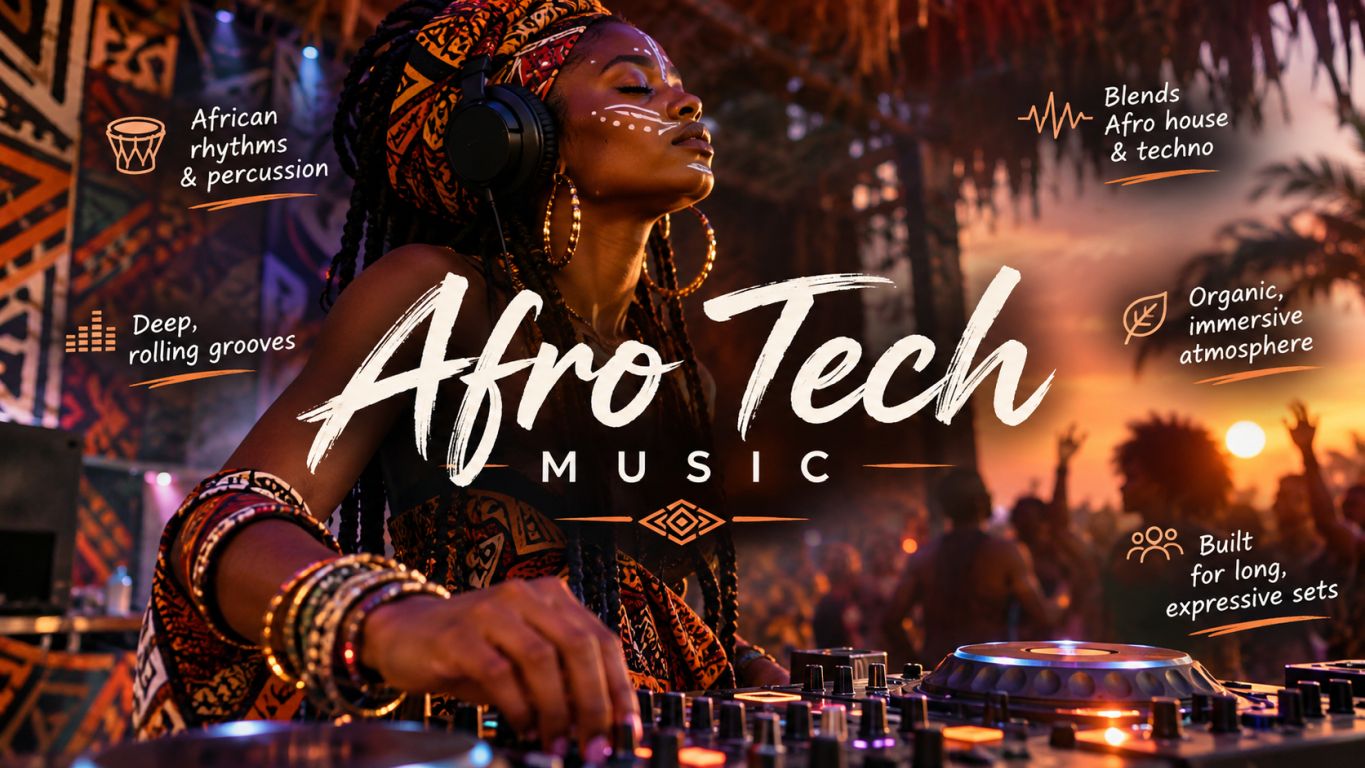
A kick lands, the percussion answers, and a dark synth line keeps circling until a small change suddenly feels enormous. That's the appeal of Afro Tech Music: movement through layers rather than endless dramatic drops.
Afro Tech grew from South Africa's house-music culture. It combines the rhythmic detail of Afro House Music with more insistent electronic textures associated with techno. It can be deep, driving, melodic, or vocal-led. The label describes a recognizable direction, not a laboratory test every record must pass.
What Does Afro Tech Music Sound Like?
At the center is a dependable dance pulse. Around it, percussion parts weave in and out, bass phrases repeat with small variations, and synths gradually change color. The result can feel intense without getting faster; or even noticeably louder.
| Element | What to listen for |
|---|---|
| Rhythm | A regular house kick with syncopated shakers, drums, claps, or electronic percussion |
| Bass | A deep, repeating pattern that locks into the drums rather than competing with them |
| Synths | Short motifs, sustained dark tones, evolving pads, or arpeggiated figures |
| Vocals | Instrumental passages, chants, or sung lines; vocals are not mandatory |
| Arrangement | Long transitions and changes in texture that build tension over time |
What BPM Is Afro Tech?
Afro Tech generally sits within the tempo territory of contemporary Afro house, but there is no universally agreed Afro Tech BPM bracket. Around 120-126 BPM is a sensible starting setting for a production exercise, not a rule for classifying recordings. A faster track with the wrong rhythmic character will not become Afro Tech just because a spreadsheet says so.
The more useful test is the interaction between kick, percussion, bass, and repeating motifs. A sparse beat can feel urgent when those parts keep nudging against one another.
Where Did Afro Tech Come From?
Afro Tech developed within South Africa's house scene during the early 2010s. Its foundations include Afro house, deep house, and the percussion-centered approaches sometimes described as tribal or ancestral house. Producers brought in darker synths and some of techno's relentless energy without abandoning the musical language of their own dance floors.
That history matters. Calling the sound simply "African techno" overlooks the house traditions and South African artists who developed it. International interest grew from an existing local scene, not the other way around.
There is also a genuine disagreement over the name. Shimza has described the incorporation of techno elements as a way to connect South African music with new audiences. Enoo Napa has questioned whether that evolution needs a separate genre label at all: for him, it remains part of Afro house. Both views help explain why a record might be tagged Afro Tech on one platform and Afro House on another.
Afro Tech vs Afro House, Techno, and 3Step
Afro Tech vs Afro House: Afro House Music is the broader category. Afro Tech is one branch of it, usually associated with more persistent electronic motifs and tightly controlled tension. That does not mean Afro house is always soft or Afro Tech is always dark.
Afro Tech vs Techno: Techno Music has its own origins and rhythmic traditions. Afro Tech may borrow techno-like synths and repetition, but its grooves and cultural lineage are rooted primarily in South African house. Similar equipment does not make two genres identical.
Afro Tech vs 3Step: 3Step Music is another Afro House branch. Its recognizable three-kick rhythmic approach is not a requirement for Afro Tech, which often maintains a steady four-on-the-floor foundation. Likewise, Afro Melodic House Music highlights a melodic direction that can overlap with either style.
Afro Tech Artists and Tracks Worth Hearing
The most useful way into a genre is through actual music, not a list of adjectives. These are starting points rather than claims that each artist records exclusively in one style.
- Jackie Queens - "Conqueror" (Enoo Napa Opaque Remix, 2015). Notice how the vocal remains distinct against the remix's darker synths and insistent percussion. The tension comes from the arrangement, not a louder kick.
- Shimza featuring Argento Dust - "All Alone" (2018). An entry point into the tougher South African house direction associated with both producers.
- Caiiro B2B Enoo Napa - The Lab Johannesburg. A DJ set is useful for hearing how these grooves create movement over longer stretches, rather than judging the style from a single track.
From there, explore Da Capo, Kususa, and Caiiro. Focus on one thing during each listen: what changes every eight or sixteen bars? Often it is a shaker, a filter, or a single missing bass note. The arrangement is doing the heavy lifting without requesting a medal.
How to Make an Afro-Tech-Inspired Groove
Start a DAW session at 124 BPM and give yourself a simple constraint: make one eight-bar loop interesting before adding a breakdown.
- Establish the pulse. Place a kick on each quarter-note beat in 4/4. Add a short bass phrase that leaves the kick's lowest frequencies room to breathe.
- Build percussion conversations. Use two contrasting rhythmic parts; perhaps a syncopated drum and a light shaker. Offset their accents instead of stacking every hit together.
- Write a small synth idea. A two- or three-note motif is enough. Change its filter, note length, or delay over several repetitions rather than immediately adding another melody.
- Arrange with restraint. Over sixteen bars, remove a kick-adjacent bass note, introduce a percussion answer, then widen a pad. Let each change register before the next one arrives.
- Check the mix. Keep kick and bass distinct, control reverb in the low end, and listen at moderate volume to judge whether the groove works without sheer loudness.
There is no mandatory instrument list or "African percussion" sample pack. Use original or licensed recordings, and treat specific musical traditions as traditions worth understanding; not as a preset category.
Why the Sound Stays Interesting
Afro Tech's strength is the way rhythm and atmosphere develop together. It rewards attentive listening but still functions on a dance floor, which is a useful combination. Follow the percussion and the synth motifs through a full recording; the changes that seemed tiny at first often turn out to be the whole story.