




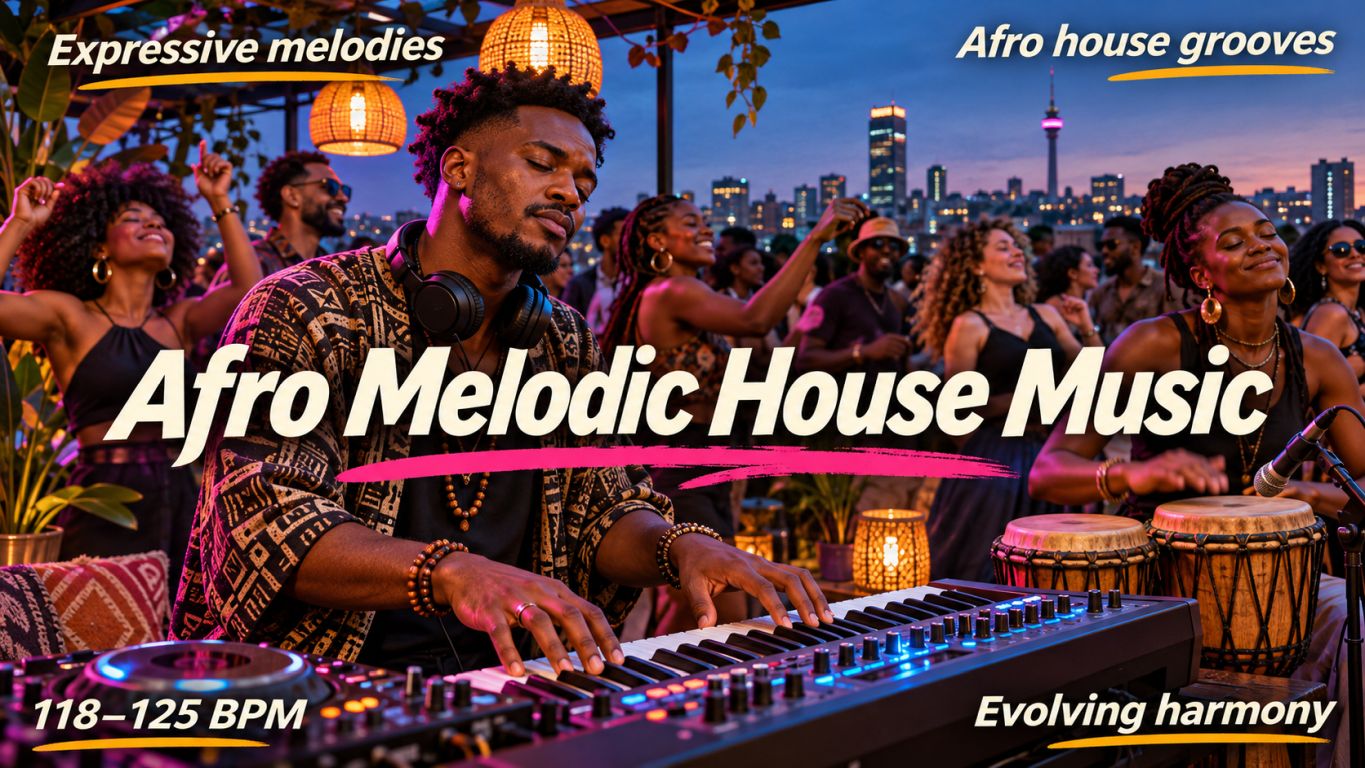
In some house records, the drums tell the whole story. In Afro Melodic House Music, the percussion still has plenty to say, but the chords and melodies are allowed to finish their sentences.
This melody-forward branch of Afro House Music combines interlocking rhythmic patterns with expressive synth themes, vocals, or harmonies that change over time. Its appeal is the tension between a groove that keeps moving and a musical idea that keeps developing. A large breakdown is optional; a memorable motif is considerably more useful.
What defines this subgenre?
Afro melodic house is a melody-forward form of Afro house. It emphasizes recognizable themes and harmonic development while retaining a percussion-led groove. Its boundaries with Afro tech and melodic house remain fluid.
Producers may release music that listeners hear as Afro melodic house, Afro Tech Music, or Melodic House Music, depending on which element stands out most. Treat the label as a useful listening guide, not a laboratory test.
The sound builds on South African house traditions and wider international exchanges between Afro house, deep house, and melody-focused Electronic Music. There is no single established founder or founding year for Afro melodic house as a separate style. Naming a subgenre is often much easier than locating the first track that fits it.
What does Afro melodic house sound like?
Imagine a steady kick and a layered percussion groove. A bassline repeats while a short synth motif appears. Eight bars later, a chord changes; sixteen bars later, the melody returns with a different supporting texture. Nothing has to explode for the arrangement to feel as if it has gone somewhere.
| Element | Typical role |
|---|---|
| Tempo | Roughly 118-125 BPM is a useful starting point, not a rule |
| Rhythm | A house-derived pulse with syncopated, interacting percussion |
| Bass | Warm or firm low-end patterns with room for the drums and melody |
| Harmony | Sustained chords, gradual changes, and tension or release across phrases |
| Lead sounds | Synth hooks, keys, plucked motifs, strings, or a distinctive vocal line |
| Arrangement | Progressive layering, breakdowns, and melodic returns that change the emotional feel |
The tempo range reflects the wider Afro-house neighborhood; it should not be mistaken for a formally measured range unique to Afro Melodic. Producers can create a busy rhythm at 120 BPM or a spacious one at 125 BPM. The arrangement matters more than the number in the corner of the DJ software.
Melody and percussion should work together
A common mistake is to finish an elaborate drum groove and drop an oversized melodic-house lead on top. Suddenly, the percussion has become background decoration. A more convincing approach lets the rhythmic accents and the melody leave space for each other.
Try listening for call and response between a drum phrase and a synth figure. Notice whether a chord change coincides with a lighter percussion section or a returning bassline. The emotional effect often comes from these small relationships, not just from playing more notes.
Afro melodic house vs Afro tech and melodic house
The styles overlap, but they usually emphasize different parts of an arrangement.
| Style | What tends to lead the track |
|---|---|
| Afro House Music | The broad rhythmic and cultural framework; may be soulful, vocal, percussive, dark, or melodic |
| Afro melodic house | Clear melodic themes and evolving harmony within an Afro-house groove |
| Afro Tech Music | Driving rhythmic tension, synthetic textures, and hypnotic low-end repetition |
| Melodic House Music | Melody-led house writing without necessarily drawing on Afro-house rhythmic traditions |
A record can sit between these categories. For example, a darker Afro-tech groove can support an expressive piano phrase, while a melodic-house arrangement can adopt syncopated percussion. Neither a chord progression nor a hand-drum sample identifies the genre on its own.
Where to start listening
Da Capo featuring Berita - "Found You" (2017). Listen for how vocal songwriting and emotional movement fit into a club-oriented house structure. It is a useful melodic Afro-house reference, not proof that the current subgenre label existed in 2017.
Francis Mercier, Faul & Wad, and African Children's Choir - "Sauti" (2024). A more recent, melody-led Afro-house example. Listen for the foregrounded melodic and vocal material and how it interacts with the rhythm.
FiNE featuring Idd Aziz - "Kidonda" (Enoo Napa Remix, 2024). This is a useful contrast from the Afro-tech side: the remix's hypnotic arpeggios and piano progression show that darker rhythmic production need not exclude melody. Here, the changing harmonies provide a useful contrast to the more insistent rhythmic foundation.
These examples cover a spectrum. Genre discovery works better when you compare records than when you try to find one song that obeys every supposed rule.
How to produce an Afro melodic house idea
Start around 122 BPM. Build a simple kick-and-bass foundation and two percussion patterns with different jobs: perhaps one shaker marks the pulse while a second pattern adds offbeat movement. Keep the low end clear; bass and kick do not need to compete for every beat.
Next, write a four- or eight-bar melodic phrase over a short chord progression. Let the listener learn the motif before you change it. In the following section, remove a percussion layer or shift one chord while leaving the melody recognizable. Small changes can create a surprisingly large emotional result.
For a basic 64-bar sketch, introduce the rhythm first, reveal the motif during the second phrase, reduce the arrangement to bass and atmosphere for a brief transition, and bring back the full groove with one new harmonic detail. This is an exercise, not a mandatory subgenre blueprint.
If you use vocal or instrumental samples associated with a particular community or tradition, learn where they come from, work with performers when possible, and obtain the appropriate permissions. A preset labelled "tribal" does not constitute research.
The point of the style
Afro melodic house works when its melodic identity and rhythmic identity support each other. The best question is not whether the lead synth sounds emotional enough. It is whether the melody changes how you hear the groove; and whether the groove gives that melody somewhere to live.