




Imagine a house track in which the kick never loses its footing, but almost everything around it seems to move. A chord sounds once, then returns in softer, darker echoes. A hi-hat vanishes for a bar. The bass continues beneath it all, making the empty spaces feel deliberate rather than unfinished.
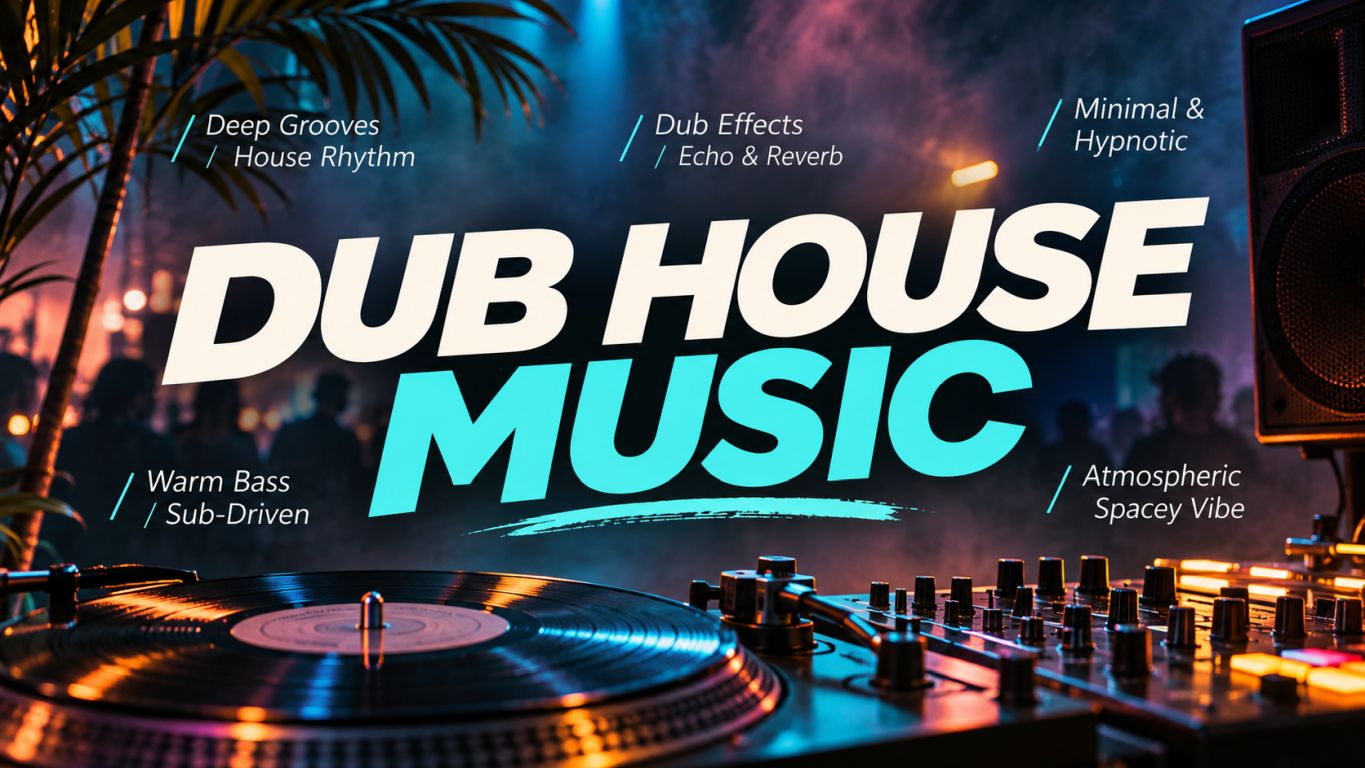
That is one of the pleasures of Dub House Music. It joins House Music's steady dancefloor pulse with the bass-first thinking and adventurous mixing of Jamaican dub. The result can be gently hypnotic, playful, shadowy, or remarkably warm. Instead of asking how many sounds can fit into a track, Dub House asks how much character a few sounds can develop.
The name is not a rigid formula. Plenty of house records use delay, and not every dub-influenced track is called Dub House. The clearest clue is how the groove and the mix work together: the rhythm holds its ground while effects and carefully timed absences become part of the music.
What makes Dub House sound different?
Dub House is easier to recognize by listening to what happens in a track than by counting instruments. Four details are especially revealing:
- A house pulse you can follow. The kick commonly plays on every quarter-note beat in 4/4; the familiar four-on-the-floor pattern. Hats, claps, and small percussion accents give the rhythm its movement.
- Bass with a leading role. A rounded, repeating bassline can carry the track even when the chords fall away. The bass need not be aggressive; it needs to feel connected to the kick.
- Echoes that answer the original sound. A chord stab, rimshot, or short vocal fragment may repeat through delay, with each repetition growing quieter or darker. The effect becomes a new rhythmic phrase.
- Room to hear the changes. Instruments drop out, reverbs trail off, and a familiar sound returns in a different form. That contrast is often more exciting than adding another layer.
Tempos commonly sit around 115-125 BPM, though this is only a rough neighborhood, not a genre test. Dub House can be slower, faster, softer, or more driving. The defining interest lies in the relationship between its groove, low end, and spacious treatment of sound.
The little moments that keep a loop alive
Consider a simple eight-bar passage. For the first two bars, you hear only kick, bass, and a lightly swung shaker. A muted chord appears in bar three. At the end of bar four, the chord is sent into a bouncing delay; the original instrument falls silent, but its echoes continue. In bar seven, the bass drops out for a moment. When it returns, the same groove suddenly feels bigger.
There is no dramatic melody change here. The excitement comes from expectation: you learn the pattern, notice something missing, and feel its return. This is why a sparse Dub House record can remain engaging long after a busier arrangement has shown all its cards.
The Jamaican roots behind the sound
To understand the word dub in Dub House, it helps to look at Dub Music, which developed in Jamaica in the late 1960s and 1970s. Dub developed from reggae recording and sound-system culture, where producers and engineers transformed existing recordings into striking new versions. They emphasized drums and bass, removed parts of the original arrangement, and used echo, reverb, filtering, and the mixing desk itself as creative instruments.
Figures such as King Tubby and Lee "Scratch" Perry helped establish this approach, alongside other important Jamaican engineers and producers. A vocal could disappear halfway through a phrase; a snare hit could ring out far longer than expected. These were not simply instrumental copies of songs. The mix was a performance of its own. The Jamaica Information Service's overview of dub and London Museum's history of dub and sound systems provide useful background on those roots and their wider influence.
As electronic dance music developed, this approach traveled into different rhythmic settings. House Music producers could apply dub's techniques to drum machines, sampled chords, synthesizers, and club tracks. By the 1990s, dub-influenced ideas were circulating through overlapping areas of house and other underground Electronic Music.
Dub House did not spring from one inventor or a single definitive record. It is better understood as a meeting of musical approaches. And Jamaican dub is more than a convenient collection of plug-in effects: its sound-system culture and inventive studio practices are central to the story.
What to listen for in a Dub House track
If you are new to the style, try following one part of the music at a time rather than listening for a big chorus or drop.
First, follow the bass. Does it repeat almost unchanged while the rest of the track shifts? Does it play around the kick with little syncopated movements? The low end often provides the stability that lets the mix become adventurous.
Next, listen behind the drums. A clap or chord might trigger an echo that lands between beats. Reverb may make a tiny sound seem distant, while a filtered repeat creates the impression of something receding. These details often become clearer on a second listen.
Finally, notice what disappears. When the percussion briefly thins out, do the remaining sounds feel larger? When the full beat returns, does it feel like a release even though nothing new was added? Dub House frequently builds momentum through these small shifts rather than conventional peaks.
Vocals are optional. You may hear no voice at all, or just a phrase that is chopped, delayed, or tucked into the background. Chords likewise range from warm, rounded stabs to misty, ambiguous textures. There is no mandatory instrument, chord progression, or mood.
Dub House Music, Deep House Music, and Dub Techno Music: where is the line?
These styles are neighbors, and genre tags cannot always capture the overlap. The most useful distinction is the main musical emphasis.
| Style | What often stands out |
|---|---|
| Dub House Music | House-oriented groove, bass-led arrangement, echo, dropouts, and mix changes that actively shape the track |
| Deep House Music | Warm or soulful harmonic color, restrained dance rhythms, and often jazz-influenced musical detail |
| Dub Techno Music | Repeated, heavily processed chord textures and the more austere rhythmic language of techno |
| Ambient House Music | Immersive atmosphere and drifting textures, sometimes with a gentler relationship to dancefloor momentum |
Here is a practical test: if the chords and harmony draw most of your attention, you may be hearing a Deep House Music emphasis. If the hypnotic repetition and treated chord textures feel more techno-oriented, Dub Techno Music may be the better description. If the rhythm feels distinctly house-like and the mixing decisions themselves keep reshaping it, Dub House is a useful name.
These are listening guides, not hard borders. A track can combine several of these qualities without needing to choose a single identity.
How producers create that sense of space
You do not need a vintage tape machine, a spring-reverb tank, or an expensive studio to explore Dub House. Those tools are historically important to dub, but the underlying ideas work with modern software too.
A convincing starting point is surprisingly small: kick, bass, percussion, and one short chord sound. Once those elements groove together, try making the arrangement interesting without writing another part.
- Give the kick and bass separate jobs. Let the kick establish the beat and shape the bass notes around it. A clear low end makes the quieter atmospheric details easier to appreciate.
- Send one sound to a delay. Try a short chord on a tempo-synchronized echo, then mute the original part and allow the repeats to finish the phrase. Experiment with filtering the repeats so they gradually lose brightness.
- Use reverb selectively. A long tail can make a small percussion hit sound huge, but washing everything in reverb removes contrast. Keep the main groove relatively defined.
- Arrange by taking something away. Drop the bass for a few beats, pause a hat pattern, or leave only an echo at the end of a section. Bring the missing sound back at a moment that matters rhythmically.
For example, delay on the final chord of an eight-bar phrase can make a transition feel natural without a cymbal crash or a new synth lead. Automating the amount sent to the delay is often more expressive than leaving the effect at one fixed setting.
The challenge is not making every sound enormous. It is allowing a crisp drum hit, a deep bass note, and a long, fading echo to coexist. If the reverb and delay returns become muddy, reduce their low frequencies or shorten their decay. Space only feels spacious when some parts remain clear.
For a more detailed look at the technique, Sound on Sound's guide to dub mixing explains how mixer moves and effects can become a creative performance.
Finding your way into Dub House
Dub House is not always neatly labeled on streaming services or in record shops. Some music with a strong dub-house character appears under Deep House Music, Minimal House Music, or other electronic categories. That can make discovery frustrating, but it also reveals how naturally the styles connect.
One useful way to explore is to listen across three related directions: early Jamaican dub to hear the original bass-and-mixing philosophy; dub-influenced house to hear those ideas inside a steady club groove; and Dub Techno Music to hear what happens when similar effects meet a different rhythmic foundation.
Listen for the relationship rather than a checklist. A particular delay preset does not turn a record into Dub House. Neither does a low BPM, a dark chord, or a thick bassline on its own. The character emerges when those elements leave room for one another and the production continually changes how you experience the groove.
The appeal of doing less, deliberately
Dub House offers a different kind of dancefloor drama. Instead of constantly presenting new musical ideas, it lets a few good ones stretch, echo, disappear, and return. A beat holds you in place while the space around it keeps changing.
That is what makes the style worth revisiting. The first listen reveals the groove; the next might reveal a delayed percussion hit tucked behind it, or a bass dropout you barely noticed. Dub House rewards attention without demanding it; and shows how much can happen when a producer knows exactly what not to play.