


Deep House Music
Explore deep house music, from its Chicago roots and Larry Heard’s pioneering recordings to its rich chords, expressive basslines, production techniques, and international scenes.
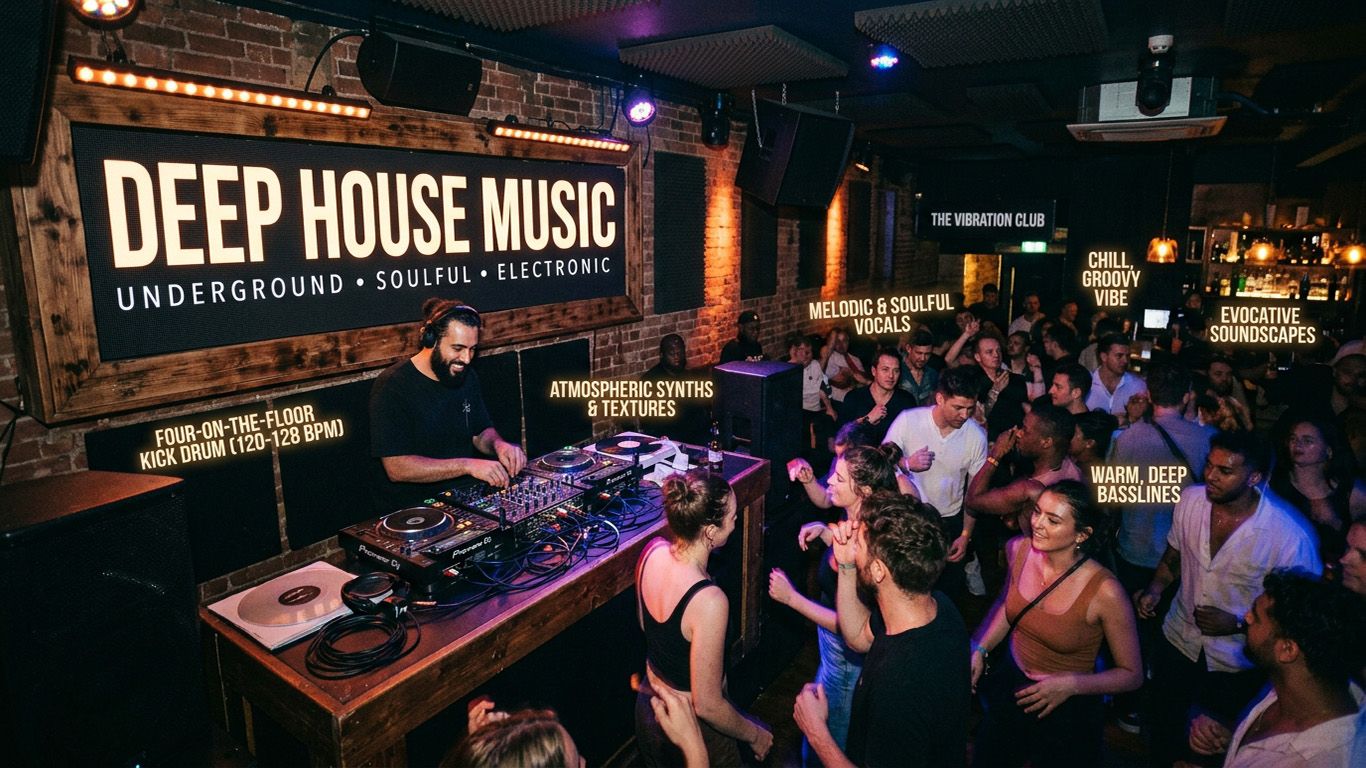
Deep house is a form of House Music known for rich harmonies, expressive basslines, and grooves that unfold over time. It developed within Chicago’s mid-1980s dance scene, where electronic instruments met influences from soul, jazz, disco, and gospel. Its sound can be intimate and restrained, but it can also be driving, raw, and built for a crowded club.
Within the House Music Family, deep house describes a recognizable approach rather than a fixed recipe. Warm chords and spacious arrangements are useful clues, yet neither a mellow mood nor a particular tempo is enough to define it. The interaction between rhythm, harmony, sound, and the dance floor matters most.
The Chicago Roots of Deep House
Deep house grew out of the wider culture described in Chicago House Music. Black, Latino, and LGBTQ+ communities helped sustain clubs where DJs could connect disco, soul, and newer electronic records. Dancers, singers, producers, radio programs, and record shops all contributed to the music’s development.
Frankie Knuckles’ earlier residency at The Warehouse helped establish the club culture from which house emerged. It should not be confused with a residency built around deep house records released later in the decade. Ron Hardy, associated with The Music Box, likewise helped create an audience receptive to experimental local productions. Their contributions provided an environment for new sounds, rather than following a single deep house record as a starting signal.
Larry Heard, recording as Mr. Fingers, became a central figure in the more harmonically expansive side of the scene. His background as a musician informed electronic arrangements in which chords and bass could carry as much emotional weight as a singer. His work with Fingers Inc., alongside Robert Owens and Ron Wilson, also demonstrated how those textures could support distinctive vocal performances. Heard discusses his musical development and collaborations in his Red Bull Music Academy interview.
It is tempting to identify one definitive first deep house track. In practice, the style emerged through overlapping recordings and ways of listening. “Can You Feel It” is a landmark, but its importance does not erase the broader scene around it.
What Does Deep House Sound Like?
Deep house usually retains the four-on-the-floor foundation of house: a kick drum on each quarter-note beat in a four-beat bar. Claps or snares commonly emphasize beats two and four, while hi-hats and other percussion create movement between them.
Many tracks sit around 115–125 BPM, though slower and faster examples exist. Treat that range as a listening guide, not a boundary. A track at 120 BPM could belong to several house styles; its tempo does not tell you how the chords, bass, vocals, and percussion interact.
Harmony, Bass, and Atmosphere
Seventh and ninth chords, suspended voicings, and sustained synthesizer textures are common. A small change in the notes or spacing of a chord can alter the mood without introducing a new melody. Electric piano sounds may suggest jazz or soul, while a simple synthesizer patch can produce an equally expressive result.
Basslines often do more than reinforce the kick. They may anticipate a beat, leave a gap, or answer a chord phrase. Some are rounded and subdued; others are prominent and rhythmically assertive. “Deep” does not mean that every bassline must be muted or confined to sub-bass frequencies.
Atmosphere also comes from space. A short chord with a trailing echo can feel different from a long pad, even when both use the same notes. Leaving gaps between parts lets those details register.
Vocals and Gradual Development
Deep house can feature a complete song, a repeated phrase, spoken words, or no voice at all. Soul and gospel influences are important, but they do not make vocals compulsory.
Arrangements often develop through additions, removals, and changes in texture. A producer might introduce a shaker, shorten a bass note, or briefly remove the kick before restoring the full groove. These changes can create considerable energy without requiring a large drop. Deep house can still contain breakdowns and dramatic moments; gradual development is a tendency, not a prohibition.
Classic Recordings: What to Listen For
A few recordings offer a clearer introduction than a long list of genre adjectives. Listen to how each balances percussion, harmony, and repetition.
Mr. Fingers ; “Can You Feel It” (1986)
This foundational recording pairs a steady rhythm with sustained chords and a memorable synth bassline. Its spaciousness comes from the relationship between a few carefully balanced parts. Roland’s account of the recording identifies the Juno-60 and TR-909 as its instruments.
Begin with the original instrumental version. Later versions with spoken material can give a different impression of the composition. Notice how the harmony creates emotional movement while the rhythm remains consistent.
Fingers Inc. ; “Mystery of Love”
Heard’s early “Mystery of Love” recordings and the Fingers Inc. vocal interpretation reveal closely connected instrumental and song-based approaches. Heard’s account of making his first house tracks describes the early experiments behind this period.
Listen for the space left around the repeating musical figures and, in the vocal interpretation, how the voice changes the emotional focus. Different versions are worth comparing rather than treating every release as the same recording.
Fingers Inc. ; Another Side (1988)
This album provides a broader view of the group’s partnership between electronic production and singing. Its longer format helps explain why the history of deep house includes songs and sustained moods as well as individual club tools.
Listen across several tracks for changes in density, vocal presence, and harmonic color. The range challenges the idea that early deep house was simply unobtrusive lounge music.
Production Tools and Techniques
No single piece of equipment defines deep house. Classic hardware influenced its vocabulary, but musical decisions matter more than a particular brand or an all-analog signal path.
The Roland TR-909 is an important reference for kicks, snares, claps, and hi-hats. Its familiar sounds do not automatically create swing: the timing and emphasis of programmed hits determine how a rhythm moves. Other drum machines, sampled percussion, and software instruments can serve the same musical roles.
The Roland Juno-60 is especially relevant to Heard’s early sound. Other synthesizers, including the Juno-106, offer related production possibilities, but they should not be substituted for the actual instrument used on a specific recording.
Electric pianos such as the Rhodes provide expressive chord textures. The Korg M1 supplied a different, digital palette for later house production. It was introduced in 1988, as documented by Korg, so it cannot explain the sound of a 1986 recording. Warmth can come from digital instruments, playing, and mixing as well as analog circuitry.
Building a Deep House Groove
A useful starting process is to establish a simple drum pattern, then write a bassline that leaves room for the kick. Add a short chord progression and decide which element should hold the listener’s attention. Avoid filling every gap just because more sounds are available.
Next, vary note lengths, velocity, and percussion timing. Use reverberation and delay to establish depth while keeping the low end clear. Finally, arrange the track in phrases, introducing changes that a dancer can feel and a DJ can work with. A modern digital audio workstation can handle this entire process.
International Scenes and Changing Meanings
Deep house spread through records, clubs, DJs, and independent labels. Producers in other American cities and abroad developed their own combinations of soulful vocals, jazz-influenced harmony, electronic textures, and rhythmic detail. This was an exchange among scenes, rather than a single sound exported unchanged from Chicago.
Labels such as Prescription, Guidance, Naked Music, and Om Records offer useful paths into different parts of that history. Their catalogs extend beyond one genre, and polished or lounge-oriented releases should not stand in for deep house as a whole.
South Africa also deserves attention as a place where house developed a substantial local culture. Deep house listening and production became part of that environment alongside other approaches. The Red Bull Music Academy’s account of its 2003 Cape Town event documents a deep house gathering within that scene. This history is broader than an overseas audience simply copying Chicago records.
The label “deep house” is also used loosely in playlists and marketing. A relaxed electronic track may carry the tag even when its relationship to the earlier club sound is limited. Listening to recordings and their context is more informative than relying on the label alone.
Deep House and Related House Styles
Deep house shares foundations with Chicago house, but the terms emphasize different things: one identifies a particular musical approach, while the other also names a local scene and its history. Acid House Music emphasizes resonant, evolving bass patterns, although acid sounds can appear in a deep house track.
Soulful House Music overlaps through singing and soul or gospel influences. Afro House Music, Minimal House Music, Tech House Music, and Melodic House Music have their own histories and identities. They can interact with deep house without becoming its subdivisions. In this site’s taxonomy, Deep House Music sits under House Music; those relationships should not be replaced by informal labels such as “melodic deep house” or “minimal deep tech.”
Deep house remains rewarding both on a dance floor and in close listening. Its lasting appeal lies in how a few rhythmic and harmonic ideas can sustain attention, invite movement, and carry emotion. For the wider context, explore House Music, Chicago House Music, and the House Music Family.
Related Questions And Answers
- • What is deep house music?Deep house is a form of house music associated with rich chords, expressive basslines, atmospheric arrangements, and sustained dance grooves. It can be instrumental or vocal, restrained or energetic.
- • Where did deep house originate?Deep house took shape within Chicago’s mid-1980s house scene, drawing on soul, jazz, disco, and electronic production. Related developments in other cities helped broaden the style.
- • What is the typical tempo of deep house?Many deep house tracks sit around 115–125 BPM, but slower and faster examples exist. Tempo alone does not determine whether a track is deep house.
- • Who pioneered deep house?Larry Heard, also known as Mr. Fingers, is a central pioneer. His solo recordings and work with Fingers Inc., alongside Robert Owens and Ron Wilson, helped establish the style.
- • What is an important early deep house track?Mr. Fingers’ Can You Feel It, released in 1986, is a foundational recording. Calling it the definitive first deep house track would oversimplify the genre’s gradual development.
- • What instruments are associated with deep house?Drum machines, synthesizers, electric pianos, samplers, and sequencers are common. Larry Heard used a Roland Juno-60 and TR-909 for Can You Feel It, but no particular device is required.
- • How is deep house different from house music?House music is the broader category. Deep house often emphasizes harmonic richness, atmosphere, bass movement, and gradual development within the shared house rhythm.
- • Does deep house always have vocals?No. Some recordings feature full songs, spoken passages, or brief vocal samples, while others are entirely instrumental.
- • Is Afro House Music a subgenre of Deep House Music?The styles can overlap and influence each other, but Afro House Music has its own history and identity. In this site’s taxonomy, it is a separate branch within the House Music Family.
- • Can deep house help with studying or working?Some listeners enjoy its steady grooves while working, but concentration depends on the listener, task, and recording. Deep house is not inherently background music or a proven concentration aid.
- • Which labels are associated with deep house?Examples include Prescription, Guidance, Naked Music, and Om Records. These labels also released other kinds of house and electronic music.
- • Do I need vintage hardware to produce deep house?No. Software instruments, drum samples, and a digital audio workstation can provide the necessary tools. Rhythm, harmony, arrangement, and sound choices matter more than owning specific equipment.