


Chicago House Music
Explore Chicago House Music, from its early 1980s club roots to its classic drum machine sound, influential artists, and worldwide legacy.
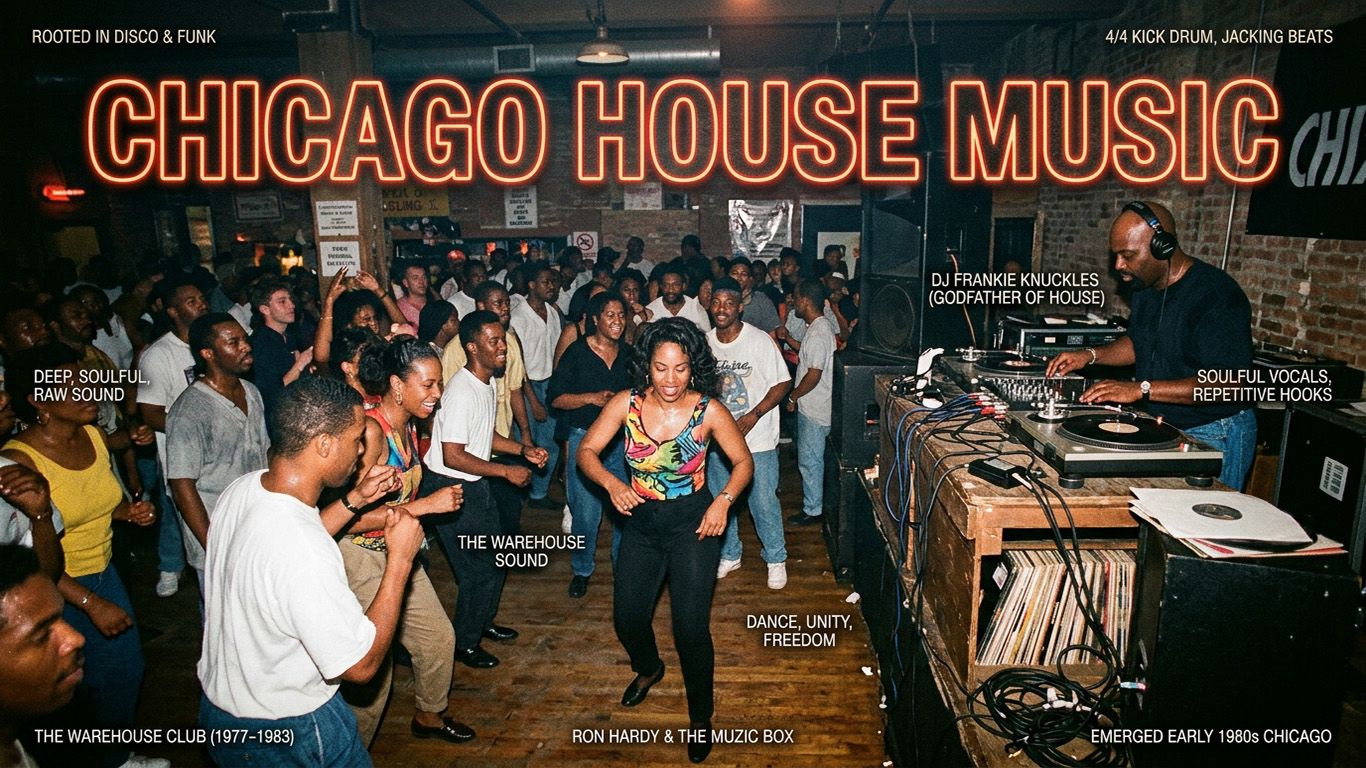
Chicago house is one of the earliest forms of House Music. It developed in Chicago during the early 1980s, building on the disco and underground club culture of the previous decade. DJs extended grooves and mixed records in new ways, while local producers began making tracks with drum machines, synthesizers, and voices.
The result was music that could be raw and minimal, soulful and melodic, or strange and hypnotic. Its identity came as much from the relationship between DJs and dancers as from any particular instrument. Within the House Music Family, Chicago house represents a foundational local scene whose influence spread worldwide.
How Chicago House Music Began
Disco remained central to Chicago's underground nightlife after its mainstream American popularity declined. Black, Latino, and LGBTQ+ communities sustained spaces where dancing offered belonging, freedom, and self-expression. The emerging music grew through those communities rather than through a single inventor or recording session.
The Warehouse, opened in 1977 by Robert Williams, became a crucial meeting place. Its resident DJ, Frankie Knuckles, blended disco, soul, and electronic records into long sets. Tape edits and extended passages let familiar songs take on a different shape on the dance floor.
The Warehouse is closely associated with the name house music. In Knuckles' account of hearing the term, the phrase described music connected with his club selections. The details of how the name spread remain debated, so it is better understood as a club and record-shop expression that became a genre name than as a precisely dated invention.
Ron Hardy developed another influential approach at The Music Box, also known as the Muzic Box. His forceful selections and adventurous edits encouraged dancers to embrace unfamiliar sounds. Playing an unreleased track in a club could reveal possibilities that were difficult to hear in a home studio.
The scene also extended beyond nightclubs. The Hot Mix 5 on WBMX brought DJ mixing to radio listeners, giving young musicians access to the records and techniques shaping local dance culture. Larry Heard recalls the program as an important source of musical ideas.
What Does Chicago House Music Sound Like?
The foundation is usually a four-on-the-floor rhythm: a kick drum on each of the four beats in a bar. Claps or snares commonly mark beats two and four, while hi-hats add movement between the kicks. A repeating bassline ties those parts together.
What happens above that rhythm varies considerably. Some tracks use gospel-influenced singing or piano chords; others rely on a short spoken phrase, a rough synthesizer pattern, or percussion alone. Disco, soul, funk, and electronic dance records all contributed ideas to the developing sound.
Listen for three especially useful characteristics:
- The relationship between bass and drums: A short bass pattern can push against a rigid beat, creating movement without a busy arrangement.
- Changes in texture: Removing a kick, opening a hi-hat, or bringing back a chord can transform the energy of a repeated passage.
- Room for the DJ: Extended instrumental sections allow records to overlap, making a track part of a longer musical journey.
Repetition is therefore an expressive tool. A pattern can feel different after a vocal enters, a bassline drops out, or another record begins to blend with it. Chicago house rewards listening to how a groove develops over several minutes.
The Instruments Behind the Sound
Drum machines and synthesizers allowed musicians to construct dance tracks without hiring a full band. Some equipment became accessible secondhand, and producers developed distinctive methods around whatever tools they could obtain. There was no single compulsory setup.
The Roland TR-808 supplied electronic percussion, including deep kicks and sharp handclaps. The TR-909, with its combination of synthesized and sampled drum sounds, became closely associated with house and techno. Roland's history of the TR-909 describes its adoption by Chicago and Detroit producers during the mid-1980s.
The TR-707 also deserves a place in this history. Its sampled drums offered another recognizable palette for programmed rhythms. Roland documents the TR-707 and TR-727 across Chicago house and other electronic styles.
The Roland TB-303 was a bass synthesizer and sequencer, rather than a drum machine. Adjusting its filter, resonance, accents, and slides could turn a repeating bass pattern into the shifting sound associated with acid house.
Synthesizers supplied chords, melodies, and basslines, while tape editing helped DJs extend and rearrange recordings. Samplers added further possibilities, but sampling was not a requirement: many records depended on programmed instruments and original performances.
Pioneers and Classic Tracks: A Listening Guide
Chicago house developed through overlapping contributions. Knuckles and Hardy shaped club listening; producers translated dance-floor ideas into records; singers gave those records emotional character. Independent labels such as Trax Records and DJ International helped circulate the music beyond its original audience.
The following recordings provide a starting point. They show different directions within the scene rather than a single formula that every Chicago producer followed.
Jesse Saunders ; "On and On" (1984)
Made with Vince Lawrence, "On and On" is widely cited as an early commercially released Chicago house record. Its historical importance does not mean house culture began on its release date: DJs and dancers had already been developing that culture for years. Saunders' account of his early recordings places the record within that wider activity.
Listen for the spare electronic arrangement and repeating bass pattern. The groove demonstrates how a small number of parts can sustain a dance track.
Marshall Jefferson ; "Move Your Body" (1986)
Often subtitled "The House Music Anthem," this recording places an insistent piano figure and an expressive vocal over a driving rhythm. It is a useful introduction to house music's connection with songwriting and collective celebration.
Listen to how the piano operates as both a rhythmic hook and a harmonic foundation. The track's direct emotional appeal contrasts with the austerity of more minimal productions.
Mr. Fingers ; "Can You Feel It" (1986)
Larry Heard, recording as Mr. Fingers, helped establish the spacious, harmonically rich approach associated with early deep house. His work, including his collaborations with singer Robert Owens, is essential to understanding Chicago's musical range. Heard discusses his recordings and partnerships in his Red Bull Music Academy interview.
Start with the original instrumental version and listen to the relationship between bass, chords, and percussion. Its atmosphere comes from the balance of those parts, without needing a lead vocal.
Farley "Jackmaster" Funk and Jesse Saunders ; "Love Can't Turn Around" (1986)
Featuring Darryl Pandy, this recording helped carry Chicago house into the British mainstream. It reached No. 10 on the UK Singles Chart in 1986, as recorded by Official Charts.
Listen for Pandy's theatrical vocal delivery against the programmed backing. The combination makes clear that electronic production could support a commanding soul performance.
Phuture ; "Acid Tracks" (1987)
DJ Pierre, Spanky, and Herb J, together as Phuture, made a foundational acid house recording. Its release followed a period of club exposure, including plays by Ron Hardy. DJ Pierre's firsthand account explains the experiments and relationships behind it.
Listen for how changes to the TB-303's tone create tension while the underlying pattern repeats. The sound itself becomes the main event.
Chicago House and Related Styles
Acid House Music emerged from experiments within Chicago's scene. Its defining bass sound makes it easy to recognize, but acid house and Chicago house are not interchangeable terms: much Chicago house contains no acid bassline.
Deep house emphasizes a different side of the city's legacy, particularly the rich chords and spacious arrangements associated with Larry Heard. Soulful house foregrounds expressive vocals and soul or gospel influences. These descriptions overlap in practice; a record can be both deep and soulful.
Ghetto house developed a more stripped-down, rhythm-focused approach within Chicago's later dance culture. Garage house belongs to related New York and New Jersey club traditions. These histories connect through records, DJs, and dancers, while retaining distinct local foundations.
These relationships describe musical influence and shared practices. They do not make every related style a subdivision of Chicago house, nor do they replace the broader House Music category.
From Chicago Clubs to International Dance Floors
During the mid- and late 1980s, records, radio, shops, and travelling DJs carried Chicago house beyond the city. British audiences embraced the music, and acid house became a major part of the UK's late-1980s club and rave culture. The success of "Love Can't Turn Around" provides one clear marker of that crossover.
Exchange also took place closer to home. Chicago house and Detroit techno developed distinct identities, but musicians and DJs moved between their scenes and shared records. Accounts of Chicago's influence in Detroit show why treating the two histories as completely separate misses important connections.
Why Chicago House Still Matters
Chicago house established enduring ways of making and playing dance music: economical arrangements, memorable grooves, extended mixes, and close exchange between producers and club audiences. Its history also demonstrates how a local community can shape music heard around the world.
To explore further, start with House Music, compare the bass experiments of Acid House Music, or follow the wider connections in the House Music Family.
Related Questions And Answers
- • What is Chicago House Music?Chicago House Music is an early form of House Music that developed in Chicago in the 1980s. It combines a steady four-on-the-floor beat with disco influences, drum machines, basslines, and repeated musical patterns.
- • When did Chicago House Music begin?Chicago House Music emerged in the early 1980s, building on the disco and underground club scenes of the late 1970s.
- • Where did Chicago House Music originate?Chicago House Music developed in Chicago clubs, especially around The Warehouse and other venues where DJs played extended dance sets.
- • Who is Frankie Knuckles?Frankie Knuckles was a pioneering DJ associated with The Warehouse. He helped establish the sound and culture of Chicago House Music and is widely called the Godfather of House Music.
- • What does Chicago House Music sound like?It usually features a regular kick drum on every beat, crisp hi-hats, claps or snares, repeating basslines, and elements of disco, soul, or funk.
- • What equipment was used to make Chicago House Music?Producers often used drum machines such as the Roland TR-808, TR-707, and TR-909, alongside synthesizers and sequencers; some productions also used samplers to build dance tracks.
- • How is Chicago House Music related to Acid House Music?Acid House Music grew from the Chicago house scene and became known for its moving, resonant bass sounds, often created with the Roland TB-303.
- • Which artists helped shape Chicago House Music?Important figures include Frankie Knuckles, Ron Hardy, Jesse Saunders, Vince Lawrence, Larry Heard, Marshall Jefferson, Farley Jackmaster Funk, and DJ Pierre.
- • How did Chicago House Music become popular outside Chicago?Records, independent labels, DJs, and international club networks carried Chicago house tracks to other cities and countries, including the United Kingdom.