


House Music Genres Explained: The Ultimate Guide to House Music
Explore the House Music Family's 11 genres and 34 subgenres, from Chicago, Deep, and Disco House to Afro House, Amapiano, Electro House, and progressive grooves.
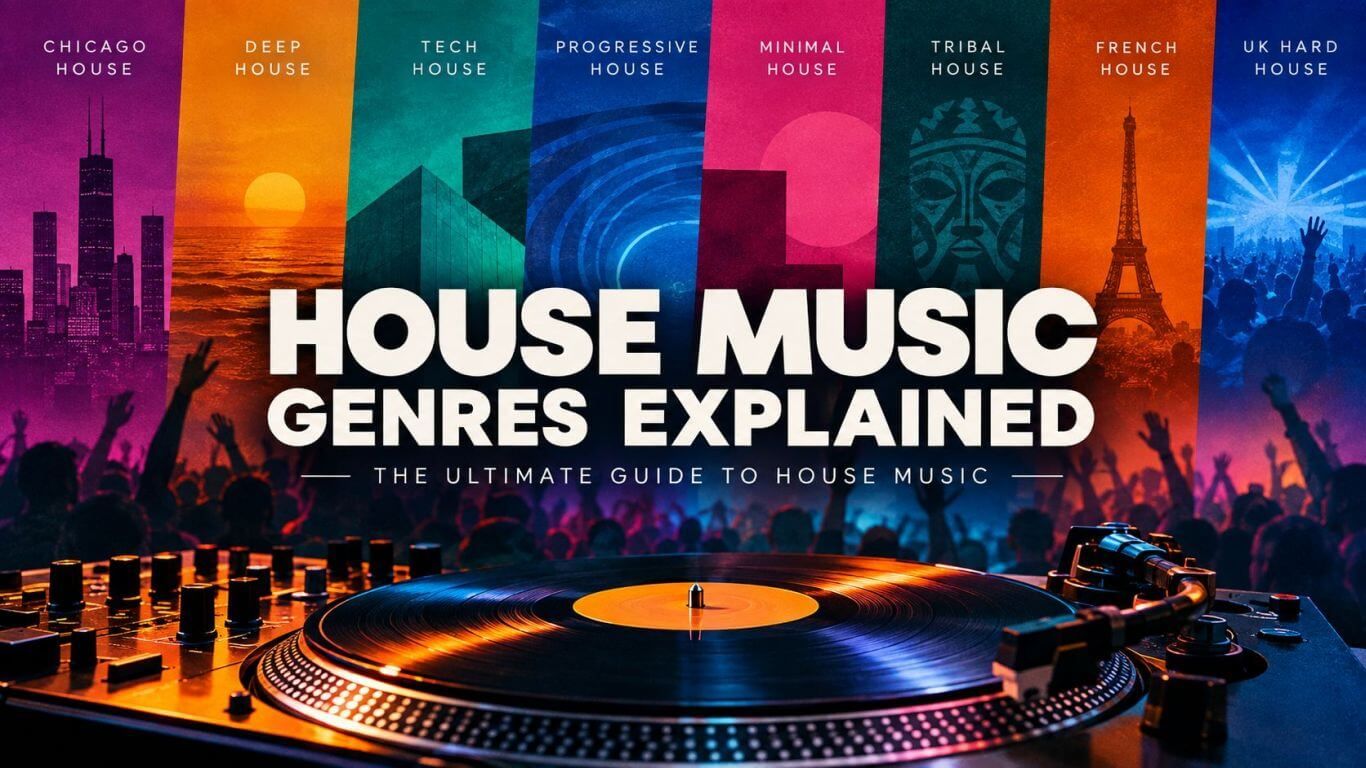
What Is House Music?
Born in the underground clubs of 1980s Chicago, House Music combines disco, funk, soul, and electronic production with bass-driven dance grooves. A kick on each quarter note is its characteristic foundation, while syncopated percussion, vocal phrases, chords, and samples give individual tracks their personality.
The wider House Music Family contains more varied rhythmic approaches, including those heard in Amapiano and 3Step. Family membership brings related musical traditions together without requiring every track to use the same drum pattern or production formula.
This guide follows 11 genres and 34 subgenres in the House Music Family. Each main genre has its own section, with its subgenres underneath. French House, Latin House, Tropical House, Minimal House, and Tribal House stand as genres without further named subdivisions in this map.
For the wider context, see the Electronic Music families guide. For a shorter introduction to the core groove, start with House Music.
House Music
House Music is the central genre within the family. Its characteristic foundation is a four-on-the-floor kick supported by syncopated hi-hats, bass grooves, percussion, and melodic or harmonic elements. Changes in sampling, instrumentation, harmony, and production give its subgenres different identities.
The Chicago tradition brought disco, funk, soul, and electronic drum programming into a new club-oriented language. The 21 subgenres below show how that language can become soulful, raw, atmospheric, bass-focused, or strongly song-based.
Chicago House Music
Chicago House Music is the foundational form of house music and represents the sound from which many later styles developed. It is built around four-on-the-floor drums, swung hi-hats, soulful or disco-derived samples, warm basslines, and simple but effective synth figures.
The jacking groove is one of its defining rhythmic characteristics, often created through syncopated drum patterns and shifting hi-hat accents. Vocals, piano chords, organ sounds, and sampled instrumentation can also play an important role, giving Chicago house its energetic yet soulful character.
Acid House Music
Acid House Music is defined by squelching, resonant basslines traditionally created with the Roland TB-303 synthesizer. Resonance, cutoff filtering, accent patterns, and repetitive 4/4 rhythms give the style its distinctive and highly recognizable sound.
Rather than relying on complex melodies, acid house often builds its character through evolving bass sequences and continuous modulation. The combination of hypnotic sequencing and constantly changing filter movement allows relatively simple patterns to become dynamic and expressive over the course of a track.
Deep House Music
Deep House Music focuses on warm basslines, atmospheric chords, lush synthesizer pads, subtle percussion, and soulful musical elements. Its arrangements generally favor space, groove, and texture rather than the more aggressive energy associated with peak-time house styles.
Jazz-influenced harmony, smooth vocal elements, organic instrumentation, and restrained arrangements are common. This combination gives deep house its deeper and more relaxed character while maintaining the steady rhythmic foundation that connects it to the wider house music family.
Dub House Music
Dub House Music combines a house groove with dub-derived production techniques.
Tape-style delays, spring or other reverb, filtered bass, and spacious effects create movement around the drums and chords. Echoes can become active parts of the arrangement rather than simply decoration.
Ghetto House Music
Ghetto House Music is a raw and minimalist Chicago style built around drum-machine programming, heavy bass pulses, repetitive vocal chants, and stripped-down rhythmic patterns.
The arrangements are usually direct and rhythm-focused, with the drums and bass carrying most of the track. Short vocal phrases, aggressive drum sounds, and repetition give the style its energetic and highly functional club character.
Italo House Music
Italo House Music combines house rhythms with melodic piano parts, bright synthesizer stabs, orchestral strings, uplifting chord progressions, and catchy melodic hooks.
Its sound has a strong connection to late-1980s and early-1990s Italian dance music. Compared with more stripped-back house styles, Italo house often places greater emphasis on memorable melodies, polished arrangements, and an energetic sense of euphoria.
Jazz House Music
Jazz House Music brings jazz harmony, instrumental phrasing, and improvisational influences into a house framework.
Piano, brass, warm bass textures, solos, or sampled jazz passages can sit alongside a steady dance rhythm. The distinctive character comes from how those musical elements interact with the groove, whether recorded live or assembled from samples.
Lo-Fi House Music
Lo-Fi House Music intentionally moves away from clean, polished, and highly controlled production. Instead, imperfections and degraded sound quality become part of the aesthetic.
Tape saturation, vinyl noise, bit reduction, distortion, muffled frequencies, dusty samples, and imperfect textures create a worn and nostalgic character. These production choices can make the music feel raw and intimate while preserving the repetitive groove of house.
Soulful House Music
Soulful House Music places strong emphasis on emotional harmony, warm instrumentation, expressive vocals, and groove. It often uses rich chords, melodic basslines, piano, organ, strings, and carefully arranged vocal performances.
The style draws heavily from soul, gospel, funk, and disco traditions while maintaining the steady four-on-the-floor rhythm of house music. Its combination of dancefloor rhythm and emotionally expressive musical elements gives soulful house a distinctly warm and human character.
Disco House Music
Disco House Music combines house production with disco samples, funk grooves, orchestral elements, rhythmic basslines, and energetic percussion.
The emphasis is often placed on familiar disco textures while maintaining the continuous movement of a house rhythm. Strings, guitar parts, vocal samples, and prominent basslines can provide much of the musical character, creating a connection between classic disco and modern dancefloor production.
Chicago Juke Music
Chicago Juke Music emphasizes fast, rhythm-heavy drum programming, chopped vocal phrases, and energetic kick-and-snare patterns. Triplet hi-hats and tightly repeated samples can give tracks a restless forward momentum.
Juke is closely connected to Footwork, but they receive different primary placements in this map: Chicago Juke is a House Music subgenre, while Footwork is a genre in the Bass Music Family.
Garage House Music
Garage House Music combines soulful vocals, piano or organ chords, and warm, swinging house grooves. Gospel and R&B influences often give its songs an expressive, uplifting character.
Its roots in New York and New Jersey club music distinguish it from UK Garage Music. The shared word “garage” reflects connected histories, but UK Garage has its primary placement in the Bass family.
Funky House Music
Funky House Music foregrounds lively basslines, disco or funk-derived guitar and keyboard phrases, vocal hooks, and an upbeat house rhythm.
Sampling and repetition can turn a short instrumental phrase into the track's main hook. The arrangement often develops by changing the relationship between that phrase, the bass, and the percussion.
Jackin House Music
Jackin House Music puts a swinging, insistent groove at the center of the track. Clipped disco or funk samples, punchy basslines, and tightly placed drum accents contribute to its rhythmic character.
Compared with more expansive melodic styles, much of its movement comes from timing, sample placement, and the interaction between short musical phrases.
Future House Music
Future House Music combines a house groove with prominent bass hooks, often using metallic or elastic-sounding timbres, crisp percussion, and drop-focused arrangements.
Future House belongs under House Music here. Future Bass Music is a different genre in the Bass family; a similar name does not make it a House subdivision.
Melodic House Music
Melodic House Music gives recurring melodies, expressive chords, and atmospheric synthesizers a prominent role over a steady house groove.
Gradually evolving arrangements can connect it with progressive approaches. In this guide, Melodic House is placed under House Music, while Melodic Progressive House is a subgenre of Progressive House Music.
Organic House Music
Organic House Music combines acoustic or acoustic-sounding instruments, layered percussion, warm bass, and spacious electronic production.
An unhurried, flowing groove allows small instrumental details to remain audible. Its character depends on timbre and arrangement as well as the underlying dance rhythm.
Ambient House Music
Ambient House Music brings atmospheric pads, spacious textures, and gradual development into a house framework. A restrained beat can coexist with long stretches of immersive sound.
Its primary placement here is under House Music. Its ambient qualities connect it with the Ambient family without making it a subdivision of Ambient Music in this map.
Hip House Music
Hip House Music combines rap verses or sampled MC vocals with a four-on-the-floor dance rhythm.
Basslines, keyboard hooks, and energetic drum programming support the vocal flow. The fusion works through the interaction between hip-hop phrasing and a house groove.
Slap House Music
Slap House Music is a pop-oriented style built around a punchy, plucked bass hook, a pronounced kick-and-bass groove, and streamlined arrangements.
Vocal melodies often play a prominent role. Short builds and focused drops can keep the production centered on the main bass and vocal hooks.
Brazilian Bass Music
Brazilian Bass Music is a house style developed by Brazilian producers, emphasizing deep bass hooks, restrained melodic elements, vocal samples, and polished club production.
Despite its name, its primary placement here is under House Music. Brazilian Funk Music and Brazilian Phonk Music are different styles in the Electronic Club and Bass families respectively.
Electro House Music
Electro House Music emphasizes heavy synthesized basslines, punchy drums, prominent electronic leads, and forceful builds and drops.
Its six subgenres below approach that framework through different bass timbres, editing techniques, lead sounds, and rhythmic accents. Electro House belongs to the House family; Electro Music is a separate genre in the Electro and Breakbeat family.
Bass House Music
Bass House Music combines the four-on-the-floor structure of house with aggressive bass sound design and modern electronic production techniques.
Distorted mid-bass sounds, heavy low frequencies, strong compression, syncopated bass rhythms, and energetic drops give the style a powerful club-focused character. The bass often functions as a central musical element rather than simply supporting the kick and other drums.
Complextro Music
Complextro Music is known for dense electronic sound design, rapidly changing basslines, and frequent variations in synth and rhythmic patterns.
Complex edits, multiple bass layers, abrupt transitions, chopped sounds, and tightly arranged electronic details create a highly active production style. Tracks can contain numerous short musical ideas that are introduced, altered, and replaced throughout the arrangement.
Dutch House Music
Dutch House Music combines bouncing basslines, pitched lead or percussion sounds, punchy drums, and energetic club arrangements.
Builds and tightly focused drops highlight the interaction between rhythmic hooks and synthesizer timbres. Percussion and short lead phrases can be as important as larger melodic themes.
Fidget House Music
Fidget House Music uses aggressive basslines, chopped vocal samples, syncopated percussion, unusual rhythmic edits, and constantly shifting electronic textures.
The production often creates movement through repeated bass changes, vocal manipulation, and tightly edited rhythmic elements. Rather than relying on a single static groove, fidget house frequently introduces small variations and unexpected changes that keep the arrangement in motion.
Big Room House Music
Big Room House Music uses powerful four-on-the-floor kicks, broad melodic builds, and relatively sparse drops designed around prominent lead or percussion hooks.
The contrast between a layered build and a focused drop is central to its impact. Large-scale presentation does not require every moment of the arrangement to be dense.
Melbourne Bounce Music
Melbourne Bounce Music combines springy offbeat bass, pitched lead sounds, punchy kicks, and tightly arranged drops.
Its bouncing feel comes from the placement and shape of the bass around the kick. Short hooks and rhythmic edits reinforce that movement.
French House Music
French House Music is associated with filtered disco and funk samples, looping grooves, compressed drums, phaser effects, and chopped vocals. A short sampled phrase can become the main source of rhythmic movement through filtering and changing dynamics.
It became strongly associated with France's electronic music scene during the 1990s. French House and Disco House share sampling and disco influences, but Disco House is listed under House Music here rather than beneath French House. Filter-based production is part of French House's vocabulary, not an additional subgenre in this map.
Afro House Music
Afro House Music is rooted in African dance traditions, particularly South Africa, and combines layered percussion, syncopated bass, melodic textures, and often vocals.
The interplay between drums, bass, and melody gives its grooves depth and movement. Afro Tech Music, 3Step Music, and Afro Melodic House Music are its three subgenres in this guide.
Afro Tech Music
Afro Tech Music combines Afro House's layered, syncopated percussion with techno-influenced bass patterns and darker synthesizer textures.
Insistent repetition and gradual arrangement changes create a hypnotic club groove. Its techno influence is a musical connection; its primary placement here remains under Afro House Music.
3Step Music
3Step Music combines Afro House, Amapiano, and broken-beat influences around a characteristic three-hit kick pattern.
The gaps in that pattern leave room for syncopated percussion, bass, and melodic development. The name describes a rhythmic approach rather than a requirement to use a three-beat time signature.
Afro Melodic House Music
Afro Melodic House Music combines layered percussion and interlocking grooves with prominent synthesizer themes, expressive harmonies, and evolving atmospheres.
Melodic development works alongside the percussion rather than replacing its rhythmic role. This gives the style a different emphasis from the darker, more insistent approach often associated with Afro Tech.
Latin House Music
Latin House Music combines house rhythms with Latin percussion, rhythmic patterns, melodic elements, and vocal influences.
Congas, bongos, timbales, shakers, and other percussion instruments can give the music a more active and organic groove. Latin rhythmic patterns are typically integrated into the house framework rather than replacing its steady four-on-the-floor foundation.
Tropical House Music
Tropical House Music is a lighter and more relaxed branch of house music, generally emphasizing atmosphere, melody, and a softer rhythmic approach.
Warm melodies, soft percussion, acoustic-style sounds, relaxed grooves, gentle basslines, and bright harmonic textures give it an open and easygoing character. The style often favors spacious arrangements and smooth transitions rather than the heavier drops and aggressive sound design found in more energetic forms of house music.
Amapiano Music
Amapiano Music is a South African genre associated with distinctive log-drum bass sounds, piano or keyboard harmony, atmospheric pads, and intricate percussion. Vocals can be central, while instrumental tracks may foreground the interaction between bass and drums.
Its rhythmic feel is more varied than a simple description of house as a kick on every beat suggests. Amapiano is a distinct genre in the House Music Family here, with Private School Piano Music and Sgija Music as its two subgenres.
Private School Piano Music
Private School Piano Music emphasizes jazz-influenced harmony, detailed piano or keyboard playing, spacious arrangements, and a restrained, flowing rhythmic foundation.
The musical detail comes from chord voicings, instrumental phrasing, and the space around the groove rather than constant changes in intensity.
Sgija Music
Sgija Music focuses on interlocking percussion, repeated bass and log-drum patterns, and stripped-back instrumental arrangements.
Its dance-floor energy comes from the relationships between those rhythmic layers. Melody may be present, but the groove often carries much of the track's identity.
Minimal House Music
Minimal House Music reduces the arrangement to carefully chosen rhythmic and melodic elements. Sparse percussion, short samples, micro-edits, deep bass, and open space allow small timing and textural changes to become noticeable.
A producer can introduce or remove a single sound and change the groove without replacing its basic pattern. This guide treats Minimal House as a genre without further named subdivisions; descriptive labels for particular production approaches do not require an extra level.
Progressive House Music
Progressive House Music focuses on gradual development, layering, and extended arrangement. Synthesizers, pads, basslines, percussion, and effects can enter or change over time to sustain a continuous musical progression.
A track's energy can grow through evolving harmony or added rhythmic detail rather than frequent abrupt transitions. Melodic Progressive House Music is its subgenre in this map.
Melodic Progressive House Music
Melodic Progressive House Music places greater emphasis on melody, harmony, atmosphere, and emotional progression while retaining the gradual development associated with progressive house.
Layered synthesizers, evolving chord patterns, atmospheric textures, arpeggios, and memorable melodic themes can gradually transform throughout the track. Melodic elements are often introduced progressively, allowing the arrangement to build emotional and harmonic intensity without relying solely on dramatic drops.
Tech House Music
Tech House Music combines house groove with techno-influenced texture, repetition, and a restrained arrangement. Punchy percussion, rolling basslines, subtle synthesizer elements, and tightly controlled rhythmic patterns are common.
Movement often comes from changes in percussion, bass phrasing, filtering, and effects. Its subgenre in this map is Minimal Tech House Music.
Minimal Tech House Music
Minimal Tech House Music reduces tech house to a small number of carefully selected elements, giving each sound a clearly defined role within the groove.
Percussion, bass, micro-edits, subtle effects, and small rhythmic changes create movement while keeping the arrangement sparse. Gradual additions and removals of individual sounds can produce variation without significantly changing the overall structure.
Tribal House Music
Tribal House Music places layered percussion at the center of a house arrangement. Congas, bongos, shakers, toms, and other acoustic or electronic drum sounds can interlock over a steady dance groove.
Adding and removing percussion layers can create progression while the bass and kick remain consistent. The genre overlaps with Afro House and Latin House in some productions, but those are separate branches of the family. Tribal House has no further named subdivisions in this map.
Related Styles: UK Hard House and Donk
UK Hard House Music shares a relationship with House through club rhythm and dance-floor function. Its forceful kicks, driving offbeat basslines, aggressive synthesizer hooks, and rave-oriented arrangements give it a different emphasis from many of the styles above.
In this map, UK Hard House Music belongs to the Hardcore and Hard Dance Music Family. Donk Music is its subgenre, built around a distinctive hollow, metallic bass stab, bouncy rhythms, and often pitched vocal hooks. They are discussed here as related styles, rather than included among the House family's 11 genres and 34 subgenres.
This distinction also illustrates why a taxonomy is not a complete musical history. A style can have meaningful connections with House while receiving its primary placement elsewhere.
Hearing the Differences Between House Styles
Genres share techniques, so one sound rarely settles a classification on its own. A disco sample can appear in French House, Disco House, or Funky House. Atmospheric pads can appear in Deep House, Ambient House, or Melodic House. Listen to how those elements work together.
Useful points of comparison include:
- Drum placement and swing: Notice where the kick falls, how the hi-hats move around it, and how other percussion creates tension or flow.
- Bass: Compare a warm supporting line with a metallic hook, a springy offbeat pattern, or an Amapiano log-drum phrase.
- Harmony and vocals: Listen for jazz-influenced chords, gospel or soul expression, rap phrasing, or a production centered on instrumental hooks.
- Texture: Filtered loops, saturated samples, acoustic-sounding instruments, and sharply designed synthesizers give grooves different characters.
- Arrangement: Some tracks develop through gradual changes; others emphasize short builds, drops, or repeated vocal and bass hooks.
For producers, these differences suggest useful choices rather than a fixed recipe. Build the relationship between kick, bass, and percussion first, then consider how sampling, melody, vocals, and effects support the intended groove. Where kick and bass mask each other, sidechain compression or automation can create space; the amount should follow the music rather than a genre rule.
Exploring the House Music Family
Start with a style whose groove interests you, compare several tracks, and then listen to neighboring branches. Deep House and Soulful House can reveal different uses of harmony and vocals; Electro House's branches can reveal different ways of shaping bass and drops; Afro House and Amapiano can reveal different relationships between melody, bass, and percussion.
The Genetic BPM Core tool offers another route into the genres and subgenres through their tempo profiles. Read the guide to electronic music genres by BPM for context, and BPM, beat, and tempo explained to distinguish speed from rhythmic feel.
House's recognizable pulse provides a starting point. The differences in groove, sound, arrangement, and musical context are what make its branches worth exploring.
Related Questions And Answers
- • What is house music?House Music typically combines a four-on-the-floor kick, syncopated percussion, bass grooves, and repeating musical patterns. It developed in Chicago's club culture during the 1980s. The wider House Music Family includes genres with different melodic, percussive, and rhythmic approaches.
- • How is a house music beat made?A typical house beat uses a kick drum on every quarter note, with hi-hats and percussion adding movement between the kicks. A bassline usually works closely with the kick, while claps, snares, shakers, and other percussion add groove. Swing, velocity changes, and small timing differences can make the rhythm feel more natural.
- • What are the main genres in the House Music Family?This guide follows 11 genres: House Music, Electro House Music, French House Music, Afro House Music, Latin House Music, Tropical House Music, Amapiano Music, Minimal House Music, Progressive House Music, Tech House Music, and Tribal House Music. Together they contain 34 named subgenres in this map.
- • What is the difference between a House family, genre, and subgenre?The House Music Family is the broad grouping. House Music is one genre within it, and Deep House Music is one of that genre's subgenres. Afro House Music and Amapiano Music are separate genres in the same family. Some genres have no further subdivisions in this guide.
- • What is the difference between Deep House and Tech House?Deep House usually focuses on warm basslines, atmospheric chords, soulful elements, and a relaxed groove. Tech House combines the house rhythm with a more stripped-back and repetitive approach influenced by techno. Deep House often emphasizes atmosphere and harmony, while Tech House usually puts more attention on percussion, bass, and groove.
- • How do you mix the low end and sub-bass in house music?Keep the deepest bass frequencies controlled and generally centered. Give the kick and bass enough space so they do not compete for the same frequencies at the same time. Sidechain compression, volume automation, or dynamic EQ can reduce the bass briefly when the kick hits. Saturation can also add harmonics that help the bass remain audible on smaller speakers.
- • What is Chicago House Music?Chicago House Music is the foundational form of house music that developed in Chicago during the early 1980s. It is known for four-on-the-floor drums, swung hi-hats, bass grooves, soulful samples, and the jacking rhythm that became an important part of the style.
- • What is Acid House Music?Acid House Music is known for its squelching synthesizer basslines, especially sounds created with the Roland TB-303. Resonance, filter movement, accents, and repetitive rhythms give acid house its distinctive sound.
- • What is Electro House Music?Electro House Music emphasizes heavy synthesized bass, punchy drums, electronic leads, and energetic builds and drops. Its subgenres here are Bass House Music, Complextro Music, Dutch House Music, Fidget House Music, Big Room House Music, and Melbourne Bounce Music.
- • What is French House Music?French House Music combines house rhythms with disco and funk samples, filtered loops, compression, rhythmic effects, and repeating grooves. It became strongly associated with the French electronic music scene during the 1990s.
- • How are Disco House and French House different?Both can draw on disco and funk. Disco House Music combines those elements with a house groove, while French House Music is especially associated with filtered loops, compression, and sample-based production. Disco House is a subgenre of House Music here; French House is a separate genre within the family.
- • What is Afro House Music?Afro House Music is rooted in African dance traditions, particularly South Africa, and combines layered percussion, syncopated bass, melodic textures, and often vocals. Its branches here are Afro Tech Music, 3Step Music, and Afro Melodic House Music.
- • What is Afro Tech Music?Afro Tech Music combines Afro House's syncopated percussion with techno-influenced bass patterns, darker synthesizer textures, and hypnotic arrangements. Its primary placement in this guide is under Afro House Music.
- • What is 3Step Music?3Step Music combines Afro House, Amapiano, and broken-beat influences around a characteristic three-hit kick pattern. The rhythm creates space for syncopated percussion, bass, and melody. The name does not mean that the music must use a three-beat time signature.
- • What is Latin House Music?Latin House Music combines house production with Latin percussion and rhythmic influences. Congas, bongos, timbales, vocal elements, and other percussion can give the music a more active and organic groove.
- • What is Tropical House Music?Tropical House Music is a relaxed form of house music that often uses warm melodies, soft percussion, acoustic-style sounds, and bright harmonic elements. Its production generally has a lighter and more open character.
- • What is Amapiano Music?Amapiano Music is a South African genre associated with log-drum bass sounds, piano or keyboard harmony, atmospheric textures, and intricate percussion. It has its own primary branch in the House Music Family here rather than being grouped beneath a generic regional category.
- • What are the Amapiano subgenres in this guide?Private School Piano Music emphasizes jazz-influenced harmony, instrumental detail, and spacious arrangements. Sgija Music emphasizes interlocking percussion, bass and log-drum patterns, and a more stripped-back instrumental groove. Both are placed directly under Amapiano Music.
- • What is Minimal House Music?Minimal House Music uses a small number of carefully selected elements. Sparse percussion, deep bass, subtle rhythmic changes, and large amounts of space allow small sounds and timing changes to become important parts of the groove.
- • What is Progressive House Music?Progressive House Music focuses on gradual development. Tracks often use long arrangements in which melodies, synths, pads, percussion, and other layers are introduced or changed slowly over time.
- • How are Melodic House and Melodic Progressive House classified?Melodic House Music is a subgenre of House Music in this guide. Melodic Progressive House Music is a subgenre of Progressive House Music. Both can foreground melodies and atmosphere, but the latter is grouped with progressive arrangement and development.
- • What is Tech House Music?Tech House Music combines the four-on-the-floor rhythm of house with repetitive patterns and production ideas associated with techno. Punchy percussion, bass grooves, subtle synths, and stripped-back arrangements are common.
- • What is Minimal Tech House Music?Minimal Tech House Music combines a tech-house groove with sparse instrumentation, machine-like rhythmic detail, and small changes in percussion, bass, or effects. It is the subgenre of Tech House Music in this map.
- • What is Tribal House Music?Tribal House Music emphasizes layered percussion and interlocking drum patterns over a house groove. It is a separate genre alongside Afro House and Latin House in this guide, without further named subgenres.
- • Is UK Hard House part of the House Music Family?UK Hard House Music has a musical relationship with House, but its primary placement in this guide's taxonomy is in the Hardcore and Hard Dance Music Family. Its forceful kicks, driving offbeat bass, and rave-oriented arrangements explain that grouping.
- • What is Donk Music?Donk Music is a bouncy hard-dance style known for a hollow, metallic bass stab, brisk four-on-the-floor rhythms, and often pitched vocal hooks. Here it is a subgenre of UK Hard House Music in the Hardcore and Hard Dance family.
- • What is Lo-Fi House Music?Lo-Fi House Music uses intentionally rough or imperfect textures. Tape saturation, distortion, vinyl noise, reduced high frequencies, dusty samples, and other processing techniques can create a warm and worn character.
- • What is Bass House Music?Bass House Music combines the four-on-the-floor structure of house with powerful bass sound design. Distorted basses, heavy low frequencies, strong compression, and energetic drops are common.
- • What is Complextro Music?Complextro Music is a highly detailed electronic style that uses frequent changes in bass sounds, synths, edits, and rhythmic patterns. Multiple layers and rapid sound changes give the production its complex character.
- • What is Dutch House Music?Dutch House Music combines bouncing basslines, pitched lead or percussion sounds, punchy drums, and energetic club arrangements. It is a subgenre of Electro House Music in this guide.
- • What is Fidget House Music?Fidget House Music uses aggressive basslines, chopped vocals, syncopated percussion, and unusual rhythmic edits. Frequent bass changes and tightly edited sounds give the style its restless movement.
- • What is Big Room House Music?Big Room House Music is a festival-oriented Electro House subgenre using powerful kicks, broad melodic builds, and sparse drops centered on a prominent lead or percussion hook.
- • What is Melbourne Bounce Music?Melbourne Bounce Music is an Electro House subgenre associated with springy offbeat bass, pitched lead sounds, punchy kicks, and tightly arranged drops. Its bouncing feel comes from how the bass moves around the kick.
- • Are Garage House and UK Garage the same genre?Garage House Music is a soulful House Music subgenre associated with New York and New Jersey club music. UK Garage Music is a separate genre in the Bass Music Family. Their histories are connected, but their names do not make them interchangeable.
- • Are Future House and Future Bass the same genre?Future House Music is a House Music subgenre associated with prominent bass hooks and drop-focused house production. Future Bass Music is a separate genre in the Bass family, often giving processed chords and melodic bass production a different rhythmic setting.
- • What makes a house music groove?A strong house groove comes from the relationship between the kick, bassline, hi-hats, percussion, and timing. A steady rhythmic foundation provides consistency, while swing, syncopation, velocity changes, and small timing variations add movement.
- • How do you get a warm analog sound in electronic music?Tape saturation, console-style processing, soft distortion, and other forms of harmonic processing can add warmth to digital recordings. The amount should be controlled so that the sound gains character without becoming muddy or overly distorted.
- • How do you sidechain a kick and bass in house music?Sidechain compression reduces the bass volume briefly when the kick plays. This creates space for the kick and helps prevent the two low-frequency elements from masking each other. Volume automation or dynamic EQ can provide similar control.
- • How do you create a late-night club atmosphere in house music production?Use a focused low end, restrained percussion, atmospheric pads, filtered sounds, delays, and controlled reverb. Long transitions and gradual changes can create a sense of space and movement. The arrangement does not need many elements; carefully chosen sounds and good spacing can create a strong atmosphere.
- • What BPM is house music?Tempo varies by genre, subgenre, track, and musical context. Many house tracks occupy a broadly similar dance-tempo range, but the entire House Music Family cannot be identified by one BPM value. Compare tempo with drum placement, bass, sound design, and arrangement rather than using speed alone.