




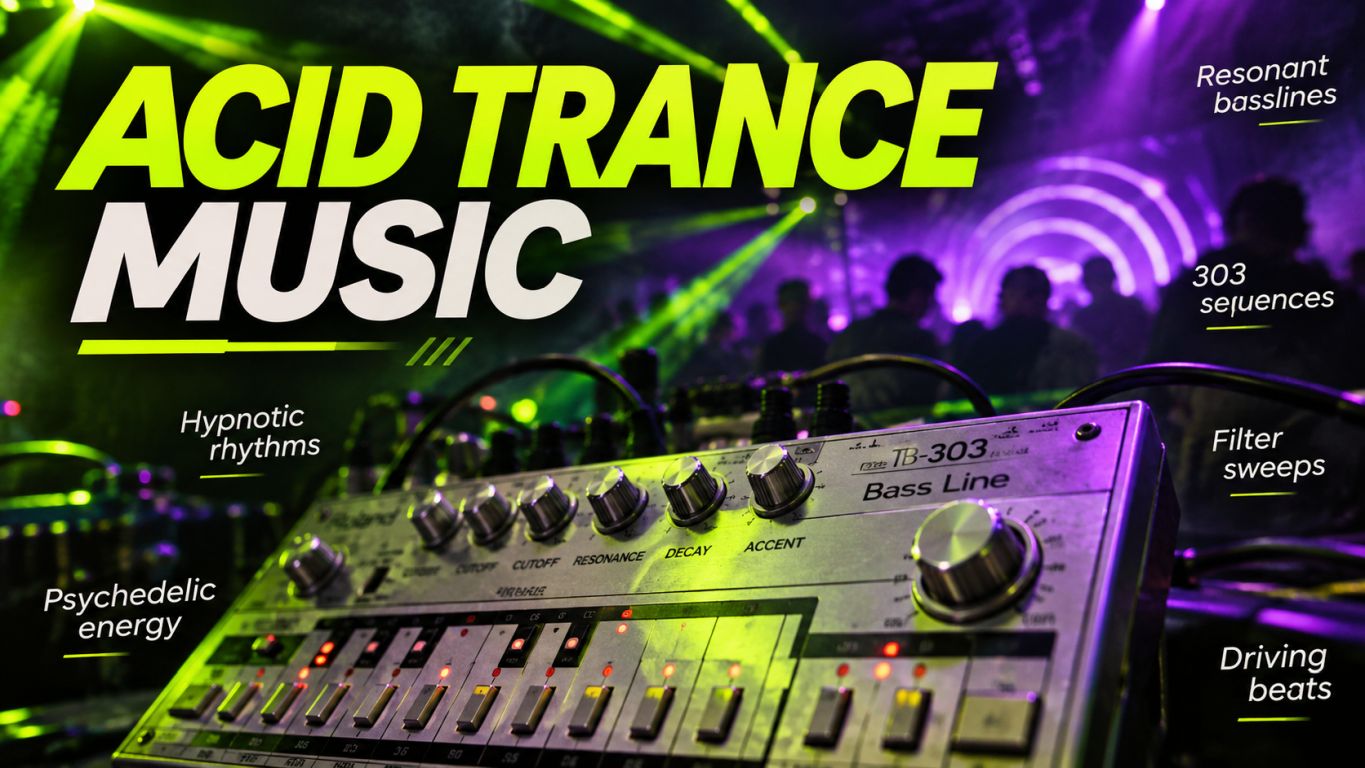
Imagine a track that starts with one kick drum and a bassline playing eight notes. Thirty seconds later, the bassline is still playing eight notes. Somehow, it sounds like a completely different idea.
That is the trick behind Acid Trance Music. The drums hold the floor steady while a restless synth line twists, slides, and slowly changes color. The music repeats, but it does not stand still. You hear the pattern again and notice something you missed the first time.
And yes, sometimes the most dramatic moment is somebody turning a filter knob. It works surprisingly well.
What Makes Acid Trance Music Different?
Acid Trance Music sits within the Trance Music Family. It borrows the distinctive acid sound that became famous in the 1980s, then gives it the extended, hypnotic development heard in early trance records.
There are three things worth listening for:
- A steady foundation. The kick often follows a four-on-the-floor pattern, landing on each quarter-note beat in 4/4. Hats and percussion provide movement without pulling attention away from the main synth.
- A bassline with a personality. The acid bassline repeats short phrases, but slides, accents, and filter changes make it sound almost conversational. Occasionally, it sounds like it is arguing.
- A slow sense of travel. Sounds enter, leave, and change over several bars. Rather than introducing a new melody every few seconds, the track finds more possibilities in what is already there.
Many energetic examples fall around 135-145 BPM, but that is a starting point for listening or producing, not a membership test. A track at 140 BPM is not automatically acid trance. Otherwise, genre identification would be a spreadsheet problem.
How Did Acid Trance Music Emerge?
The story starts before anyone called the sound trance. The Roland TB-303 was designed as a bass accompaniment machine, but producers discovered that its unusual sequencer and resonant filter were far more interesting when pushed beyond polite bass duties. The result helped define Acid House Music. Roland's history of the 303 covers that unlikely second career.
By the early 1990s, acid sounds were moving through European techno and emerging trance scenes. Some records kept the raw, squelching bassline but let the arrangement unfold over longer stretches. Repetition became part of the attraction, not something the producer needed to apologize for.
Germany's Harthouse label was important in this overlap. In 1992, Hardfloor released Acperience on Harthouse, with layers of 303 sequences that developed over an extended groove. Hardfloor's official history documents the release, while Roland's early trance listening guide discusses its influence.
In the United Kingdom, Platipus Records explored another side of the sound, often bringing more melody into the mix. Art of Trance's Deeper Than Deep E.P. (1993) is an early example. Beatportal's history of trance places both labels in the wider story.
These scenes were connected, and their music did not arrive with tidy labels attached. Some important early tracks sound just as much like techno as trance. That is useful history, not a classification emergency.
Why Does One Short Bassline Stay Interesting?
A typical acid phrase might have only eight or sixteen steps. The notes are entered into a sequencer, which plays them over and over. What keeps your ear engaged is not necessarily a stream of new notes. It is the way the same notes behave.
On a TB-303-style synth, slides connect pitches instead of making them jump instantly. Accents give certain notes extra emphasis and can affect the filter response. Filter resonance emphasizes frequencies near the cutoff, creating that sharp, rubbery, sometimes wonderfully unruly sound.
Now open the filter a little. The same pattern becomes brighter and more urgent. Close it again and the track seems to pull back, even if the drums have not changed at all. A gradual filter sweep can turn a simple loop into a build-up without adding a single note.
This is also why merely copying the pitches from a classic record rarely recreates its sound. The accents, slides, filter envelope, and timing are part of the musical phrase. Roland's TB-303 sequencer guide explains those interactions in more detail.
How Does the Trance Part Work?
The acid sequence provides the character. The arrangement gives it somewhere to go.
An airy pad might fade in underneath the bassline. A quiet arpeggio might begin picking through the notes of a chord. A hi-hat opens, a percussion fill appears, and the acid filter grows brighter. Nothing has changed dramatically on its own, yet the combined effect is unmistakable.
Some tracks use a breakdown, briefly taking away the kick or thinning the arrangement before the groove returns. Others barely stop at all. Early Acid Trance Music does not need the giant breakdown and festival-sized drop associated with some later trance styles.
Try a quick listening experiment: play a track for one minute and follow only the acid line. Then replay the minute and focus on everything behind it. The two listens often tell different stories. One is about a repeating hook; the other is about all the small decisions making that hook feel alive.
Three Records That Explain the Sound
These are historical starting points, not three examples that everyone files under exactly the same genre label.
- Hardfloor - "Acperience 1" (1992). Listen to how layered acid patterns keep developing instead of simply repeating at one intensity. This is a particularly good way to hear the overlap between Acid Techno Music and early trance. Hardfloor's release history provides the background.
- Art of Trance - "Deeper Than Deep" (1993). Pay attention to the space around the rhythm and the way the melodic atmosphere supports the electronic sequences. The Deeper Than Deep E.P. release listing documents its early Platipus release.
- Emmanuel Top - "Acid Phase" (1994). This one is more insistent and stripped back. It is useful precisely because it sits close to the techno side of the spectrum. The 1994 release listing establishes the recording's original era.
If you listen to only one, start with "Acperience 1." Rather than waiting for a big new melody, notice how the same sequence earns more attention as the sound changes. The filter has a remarkable work ethic.
Acid Trance Music or Something Else?
Several related genres use similar drums and synthesizers. The best clue is what each track does with them.
Acid House Music usually builds around a house groove and a prominent acid line. Acid Trance Music is more likely to stretch that line through a slowly evolving, hypnotic arrangement.
Acid Techno Music often feels tougher and more rhythm-driven. It can use almost identical synth techniques, so the two labels sometimes describe different aspects of the same record.
Goa Trance Music may share acid sequences and early rave influences, but often features more interlocking melodies and psychedelic textures. Psychedelic Trance Music also uses acid-like timbres without necessarily making a 303-style sequence the center of the composition.
Hard Trance Music can share the tempo and intensity, yet its main hook may be a forceful lead or stab rather than a twisting acid pattern.
The borders are useful for finding music, not for arguing with a track that refuses to stay in one box.
Build a Sixteen-Bar Acid Trance Sketch
You do not need an original TB-303. A software emulation or any suitable monophonic synth with a resonant low-pass filter, accents, and pitch glide will do. Start with a small sketch instead of trying to produce an eight-minute epic immediately.
- Give it a pulse. Set your project to 138 BPM in 4/4. Put a kick on each beat, a clap on beats two and four, and a light offbeat hi-hat.
- Write eight interesting notes. Create a short acid sequence with a couple of rests. Add accents to two or three steps and slide between a few notes. If every note slides, none of them feels special.
- Make the filter perform. Start with a fairly low cutoff and moderate resonance. Open the filter gradually over the first eight bars. Adjust the envelope until the accents stand out without becoming painfully sharp.
- Add one atmospheric layer. Try a quiet pad or sparse arpeggio. Keep it out of the bassline's way. More layers are not automatically more trance.
- Create a small surprise. Around bar nine, remove the kick for a moment or pull the filter down. Bring the groove back, then change one accent or add a short percussion fill before bar sixteen.
- Listen to the whole thing. Play it quietly and in mono. Can you follow the kick? Does the bassline remain clear when the filter opens? Most importantly, does the second half feel different from the first without needing a completely new idea?
If the groove feels flat, experiment with the accents and filter movement before adding another synthesizer. The original pattern might have plenty left to say.
The Appeal of Doing More With Less
Acid Trance Music is a reminder that repetition does not have to mean standing still. A few notes establish something familiar, and small changes in timbre, rhythm, and atmosphere turn that familiarity into anticipation.
The magic is not a strict BPM number or a specific piece of vintage equipment. It is hearing a simple idea evolve just enough to make you want another minute of it.