




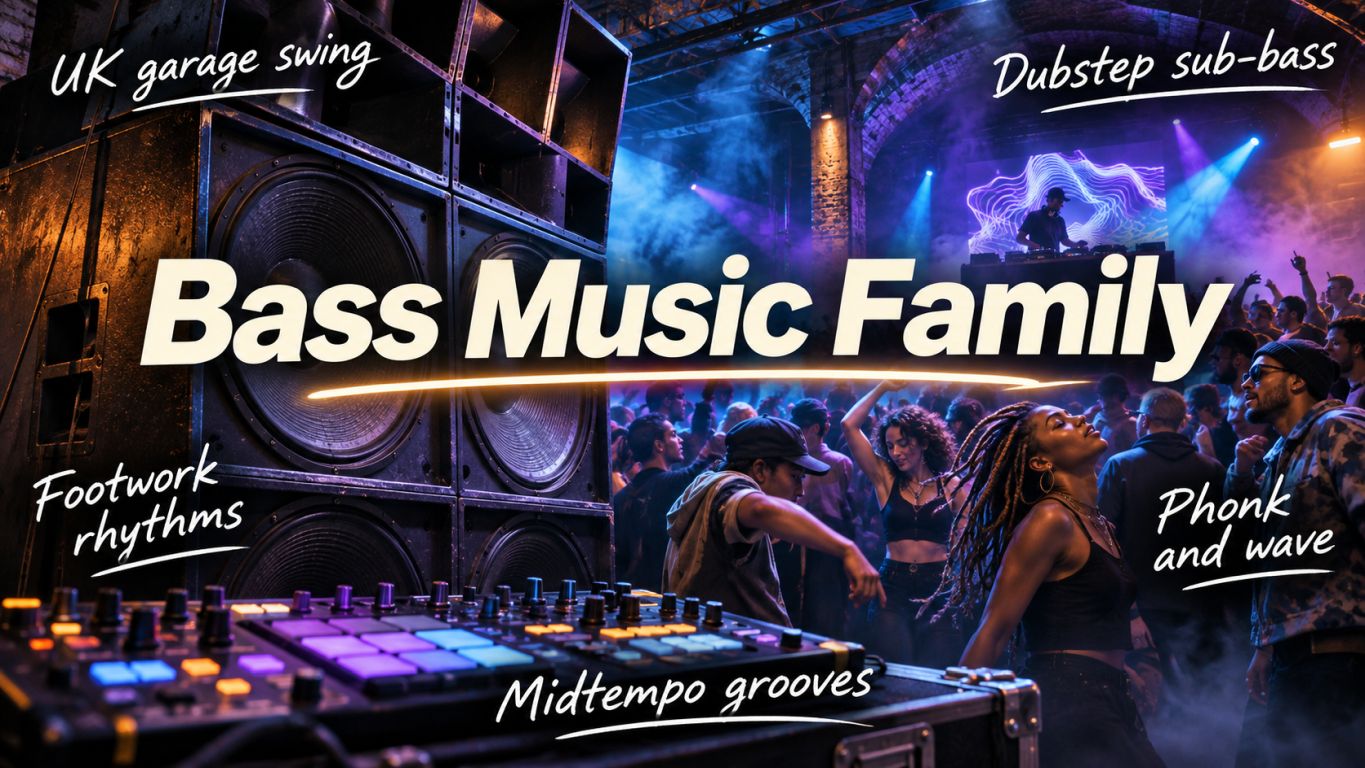
What Is the Bass Music Family?
The Bass Music Family brings together electronic genres in which low frequencies, rhythmic invention, or bass-focused sound design play a central role. It covers everything from the shuffle of UK garage to the rapid percussion of Chicago footwork and the slower, weighty pulse of midtempo bass. There is no single drum pattern, tempo, or production technique shared by every branch.
The phrase bass music can describe many bass-heavy records. The Bass Music Family brings together several distinct genres, including UK Bass Music, which has its own rhythmic traditions and history.
Origins and Shared Influences
The family does not have one birthplace or a single line of descent. In Britain, 1990s UK Garage Music drew on house, R&B, jungle, and Jamaican-influenced club culture. During the early 2000s, London's record shops, pirate radio stations, and club nights helped shape Grime Music and Dubstep Music, which developed along related but distinct paths.
Across the Atlantic, Footwork Music emerged from Chicago's ghetto house and juke scenes, closely tied to competitive dancing. Phonk Music has a different background in Memphis-influenced hip-hop and later online production communities. Other branches, such as EDM trap, future bass, and wave, reflect still more crossovers between electronic dance music and hip-hop production.
These styles share musical ideas without necessarily descending from the same earlier style.
The Ten Main Branches of the Bass Music Family
Explore ten bass-focused genres and their subgenres below.
1. UK Bass Music
UK Bass Music brings together bass-forward British club approaches, often combining garage-derived swing, house rhythms, and experimental sound design.
- UK Funky Music: Percussion-rich club music drawing on house, soca, and African-influenced rhythmic patterns.
- Wonky Music: Off-kilter beats, elastic bass, and colorful, deliberately unstable synthesizer sounds.
2. Footwork Music
Footwork Music grew from Chicago's fast-paced dance-battle culture. It is known for sharply syncopated drums, repeated vocal fragments, and patterns that leave room for intricate movement.
- Footwork Jungle Music: Combines footwork's rhythmic approach with the chopped breaks and bass pressure of jungle.
Footwork has strong historical ties to Chicago Juke Music and ghetto house. Juke retains close ties to house, while footwork develops a more fragmented, bass-focused rhythmic language. Their shared Chicago history is essential to understanding either style.
3. Dubstep Music
Dubstep developed in South London around the turn of the 2000s, drawing on UK garage, dub, and jungle. Early forms emphasized space and sub-bass; later branches explored more melodic or aggressive sounds.
- Brostep Music: Prominent, distorted midrange bass and high-impact drops.
- Deathstep Music: Especially harsh bass design with dark, metal-influenced textures.
- Post-Dubstep Music: A broad, experimental continuation that blends dubstep influences with other electronic and song-based styles.
- Riddim Dubstep Music: Repetitive, tightly syncopated bass phrases and relatively stripped-back arrangements.
- Tearout Dubstep Music: Aggressive bass modulation, abrasive timbres, and forceful drops.
- Deep Dubstep Music: Spacious percussion, weighty sub-bass, and a restrained approach to sound design.
- Melodic Dubstep Music: Combines dubstep rhythms and bass weight with expressive chords and prominent melodies.
4. EDM Trap Music
EDM Trap Music adapts trap-inspired hi-hats, 808 bass, and spacious drum patterns for electronic dance arrangements and drops.
- Hybrid Trap Music: Combines trap rhythmic ideas with more elaborate bass design drawn from other electronic styles, particularly dubstep.
5. Future Bass Music
Future Bass Music emphasizes bright or emotional harmonies, animated synth chords, bass movement, and often processed vocal textures.
- Kawaii Future Bass Music: A playful variation associated with bright melodies, chiptune-like tones, and colorful electronic textures.
6. Grime Music
Grime Music emerged in London in the early 2000s. Common features include sparse, angular electronic instrumentals around 140 BPM and energetic MC performances, although instrumental productions are central to the style as well.
- EskiBeat Music: A stark, futuristic grime sound associated with Wiley's early productions.
- Instrumental Grime Music: Focuses on grime's rhythmic patterns and synth motifs without requiring an MC vocal.
7. Phonk Music
Phonk Music draws on Memphis rap aesthetics, sampling, and lo-fi hip-hop production. Its later electronic offshoots often place more emphasis on distorted bass and sharply defined leads; cowbell melodies are especially associated with drift phonk rather than every form of phonk.
- Brazilian Phonk Music: A contemporary crossover that blends phonk-associated sounds with Brazilian funk influences.
- Drift Phonk Music: Recognizable for distorted bass, cowbell-led melodies, and forceful rhythmic loops.
8. UK Garage Music
UK Garage Music is associated with shuffled percussion, syncopated basslines, and often chopped or pitched vocal samples. Some forms use a steady four-on-the-floor kick; others use more broken patterns.
- 2-Step Garage Music: Skipping kick placement and swung percussion create a distinctive, broken groove.
- Bassline Music: Bouncy, prominent bass hooks and high-energy club rhythms.
- Breakstep Music: Broken breakbeat patterns combined with garage-influenced production.
- Future Garage Music: Airy pads, spacious arrangements, and garage-derived rhythmic details.
- Speed Garage Music: Driving garage beats, heavy bass movement, and energetic vocal sampling.
9. Wave Music
Wave Music brings together atmospheric synthesizers, trap-influenced drums, and deep bass, often with an introspective or cinematic character.
- Hardwave Music: A more forceful variation with stronger trance influences, larger synth leads, and heavier drops.
10. Midtempo Bass Music
Midtempo Bass Music favors a deliberate, often dark groove, distorted or modulated bass, and a slower pulse than many festival-oriented bass styles. It commonly sits around 90-115 BPM, though tempo alone does not define it.
Comparing the Rhythms and Sounds
Different branches can share production techniques while placing the rhythmic emphasis in different places. These are broad reference points, not fixed genre requirements.
| Genre or Group | Common Tempo or Feel | Distinctive Features |
|---|---|---|
| UK Garage Music | Often around 128-140 BPM | Swung hats, shuffled or 2-step kicks, vocal chops |
| Grime Music | Often around 140 BPM | Sparse, angular beats and space for MC vocals |
| Dubstep Music | Often around 140 BPM, frequently felt at 70 BPM | Half-time drums, sub-bass, varied degrees of distortion |
| Footwork Music | Often around 155-165 BPM | Rapid, syncopated percussion and cut-up vocal phrases |
| EDM Trap Music and Future Bass Music | Variable; half-time feel is common | Trap-derived drums, bass drops, or expressive synth chords |
| Phonk Music and Wave Music | Highly variable across substyles | Hip-hop-derived rhythms, atmospheric or distorted bass textures |
| UK Bass Music | Variable across its styles | Club percussion, syncopation, and experimental bass design |
| Midtempo Bass Music | Often around 90-115 BPM | Slower, heavy grooves and modulated bass |
Crossovers and Evolution
The borders between these styles are flexible. A producer might pair the chords of Future Bass Music with the sound design of Hybrid Trap Music, or combine the atmosphere of Wave Music with the heavier synth leads of Hardwave Music. These crossovers expand the musical possibilities.
Exploring the Family
The Bass Music Family offers several approaches to bass-centered Electronic Music: garage swing, grime's sparse intensity, dubstep's low-end space, footwork's rhythmic complexity, and the contrasting atmospheres of phonk, wave, and midtempo bass. The linked genres and subgenres offer starting points for exploring these sounds in greater depth.