




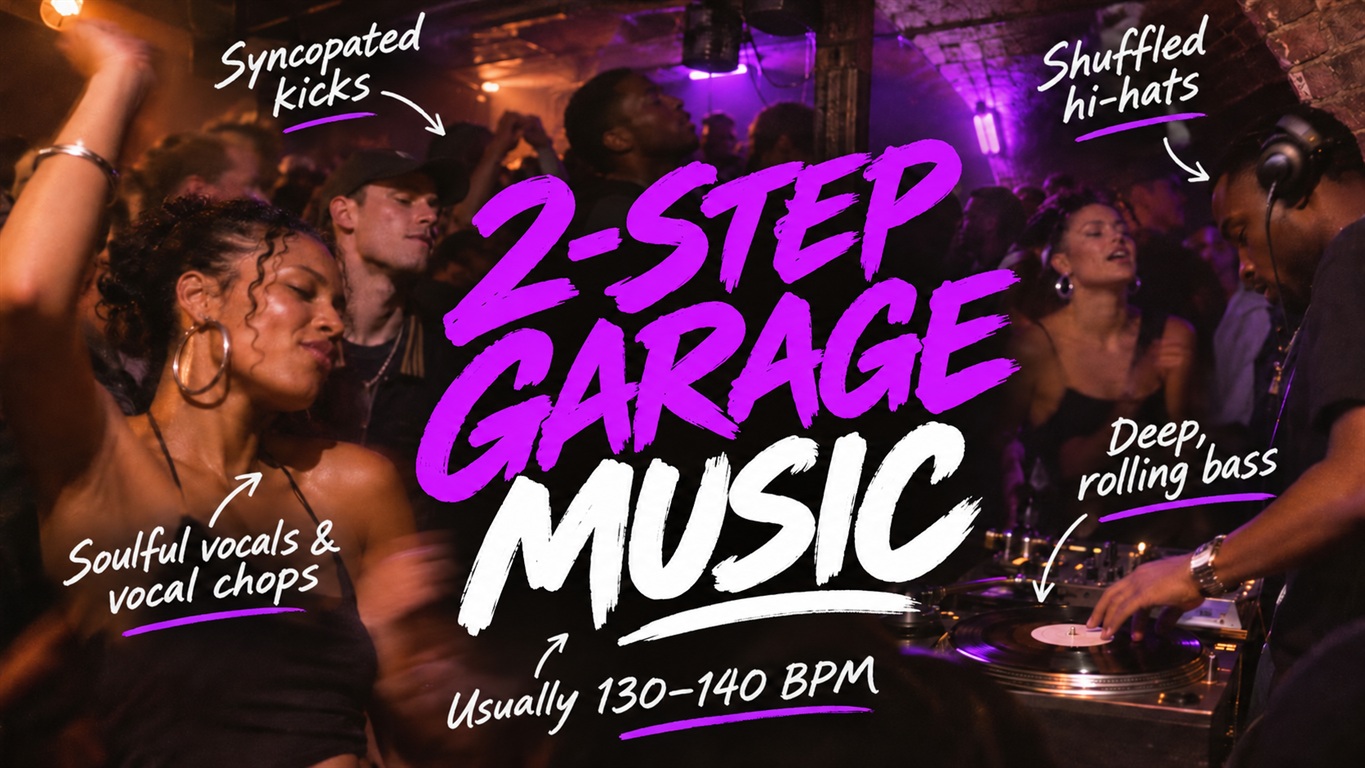
2-Step Garage Music is a subgenre of UK Garage Music built around skipping drums, shuffled percussion, deep bass, and often soulful or chopped vocals. It developed in Britain's 1990s club scene and became widely recognizable through artists such as MJ Cole, Artful Dodger, Wookie, and Craig David.
Its signature move is to leave out some of the kick drums you expect. The clap keeps you oriented while the bass and hats take the scenic route. Apparently, a beat can improve its attendance record by showing up less often.
You can hear that bounce in a polished vocal song or a sparse club track. The mood changes; the conversation between the sounds does the work.
What does 2-step garage sound like?
In much House Music, a four-on-the-floor kick lands on every quarter-note beat of a 4/4 bar. 2-step breaks up that regular pulse. Some kicks disappear, others arrive between the main beats, and the groove starts to skip.
A snare or clap often remains on beats two and four, providing a clear backbeat. Around it, shuffled hats and bass notes create movement without needing to fill every available space.
| Element | What you usually hear | What it contributes |
|---|---|---|
| Tempo | Often around 130-140 BPM | A brisk dance pulse, with room for variation |
| Kick | Broken, syncopated patterns | The characteristic skipping feel |
| Snare or clap | A backbeat on two and four | A steady reference inside the moving rhythm |
| Hi-hats and percussion | Shuffled subdivisions and varied accents | Swing, lightness, and forward motion |
| Bass | Deep notes or more textured synth phrases | Weight and a rhythmic answer to the drums |
| Vocals | Full singing, short phrases, or chopped syllables | Melody, emotion, and sometimes extra percussion |
| Harmony | Often warm chords or electric-piano-like sounds | A soulful setting, when the track calls for one |
These are common ingredients, not an entry form. Instrumental, darker, and more stripped-back records belong here too. A specific synthesizer or expensive collection of dusty samples is optional.
Does 2-step mean two beats per bar?
Usually, the music is still in 4/4. The name refers to the rhythmic approach, not a requirement for 2/4 time. Nor does every bar need exactly two kicks. Two hits make a useful beginner pattern; the rest of the genre has been rather busy exploring alternatives.
The BPM range is also a guide. Speeding a straight house loop up to 134 BPM changes its tempo. It does not automatically change its musical identity.
Where did 2-step garage come from?
2-step developed within the British UK garage scene during the 1990s, particularly around London and its club and radio networks. American Garage House Music, R&B, and Britain's sampling and bass culture all helped shape the sound.
American producer Todd Edwards was an important influence through his intricate vocal editing and swinging house productions. British producers took related ideas in their own directions, breaking up the kick pattern and making more space for basslines and vocal responses. His influence does not make every Todd Edwards recording a 2-step track.
By the late 1990s and early 2000s, producers including MJ Cole, Artful Dodger, Wookie, Sunship, Zed Bias, Steve Gurley, and Groove Chronicles were showing how varied the approach could be. Craig David became a recognizable voice of its pop crossover, while DJ EZ helped bring the wider UK garage sound to listeners through his selections and mixing.
Some records were warm and romantic; others sounded like the bass had something urgent to discuss. Both approaches could make excellent use of a few missing kicks.
Why the drums, bass, and vocal chops work together
The rhythmic foundation is syncopation: an accent arrives somewhere unexpected, or an expected hit is left out. A kick just after a clap produces a different push from one directly beneath it. Move one note and the whole phrase can seem to lean in a new direction.
Swing changes the spacing of selected subdivisions, giving them a long-short feel. Hats and small percussion sounds often carry the shuffle. It is deliberate timing, not the musical equivalent of dropping the drum machine down the stairs.
Every sound does not need the same swing setting. A dependable clap can make looser hats feel more effective. Listen to the combined groove rather than assuming that turning the swing control further must improve it.
The bassline works as another rhythmic voice. It can answer the kick, anticipate a clap, or sustain across a gap. Rounded sub-bass and more nasal, midrange-rich tones can both work. What matters is whether the bass and drums cooperate.
Vocals can do two jobs at once. A complete phrase carries a song; a chopped vowel or breath can become a rhythmic hook. Warm chords may join them, but the arrangement does not need to appoint a new instrument every time there is a silence.
Essential 2-step garage songs and artists
Start with these three records, listening for the relationship between the voice, backbeat, and bass rather than treating the drop as the only part worth noticing.
- MJ Cole - "Sincere" (1998). Hear how warm harmony and vocal fragments fit around the skipping drums. In an interview about making "Sincere", Cole describes finding his own approach to garage rather than simply copying an established formula.
- Artful Dodger featuring Craig David - "Re-Rewind (The Crowd Say Bo Selecta)" (1999). A direct vocal hook sits inside an active drum-and-bass conversation. Its crossover reached well beyond the clubs: Official Charts records a UK singles peak of number two.
- Wookie featuring Lain - "Battle" (2000). Compare the soulful singing and springy, weighty bass with the other two. Wookie's chart history places its UK top-ten run in 2000.
Then explore productions and remixes by Sunship, Steve Gurley, Zed Bias, and Groove Chronicles. Check the version name: an original vocal mix, a dub, and a remix may give the same song very different rhythmic lives. The title alone is not always doing enough administrative work.
2-step garage vs UK garage, speed garage, and dubstep
UK garage is the broader genre. 2-step is one of its subgenres, alongside approaches that retain a regular four-beat kick. That distinction saves a lot of confusion before anyone even opens a drum sequencer.
| Genre | Rhythmic character | How it relates to 2-step |
|---|---|---|
| UK Garage Music | Includes both broken-kick and four-on-the-floor approaches | The wider genre that includes 2-step |
| 2-Step Garage Music | Syncopated kicks, a clear backbeat, and often shuffled percussion | The skipping, broken-kick approach discussed here |
| Speed Garage Music | Commonly a kick on every quarter-note beat, with shuffle and prominent bass | A related UK garage subgenre with a more continuous kick pulse |
| Dubstep Music | Often more spacious, with bass-led arrangements and a pronounced half-time feel | Developed partly from darker UK garage experiments, then established its own musical language |
The table describes tendencies. Bass sounds, samples, and production techniques cross these boundaries regularly. A dark bass preset does not arrive with a binding genre certificate.
A track can also borrow a 2-step rhythm without sounding like a late-1990s UK garage record. Listen to the full combination of groove, sound, arrangement, and context.
How to make a 2-step garage beat
Set your project to 134 BPM and make a one-bar loop in 4/4. Put a short clap or snare on beats two and four. Add a kick on beat one, then another on the "and" of beat three, halfway between beats three and four. Leave the other quarter-note kick positions empty.
This is a starting exercise, not the official pattern. There is no official pattern. The paperwork would be unbearable.
Add closed hi-hats and try delaying selected sixteenth-note hits slightly. Compare the groove with and without swing, keeping the backbeat clear. Vary the hat velocities so that the quieter notes support the accents rather than competing with them.
Write a short bass phrase that answers the kicks. Leave gaps, shorten notes, and check whether the kick and bass remain distinct when they overlap. Timing and note length often solve problems that another effect merely makes louder.
Add a chord shape and a brief original or properly licensed vocal phrase. Slice the voice into a few fragments. Repeat one, move another to a different subdivision, and let them answer the percussion. You do not need to use every fragment just because the sampler has generously made them available.
Extend the loop to eight bars. Change a hat accent, remove a bass note, or let the vocal disappear at a phrase ending. Mute the decorative effects and listen again: the drums and bass should still have a convincing relationship.
That is the lasting appeal of 2-step garage. A little swing, a good bassline, and a well-placed gap can do a remarkable amount of work. Sometimes the most useful note is the one that stays home.