




What Is Electro Swing Music?
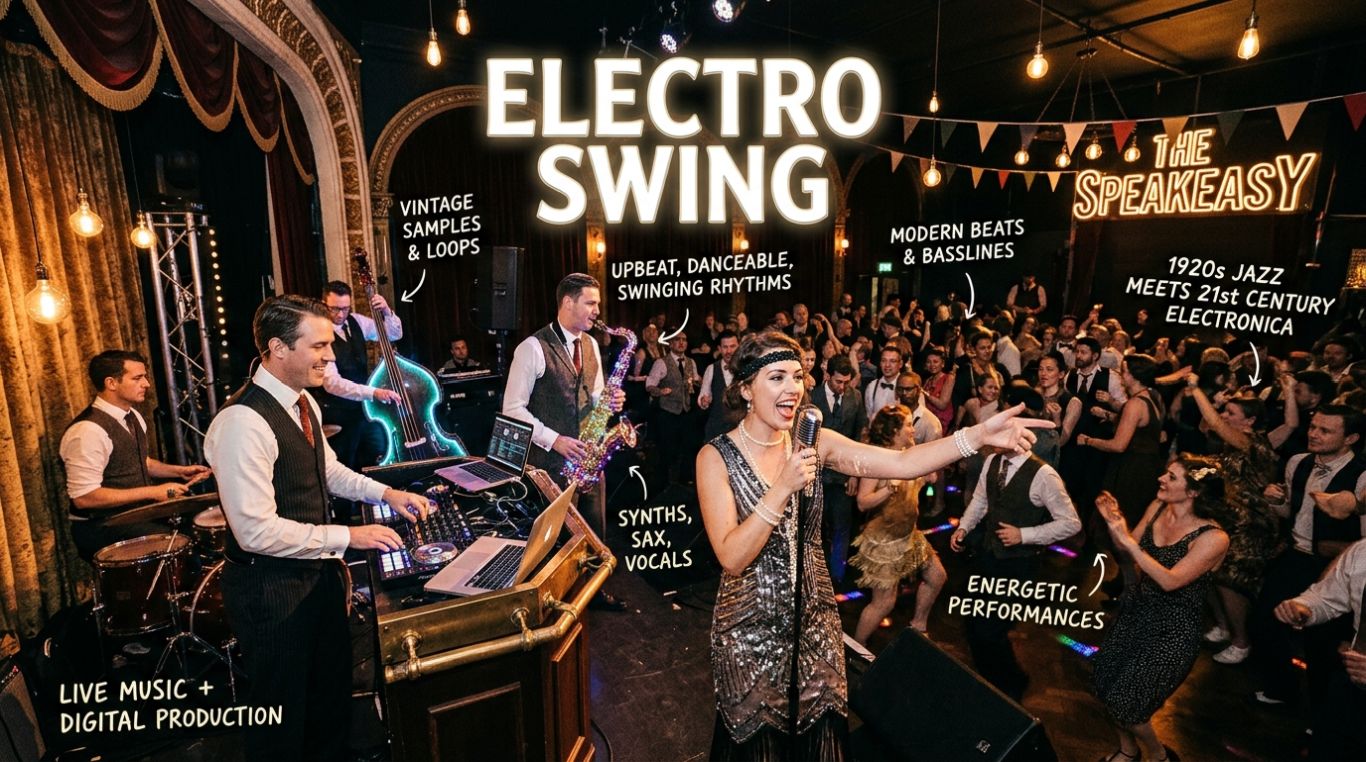
Electro swing is a style of electronic dance music that combines the sounds of vintage jazz and swing with modern beats, basslines, sampling, and digital production. Its most recognizable features include energetic brass melodies, syncopated rhythms, piano riffs, retro-style vocals, and electronic grooves influenced by house, hip-hop, breakbeat, and drum and bass.
The music draws heavily on jazz and swing traditions associated with the 1920s through the 1940s, although its influences extend beyond that period. Some tracks transform samples from historical recordings, while others feature newly recorded instruments and original compositions inspired by earlier musical styles.
Electro swing is not defined by a single tempo, drum pattern, or production technique. Its identity comes from the interaction between vintage musical characteristics and contemporary electronic arrangements.
The result can range from playful, sample-driven club tracks to elaborate live performances featuring vocalists, horn sections, acoustic instruments, and electronic production.
The History and Development of Electro Swing
Musical Roots: Jazz, Swing, and Early Dance Music
Electro swing's musical foundations lie in several traditions, particularly early jazz, swing, ragtime, and related forms of popular dance music.
Jazz developed through African American musical traditions during the late nineteenth and early twentieth centuries. Its rhythmic vocabulary, improvisation, expressive phrasing, and instrumental arrangements became important influences on subsequent popular music.
Swing emerged as a particularly influential jazz style during the 1930s and 1940s. Large ensembles, commonly known as big bands, helped popularize arrangements featuring brass sections, reeds, piano, bass, and drums.
Swing music often emphasizes a flexible rhythmic feel in which notes are not necessarily divided into equal subdivisions. Musicians create momentum through accents, phrasing, syncopation, and interaction within the rhythm section.
These characteristics became valuable musical resources for electronic producers interested in combining older recordings with contemporary dance rhythms.
Electro swing also draws inspiration from smaller jazz ensembles, hot jazz, and jazz manouche, sometimes called gypsy jazz, particularly through acoustic guitar, violin, clarinet, and double bass arrangements.
Early Experiments in the 1990s
Electro swing did not originate with a single artist or recording.
During the 1990s, producers working in house, hip-hop, breakbeat, and related electronic styles increasingly incorporated jazz recordings, vintage instrumental phrases, and swing-influenced arrangements into their music.
The Dutch group Doop achieved international success with "Doop" in 1994, an early example of combining vintage dance-band aesthetics with electronic club production.
Other recordings, including Mr. Scruff's "Get a Move On!" from 1999, demonstrated how sampled jazz material could be transformed into contemporary electronic arrangements.
These recordings were not necessarily described as electro swing when released. Nevertheless, they illustrate important musical approaches that later became associated with the genre.
The development of sampling technology, digital audio workstations, and Electronic Music production also made it easier to manipulate historical recordings and integrate them with programmed rhythms.
Electro Swing Takes Shape in the 2000s
During the early and mid-2000s, electro swing became increasingly recognizable as a distinct musical style and club culture, particularly in parts of Europe.
Austrian producer Marcus Füreder, professionally known as Parov Stelar, became one of the genre's most influential figures. His work combined jazz-influenced samples, electronic basslines, and dance-oriented arrangements.
French group Caravan Palace developed another prominent approach by combining electronic production with live instrumentation, jazz manouche influences, and original compositions.
Rather than simply placing electronic drums underneath old recordings, these artists demonstrated how vintage musical ideas could be reorganized into complete contemporary arrangements.
Labels, compilation series, DJs, and club events also contributed to the development of an identifiable electro swing scene.
In the United Kingdom, the Freshly Squeezed label and associated events helped introduce the sound to wider club audiences.
International Recognition in the 2010s
Electro swing reached broader audiences during the 2010s through international releases, festivals, online videos, and dance communities.
Yolanda Be Cool and DCUP's "We No Speak Americano," released in 2010, became an international hit. Although its classification is not limited to electro swing, its combination of vintage vocal material and contemporary house production helped expose similar musical ideas to mainstream listeners.
Artists such as Parov Stelar, Caravan Palace, Tape Five, Swingrowers, and Electric Swing Circus developed distinct interpretations of the sound.
Online platforms also helped electro swing circulate beyond its original club scenes. Music videos, dance tutorials, and independently produced remixes introduced the style to audiences interested in both Electronic Music and vintage aesthetics.
Today, electro swing remains a recognizable musical niche with an international audience, although its popularity varies across regions and periods.
What Makes Electro Swing Sound Different?
Electro swing combines musical characteristics that are often associated with different periods and production traditions.
Its distinctive sound depends less on a fixed formula than on how these elements interact.
| Feature | Traditional Swing Music | Electro Swing Music |
|---|---|---|
| Historical context | Developed prominently during the 1930s and 1940s | Developed as a recognizable electronic style during the 1990s and 2000s |
| Rhythm | Acoustic rhythm sections, swing phrasing, and interactive timing | Programmed beats combined with swing-influenced phrasing and syncopation |
| Instrumentation | Brass, reeds, piano, guitar, double bass, and acoustic drums | Jazz instruments combined with synthesizers, samplers, and electronic drums |
| Bass | Double bass and other acoustic bass instruments | Sampled bass, electric bass, synthesized bass, or combinations |
| Production | Primarily ensemble-based recording and performance | Sampling, editing, sequencing, effects, and live recording |
| Arrangement | Jazz ensemble arrangements and instrumental interaction | Repeated hooks, electronic transitions, loops, and dance-oriented structures |
| Performance | Jazz clubs, ballrooms, concerts, and dance halls | Clubs, festivals, concerts, themed events, and hybrid live performances |
Wind Instruments and Melodic Hooks
Trumpets, trombones, saxophones, and clarinets are among the most recognizable sounds associated with electro swing. Trumpets and trombones are brass instruments; saxophones and clarinets belong to the woodwind family.
Producers frequently use short wind-instrument phrases as repeating hooks. These may be sampled from recordings, played by session musicians, or created with virtual instruments.
A short trumpet phrase, for example, can become the central melodic element of an entire track.
Brass arrangements may feature sharp rhythmic accents, call-and-response phrases, harmonized melodies, and short instrumental fills.
However, brass instruments are not mandatory. Some electro swing recordings emphasize piano, acoustic guitar, violin, or vocals instead.
Swing Rhythm and Syncopation
Rhythm is central to electro swing, but two related concepts should be distinguished.
Swing feel describes a rhythmic interpretation in which subdivisions are often played unevenly, creating a characteristic long-short relationship. The exact timing varies with tempo, style, and performance.
Syncopation involves emphasizing notes or accents that fall away from the most strongly expected beats.
Electro swing frequently combines these characteristics with electronic drum patterns.
A producer might use a straight house kick pattern while placing swung brass phrases, piano notes, or percussion around it.
This creates a contrast between the stable electronic pulse and the more flexible phrasing associated with jazz.
Not every electro swing track uses a strongly swung drum pattern. Some rely primarily on syncopated melodies and vintage instrumentation to establish their musical identity.
Electronic Drums and Basslines
Electronic percussion gives many electro swing recordings their dance-oriented character.
Common rhythmic approaches include:
- House rhythms: A kick drum on every quarter-note beat in 4/4, commonly called four-on-the-floor, with claps, snares, and hi-hats supporting the groove.
- Hip-hop rhythms: Patterns that emphasize backbeats, rhythmic space, and sample-based percussion.
- Breakbeats: Syncopated drum patterns built from programmed hits or edited drum recordings.
- Drum and bass rhythms: Faster arrangements using complex breakbeat patterns and prominent bass.
Basslines may be played on double bass, sampled from older recordings, or synthesized electronically.
Some producers combine acoustic-style bass phrases with deeper electronic bass layers. Others use a single bass instrument to keep the arrangement clear.
The relationship between kick drum and bass is especially important because both occupy overlapping low-frequency ranges.
Vintage Vocals and Piano
Electro swing frequently uses vocal styles inspired by early jazz, blues, cabaret, and swing-era popular music.
These may include scat singing, theatrical vocal delivery, close harmonies, and short repeated phrases.
Some productions use samples of historical vocal recordings, while others feature contemporary singers performing original material.
Piano also plays an important role. Ragtime-inspired passages, stride-style accompaniment, short jazz chords, and syncopated piano riffs can provide much of a track's vintage character.
These musical references are stylistic choices rather than requirements. A track can be recognizably electro swing without using vocals or piano.
Electro Swing Styles and Related Musical Influences
Electro swing is often treated as an umbrella term for several approaches to combining vintage jazz influences with electronic production.
The names used for these approaches are not always standardized. Some function as established scene descriptions, while others are informal labels for particular combinations of musical characteristics.
They should not automatically be interpreted as independent genres with universally agreed boundaries.
Swing House
Swing house combines swing-influenced musical material with House Music production.
A typical arrangement uses a steady four-on-the-floor kick pattern, electronic bass, and jazz-inspired melodic phrases.
Tempos around 120-130 BPM are common in many examples, but this range is not a strict definition.
Swing house and electro swing are sometimes used interchangeably. In more specific usage, swing house describes the house-oriented portion of the broader electro swing sound.
Swing Hop
Swing hop combines vintage jazz or swing influences with hip-hop production.
Its arrangements often emphasize sampled instrumental loops, breakbeats, and rhythmic vocal phrases.
Compared with many swing house tracks, swing hop may use slower tempos and place greater emphasis on groove rather than continuous four-on-the-floor momentum.
However, the boundaries between swing hop, instrumental hip-hop, and jazz-influenced beat music are not always clear.
Swing and Drum and Bass Fusion
Some producers combine swing-inspired brass, piano, or vocal phrases with drum and bass rhythms.
These tracks typically feature faster breakbeats, electronic bass, and energetic transitions.
Labels such as swing and bass or drum and swing are sometimes used to describe this approach.
These names are descriptive and do not necessarily identify formally established subgenres.
Electro Blues and Other Related Fusions
Electro blues combines blues-influenced vocals, guitar, and instrumental phrasing with electronic production.
It overlaps with electro swing when arrangements incorporate swing rhythms, vintage jazz aesthetics, or related dance-music influences.
Nevertheless, electro blues is not inherently a subdivision of electro swing. Blues-based Electronic Music can develop independently of swing traditions.
Similarly, jazz-influenced house, breakbeat, and other electronic styles may share musical techniques with electro swing without belonging to the same genre.
The most useful distinction is the overall musical arrangement, not simply the presence of a jazz sample.
How Electro Swing Music Is Produced
Electro swing production typically involves balancing vintage musical characteristics with the clarity and rhythmic consistency expected in contemporary Electronic Music.
There is no compulsory software, instrument, or workflow. Producers can create the style through sampling, live recording, synthesis, or combinations of these techniques.
1. Establish the Rhythmic Foundation
A producer usually begins by choosing the rhythmic direction of the track.
A house-oriented arrangement might use a tempo near 125 BPM and a four-on-the-floor kick pattern.
A hip-hop-influenced arrangement may use a slower beat with greater rhythmic space, while a drum and bass fusion would generally require a substantially faster tempo.
The choice of tempo should support the musical material rather than follow a fixed electro swing rule.
When using swing-influenced samples, the producer must also consider their timing.
Historical recordings were often performed without a metronome, so their tempo may fluctuate naturally.
A rigid electronic drum pattern can clash with these variations unless the sampled material is carefully edited or the programmed rhythm is adapted.
2. Select or Record Vintage-Inspired Material
The next step is to establish a recognizable musical identity.
Suitable material might include:
- Short trumpet or saxophone phrases.
- Clarinet melodies and brass section accents.
- Ragtime-inspired piano figures.
- Double bass patterns.
- Jazz guitar or violin phrases.
- Scat vocals or vintage-style singing.
These elements can come from newly recorded performances, licensed samples, properly cleared recordings, or other material the producer is authorized to use.
An important distinction concerns copyright.
An old musical composition and a particular sound recording may have separate rights. A recording that sounds historical is not automatically free to sample.
Producers should verify the applicable rights before distributing music containing third-party recordings.
3. Edit and Arrange the Musical Phrases
Sampling allows a producer to transform existing audio into new musical structures.
Common techniques include:
- Chopping: Dividing a recording into shorter phrases or individual hits.
- Time-stretching: Changing audio duration to fit a target tempo.
- Pitch-shifting: Adjusting the pitch of a sample.
- Filtering: Changing the frequency balance of a sound.
- Looping: Repeating selected musical passages.
- Rearranging: Changing the order and placement of musical fragments.
For example, a two-bar brass phrase might be divided into several shorter sections and rearranged into a new four-bar hook.
The producer can then build variations by changing the timing, pitch, or rhythmic placement of individual fragments.
Excessive time-stretching or pitch-shifting may introduce audible artifacts, particularly in complex recordings containing several instruments.
Sometimes preserving the original character of the recording produces better results than forcing every note onto a rigid grid.
4. Build the Bassline
Bass is essential to the relationship between vintage instrumentation and modern electronic production.
A producer might use a double bass sample for a more acoustic character or a synthesized bassline for stronger electronic emphasis.
Combining both approaches is possible, but their frequency ranges must be managed carefully.
If a sampled double bass and a synthesizer play simultaneously, their overlapping low frequencies can create masking or an excessively dense mix.
Arranging the parts in different registers, reducing unnecessary low frequencies, or allowing them to alternate can improve clarity.
5. Create a Modern Arrangement
Electro swing often adapts structural techniques from electronic dance music.
A typical arrangement might include an introduction, verse or main groove, contrasting section, breakdown, return of the main hook, and outro.
Some tracks also use build-ups and drops, particularly when influenced by contemporary club production.
These structures are optional.
Live-band electro swing may follow more conventional song forms, with verses, choruses, instrumental solos, and transitions performed by the ensemble.
A strong arrangement allows the vintage musical elements and electronic production to complement each other rather than compete continuously for attention.
6. Mix Vintage and Electronic Sounds
One of the main production challenges is maintaining a coherent sound when combining recordings with very different sonic characteristics.
Historical recordings may contain restricted frequency ranges, noise, room ambience, or limited stereo information.
Modern synthesizers and drum samples are often much cleaner and more extended in frequency response.
Producers may use equalization, compression, saturation, reverberation, and filtering to help these elements fit together.
However, vintage character does not require deliberately degrading every sound.
For example, a slightly filtered brass sample can coexist effectively with a clean electronic kick and bassline.
The objective is a balanced arrangement that preserves the personality of the musical material.
For a practical production example, see the Native Instruments electro swing production tutorial.
Electro Swing Dance and Cultural Identity
Electro swing is associated with a distinctive visual and social culture that combines references to historical dance music with contemporary club environments.
However, the culture is not uniform. Events, audiences, and performance practices vary considerably.
Dance Styles
Electro swing dancing often draws from several different traditions.
Charleston-inspired footwork, Lindy Hop movements, and other swing dance techniques may appear alongside contemporary shuffle and street dance movements.
Dancers frequently combine these influences rather than following a single standardized electro swing dance system.
This flexibility reflects the music itself, which brings together rhythmic characteristics from different musical traditions.
Fast footwork, changes in direction, rhythmic accents, and improvisation are common features of many electro swing dance performances.
Nevertheless, there is no requirement to perform a particular dance style when listening to electro swing.
Fashion and Vintage Aesthetics
Some electro swing events feature clothing and visual themes inspired by the early twentieth century.
Examples include waistcoats, suspenders, hats, vintage-style dresses, and accessories associated with historical jazz and dance cultures.
Stage designs may also incorporate Art Deco references, cabaret imagery, and retro-inspired lighting.
These visual elements contribute to the atmosphere of themed events, but they are not essential characteristics of the music.
It is also important to distinguish historical accuracy from modern reinterpretation. Electro swing fashion often combines references from several decades rather than reproducing one specific historical period.
Clubs, Festivals, and Live Performances
Electro swing appears in several performance environments.
DJ sets emphasize the genre's relationship with electronic dance music, using mixing, transitions, and continuous rhythmic energy.
Live-band performances may feature singers, brass instruments, guitar, bass, drums, and electronic backing tracks.
Hybrid performances combine these approaches, allowing musicians to improvise or perform original arrangements over programmed electronic material.
Specialized club nights and festivals have played an important role in building the genre's audience.
Online communities, dance videos, and independently released recordings have also contributed to its international circulation.
Conclusion
Electro swing combines jazz and swing influences with electronic rhythms, sampling, synthesis, and modern arrangement techniques.
Its development reflects contributions from multiple artists and Electronic Music scenes rather than a single inventor or definitive starting point.
The genre encompasses house-oriented productions, hip-hop-influenced grooves, breakbeat experiments, and live-band performances. Its boundaries are flexible, and its musical identity depends on more than tempo or instrumentation alone.
Understanding electro swing requires attention to both sides of its sound: the historical musical traditions that inspire it and the contemporary production methods that transform those influences into new compositions.