




What Is Future House Music? Origins and History
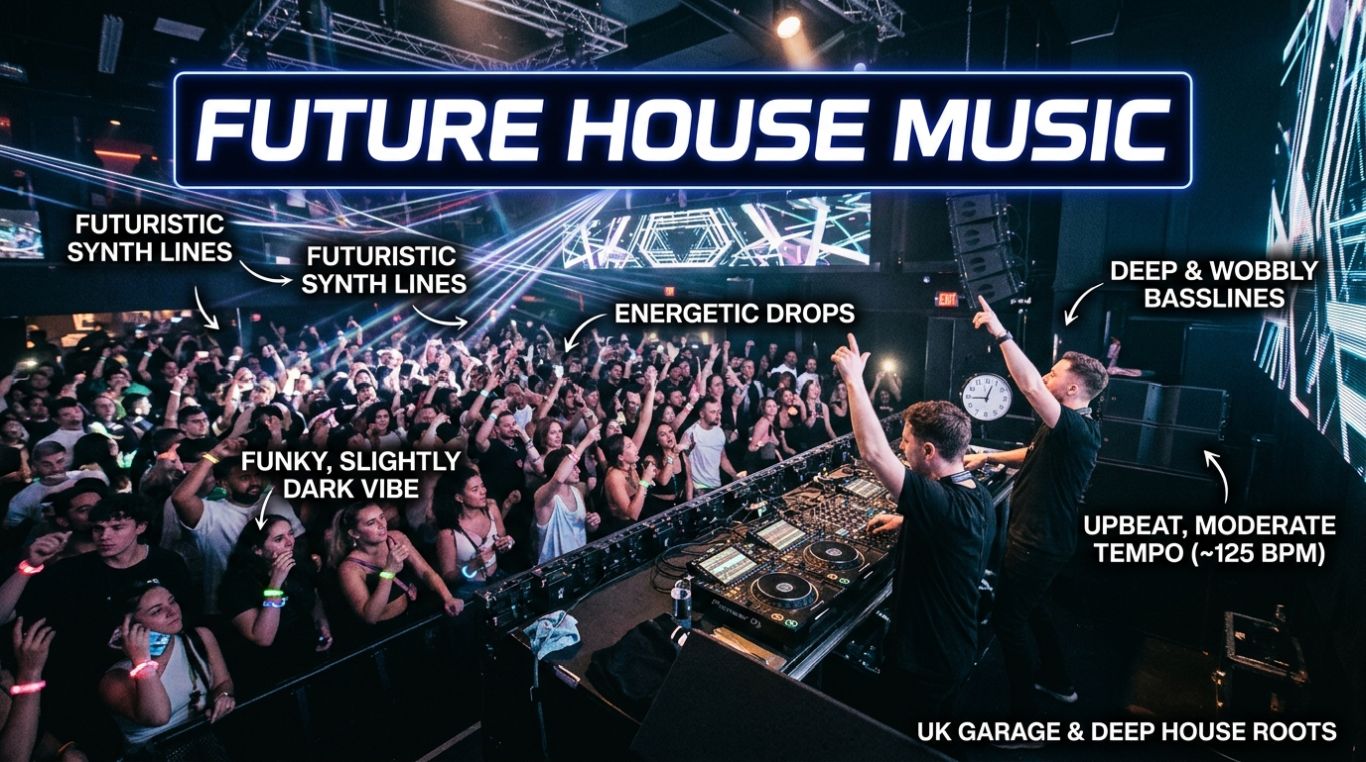
Future house is an electronic dance music style combining house rhythms with prominent basslines, distinctive synthesizer textures, and contemporary production techniques. Emerging in the early 2010s, it offered an alternative to the dense synthesizer layers and dramatic drops common in some festival-oriented Electronic Music.
Its defining feature is often a rhythmically expressive bassline functioning as the main musical hook.
Musical Roots
Future house developed from established house traditions. House originated in Chicago during the early 1980s, drawing on disco, soul, funk, and electronic experimentation.
Deep house, electro house, and UK garage-influenced dance music subsequently contributed ideas that shaped future house. Producers combined groove-focused rhythms with unusual bass timbres, gradually developing a recognizable sound.
Tchami and Oliver Heldens
French producer Tchami helped popularize the term future house around 2013. Tracks such as "Promesses" and "Shot Caller" demonstrated his approach to spacious arrangements, carefully shaped basslines, and house grooves.
Dutch producer Oliver Heldens also played a central role. His instrumental track "Gecko" attracted attention in 2013 and 2014 through its distinctive bouncing bass hook.
The subsequent vocal version, "Gecko (Overdrive)," featuring Becky Hill, reached number one on the UK Singles Chart in 2014, introducing the sound to wider audiences.
Future house cannot be attributed to one inventor. Its development reflected overlapping musical ideas from several producers.
By the mid-2010s, artists, labels, DJ sets, and online platforms had established future house within international dance music.
The Signature Sound of Future House
Future house is defined by its combination of rhythmic, melodic, and electronic elements rather than a fixed tempo or synthesizer preset.
Rhythm, Tempo, and Groove
Most productions use a four-on-the-floor kick, with a kick on every quarter-note beat in 4/4 time.
Claps or snares commonly emphasize beats two and four, while hi-hats, shakers, and percussion create rhythmic movement.
Many tracks fall around 120-128 BPM, although this is not a strict requirement.
Syncopation is particularly important. Bass notes frequently fall between the main beats, creating a bouncing relationship with the steady kick.
Basslines and Synthesizer Design
The bassline often serves as the central musical hook rather than merely supporting the harmony.
Future house bass sounds may be hollow, metallic, rubbery, rounded, or sharply percussive. Their character comes from filtering, envelopes, distortion, and modulation.
Producers create these textures through subtractive, wavetable, or frequency modulation (FM) synthesis.
FM synthesis can generate complex metallic harmonics, while wavetable movement and filter automation introduce timbral changes. No single synthesis method is essential.
Short vocal chops, piano chords, plucked synthesizers, and atmospheric pads frequently complement the bassline, particularly during breakdowns.
Future House vs Related Genres
| Genre | Common Tempo | Musical Emphasis |
|---|---|---|
| Deep House | 115-125 BPM | Warm chords, soulful harmony, understated grooves |
| Future House | 120-128 BPM | Modulated bass hooks, syncopation, energetic drops |
| Bass House | 125-130 BPM | Heavy bass processing, distortion, aggressive rhythms |
| Future Bounce | 125-130 BPM | Bright melodies, bouncy bass, festival-oriented arrangements |
These ranges are approximate and overlap. Classification depends on the overall sound, not BPM alone.
Future house typically emphasizes more prominent bass hooks than traditional deep house. Bass house generally favors heavier processing, while future bounce tends toward brighter melodic arrangements.
Individual tracks may combine characteristics from several styles.
How to Produce Future House Music
Future house production involves balancing rhythmic clarity, distinctive bass design, and arrangement contrast. These techniques work in Ableton Live, FL Studio, Logic Pro, or other capable digital audio workstations.
1. Establish the Drum Groove
Begin around 125 BPM with a four-on-the-floor kick, a clap or snare on beats two and four, and offbeat hi-hats.
Add shakers or percussion selectively. Aim for a clear, danceable foundation rather than a crowded pattern.
Subtle swing can introduce movement while the kick maintains a consistent pulse.
2. Write and Design the Bassline
Create a short, syncopated bass phrase before applying complex processing.
Experiment with note length, rhythmic rests, octave changes, and repeated motifs. Simple patterns can become memorable through articulation and timbre.
Begin with a sawtooth, square, or wavetable oscillator. Use a short amplitude envelope and filter modulation to shape the attack and decay.
Introduce resonance, FM, or wavetable movement when appropriate. Saturation can add harmonics, although excessive distortion may reduce clarity.
A separate sub-bass layer can reinforce low frequencies if it complements the main bass.
3. Build Harmony and Arrangement
Use piano chords, synthesizer plucks, pads, or vocals to establish the atmosphere.
A typical structure may include an intro, groove, breakdown, build-up, drop, and outro.
Breakdowns can emphasize harmony and melody. During drops, simplifying the arrangement allows the bass hook to stand out.
Varying percussion, bass articulation, and melodic phrases between sections helps maintain interest.
4. Mix the Kick and Bass
Kick and bass often compete for low-frequency space.
Choose complementary sounds, adjust note lengths, and apply EQ where necessary.
Sidechain compression or volume automation can temporarily reduce bass level when the kick plays.
Keep complex midrange bass textures from masking vocals and chords. Musical spacing can be as effective as additional processing.
Finally, use reverb, delay, filtering, and automation to create depth and transitions without obscuring the groove.
Influential Artists and the Evolution of Future House
Several producers helped establish future house and expand its musical possibilities.
Tchami helped define the early sound through bass-focused grooves and spacious arrangements.
Oliver Heldens brought the style to wider audiences with tracks such as "Gecko," combining accessible hooks with distinctive bass production.
Don Diablo contributed to its melodic development and founded the HEXAGON label, associated with future house and related electronic styles.
Lucas & Steve explored uplifting melodies and energetic house arrangements, while Mike Williams and Brooks became associated with brighter productions often described as future bounce.
The Development of Future Bounce
During the mid-2010s, some producers emphasized brighter melodies, vocal chops, and more dramatic build-ups.
This approach became associated with future bounce.
Future bounce shares future house's rhythmic foundation and bass-focused production but commonly features more prominent melodic leads and uplifting drops.
The distinction is not universally standardized, and many productions overlap.
Continuing Influence
Future house helped popularize distinctive, modulated basslines as central musical hooks within contemporary house production.
Although these techniques existed previously, their combination became particularly recognizable during the 2010s.
Similar bass design, syncopated grooves, and contrasting arrangements continue to appear across Electronic Music styles.
Future house remains both a recognizable genre and a useful production reference for bass-driven House Music.
Conclusion
Future house combines traditional house rhythms with expressive bass sound design and contemporary electronic arrangements.
Tchami and Oliver Heldens helped establish its identity, while later producers expanded its melodic possibilities.
Although its boundaries overlap with deep house, bass house, and future bounce, its emphasis on syncopated bass hooks, modulation, and groove gives it a recognizable musical character.
Understanding future house means examining how rhythm, basslines, synthesizers, and arrangement work together; not simply identifying a tempo or preset.