




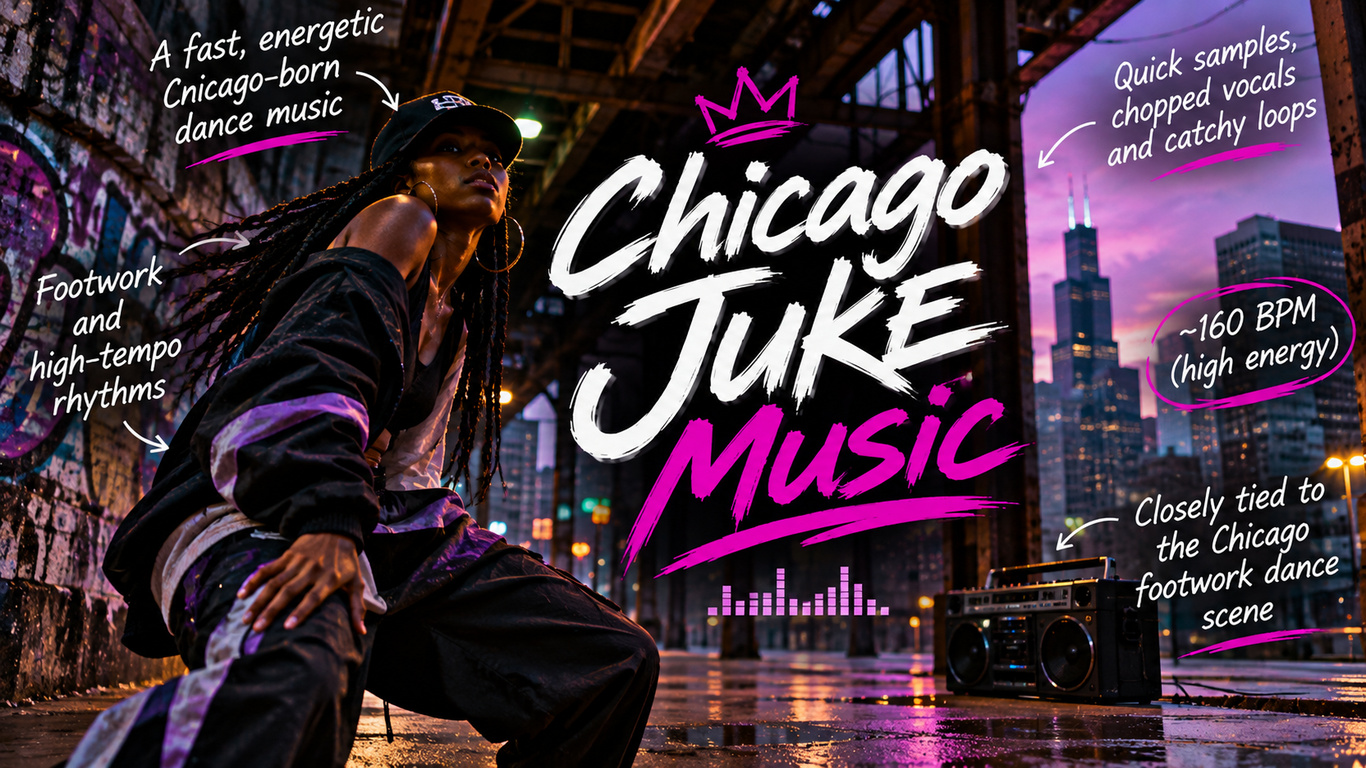
At 160 BPM, Chicago juke has no trouble sounding fast. The remarkable part is how much movement producers squeeze into the spaces between its kicks. Toms roll, vocal syllables snap into place, and a tiny loop can change direction before you have decided where the first beat went.
Chicago Juke Music grew from the city's Ghetto House Music underground. Its sound developed alongside neighborhood parties, dance crews, and the closely connected footwork scene. The music was made for people who moved to it, not just people who cataloged it later.
Where did Chicago juke come from?
The story begins with Chicago house and its faster, rawer ghetto-house offshoot in the 1990s. Producers such as DJ Deeon, DJ Funk, and DJ Slugo favored punchy drum machines, commanding vocal phrases, and bass-driven tracks that worked in local party settings.
By the late 1990s, the word juke was becoming part of the scene's vocabulary. DJ Gant-Man and DJ Puncho helped popularize the term in tracks and mixtapes, while dancers at Chicago's South and West Side parties were pushing the music toward faster and more intricate rhythms. The transition from ghetto house to juke was gradual; it was not the work of a single inventor on a single afternoon.
As the style evolved, producers including DJ Rashad, DJ Spinn, Traxman, DJ Clent, and RP Boo developed different approaches to percussion and sampling. Dancers and DJs influenced one another directly: a surprising drum break could inspire new footwork, while a difficult dance move could demand a new beat.
What does Chicago juke sound like?
The tempo is often 150-160 BPM, with 160 BPM particularly familiar. Yet the genre's signature is not just speed. Juke builds motion through syncopation: kicks, claps, and bass hits are placed where a listener might not expect them, creating a groove that keeps changing its emphasis.
| Musical element | Common characteristic |
|---|---|
| Tempo | Around 150-160 BPM; often close to 160 |
| Kick | Fast pulses, offbeat accents, and intentional gaps |
| Claps and snares | Sharp punctuation against the kick pattern |
| Toms | Rolling fills that create a second rhythmic conversation |
| Vocals | Short spoken or sung fragments repeated like percussion |
| Bass | Compact low-end hits, sometimes closely tied to the kick |
| Arrangement | Sudden mutes, tiny edits, and rapid variations of a small idea |
Because the music is so fast, 160 BPM can also feel like 80 BPM in half-time. A producer can let the bass suggest the slower pulse while the hats and toms insist on full speed. Both perceptions can exist in the same track.
The vocal chops are especially distinctive. A sampled word may repeat until its meaning becomes less important than its rhythm. It is effectively another drum, except this one occasionally has an opinion.
Juke versus footwork: the difference is not a wall
The words juke and footwork overlap considerably, and musicians from the scene have not always defined them in the same way. Both draw from the same Chicago dance culture, often share a tempo near 160 BPM, and use sharp, repeated samples.
A useful tendency, rather than a strict rule, is that juke often keeps a more immediate party bounce, while Footwork Music may use fractured beats, dramatic pauses, and patterns tailored to competitive dance battles. Some tracks fit both descriptions perfectly well.
Chicago Juke Music developed from House Music and Ghetto House Music, while Footwork Music developed a distinct, bass-focused rhythmic language. These differences do not mean the two Chicago traditions developed independently. Their shared history is essential to understanding either one.
DJs, records, and a useful listening path
Rather than starting with a random playlist labeled juke, follow a few records that reveal the scene's development and its different rhythmic purposes.
- DJ Puncho - "Juke It" (late 1990s). An early reference for the term that DJ Puncho and DJ Gant-Man helped spread through Chicago's party scene.
- DJ Spinn - "Bounce N Break Yo Back" (originally 2007). A highly recognizable juke recording that demonstrates the power of a vocal hook and a rapidly moving drum groove. It was reissued years later, so a newer release date does not make it a new composition.
- Traxman - Da Mind of Traxman (2012). Explore the jump from party-oriented rhythms toward more adventurous sampling and footwork structures.
- DJ Rashad - Double Cup (2013). Hear how the Chicago rhythmic vocabulary can coexist with melodic warmth, spaciousness, and a broad range of influences.
- RP Boo - Legacy (2013). A contrasting look at the sparse, unpredictable structures associated with the footwork side of the scene.
The last three releases sit particularly close to footwork. That is intentional: listening across the boundary explains the music better than pretending every track comes with a permanent genre certificate.
How to make a juke drum pattern
Open a DAW at 160 BPM and create a two-bar loop. Start with a short kick and clap, then add two tom sounds with different pitches. Place a few hits off the main beats and leave one or two gaps where the kick would normally go. Juke does not require the kick to land on every quarter note.
Add a brief original or properly licensed vocal phrase. Slice it into syllables, repeat one fragment, then shift another by a sixteenth note. Use the edits to answer the tom pattern rather than simply placing a full vocal over the drums.
Next, build a 16-bar section from the same materials. Every four bars, mute a kick, reverse a short sample, or remove the vocal for half a beat. Keep the bass tail short enough that consecutive low notes remain intelligible. At this speed, overlapping kick and bass decays can quickly turn an intricate groove into one long rumble.
Finally, compare the result with a conventional house beat sped up to 160 BPM. If both feel identical, your rhythm probably needs more thought. Juke is about the placement and conversation of its sounds, not merely the tempo number.
Why Chicago juke matters
Juke reflects a local exchange between producers, DJs, dancers, and audiences that reshaped the possibilities of machine-made rhythm. Its influence extends into footwork, sampling-based electronic music, and modern club production, but its identity remains rooted in Chicago.
To hear what makes it work, follow the gaps as closely as the drum hits. At this speed, silence has remarkably good timing.